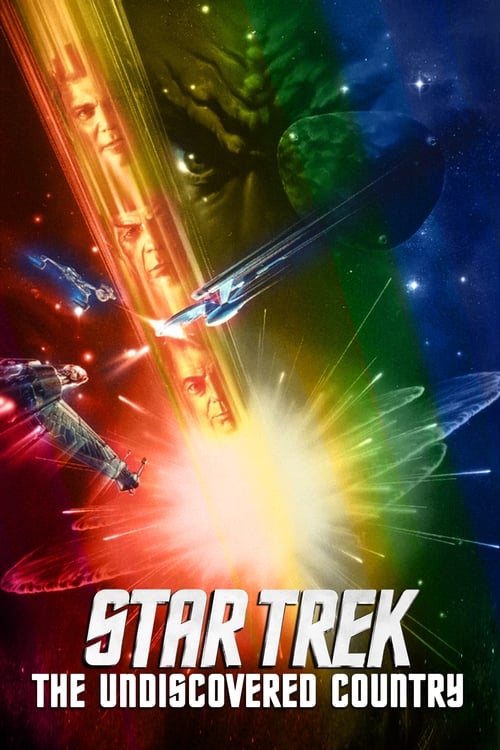
Star Trek VI: The Undiscovered Country (1991)
Directed by Nicholas Meyer
No — Star Trek VI: The Undiscovered Country is not especially woke, scoring 22 out of 100 on our wokeness meter.
Star Trek VI: The Undiscovered Country arrives in 1991 as the sixth and final voyage of the original crew, a farewell tour dressed as a Cold War thriller.
Consciousness Markers
A genuinely multiethnic bridge crew for 1991 — Nichelle Nichols, George Takei, and Brock Peters in a prominent role — though this is the inherited Original Series ensemble rather than a modern casting statement.
The Klingon-as-Other allegory carries deliberate xenophobia and anti-immigration subtext, and Meyer cast Brock Peters as the racist admiral precisely to weaponize that irony; Nichols also objected to dialogue with racial undertones.
Kirk's arc about shedding prejudice and the closing 'new generation' log carry a clear peace-and-tolerance moral, delivered with some speechifying but not relentless sermonizing.
Azetbur ascends to Klingon Chancellor and Uhura holds a command post, but the film makes no argument about gender and treats these as unremarkable facts of the setting.
The destruction of Praxis is an ecological catastrophe that drives the plot, but it functions as a Chernobyl stand-in for Cold War collapse rather than an environmentalist message.
No LGBTQ+ characters, themes, or subtext anywhere in the film.
No critique of capitalism, wealth, or class anywhere in the narrative.
No body-positivity themes or messaging present.
Spock's Vulcan stoicism is species-based, not a neurodivergence narrative.
The film is a fictional Cold War allegory, not a revisionist retelling of real historical events.
Why it received this score
Star Trek VI: The Undiscovered Country arrives in 1991 as the sixth and final voyage of the original crew, a farewell tour dressed as a Cold War thriller. The Klingon Empire, its homeworld crippled by the explosion of the Praxis moon, sues for peace with the Federation. It is the Berlin Wall falling in space, and the film knows it. Director Nicholas Meyer stages the affair with grim, autumnal dignity. The Klingons are the Soviets. The conspiracy is the military apparatus that cannot abide the thaw. This is allegory, not sermon, and the distinction matters.
The bridge crew remains what it was in 1966: a genuinely multiethnic ensemble for its era, with Nichelle Nichols, George Takei and Walter Koenig at their stations. The film does not congratulate itself for this. It simply inherited the casting and moved on. Meyer puts Brock Peters, who played Tom Robinson in To Kill a Mockingbird, in the admiral's chair to demand a wall against Klingon immigration, a piece of ironic cruelty that lands. Nichols herself refused two lines she found racially loaded, including a guess-who's-coming-to-dinner joke, and that discomfort shows the material was testing boundaries it did not always clear. Azetbur, played by Rosanna DeSoto, rises to Klingon Chancellor. Uhura holds a command post. The film makes no argument about either. These are facts of the setting.
The moral is tolerance, delivered through Kirk's reluctant journey from grief to grudging peace. It is speechifying, but earned speechifying, and the closing log about a new generation of explorers carries a gentle hand. There is no LGBTQ subtext, no economic critique, no body politics. Spock's Vulcan reserve is xenobiology, not a diagnosis. What remains is a well-made farewell to a Cold War, one that gestures at social conscience without ever stopping the ship to lecture us about it.
Analysis generated by our Consciousness Algorithm
Part of


Synopsis
After years of war, the Federation and the Klingon empire find themselves on the brink of a peace summit when a Klingon ship is nearly destroyed by an apparent attack from the Enterprise. Both worlds brace for what may be their deadliest encounter.
Questions about Star Trek VI: The Undiscovered Country
Is Star Trek VI: The Undiscovered Country woke?
No — Star Trek VI: The Undiscovered Country is not especially woke, scoring 22 out of 100 on our wokeness meter. That earns it a verdict of Based.
Does Star Trek VI: The Undiscovered Country have any woke elements?
2 of the 10 markers register at 30 or above, led by Representation Casting (40) and Racial Consciousness (35). On Representation Casting: A genuinely multiethnic bridge crew for 1991 — Nichelle Nichols, George Takei, and Brock Peters in a prominent role — though this is the inherited Original Series ensemble rather than a modern casting statement.
How does Star Trek VI: The Undiscovered Country compare to other 1991 movies?
It ranks #11 of the 68 films from 1991 we've scored; their average is 14. The wokest is Paris Is Burning (77).
Is Star Trek VI: The Undiscovered Country the most woke Star Trek: The Original Series movie?
No. It ranks #2 of the 6 Star Trek: The Original Series films we've scored; the wokest is Star Trek IV: The Voyage Home (42).