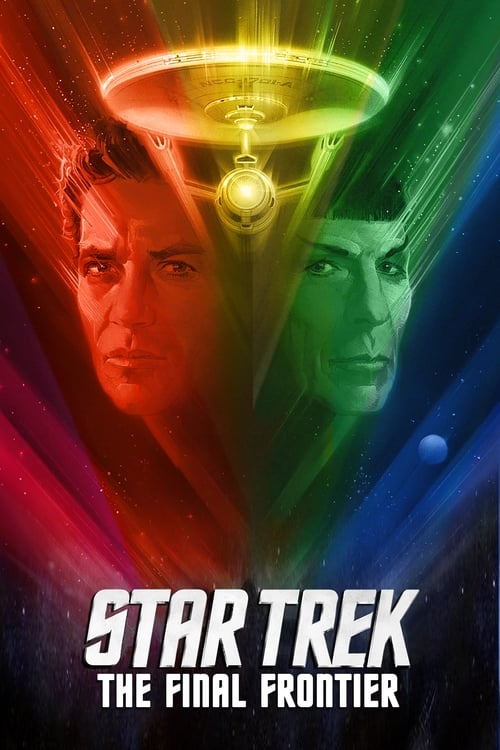
Star Trek V: The Final Frontier (1989)
Directed by William Shatner
No — Star Trek V: The Final Frontier is not woke, scoring 11 out of 100 on our wokeness meter.
Star Trek V: The Final Frontier arrives with the weight of a franchise already creaking under its own mythology, and William Shatner directs it with the enthusiasm of a man who has been promised the con.
Consciousness Markers
The Enterprise crew is notably diverse for its era (Uhura, Sulu, Chekov), but this is natural ensemble diversity inherited from the 1960s series, not modern representation casting with commentary.
The film touches on faith, false gods, and Kirk's skepticism ('What does God need with a starship?'), but it dramatizes these ideas rather than preaching them at the audience.
No LGBTQ+ characters or themes appear; George Takei's off-screen identity is irrelevant to the film's content.
Uhura's fan-dance distraction is a sexualized set piece rather than a feminist statement, and the film offers no gender-justice agenda.
The film engages no racial themes or commentary whatsoever.
No environmental or climate content is present.
The villain Sybok is a cult leader modeled on televangelists, but the critique targets religious fraud and false prophets, not capitalism or wealth redistribution.
No body-positivity themes or messaging appear.
No neurodivergence themes or characters are present.
The film is a fictional space adventure with no historical revisionism.
Why it received this score
Star Trek V: The Final Frontier arrives with the weight of a franchise already creaking under its own mythology, and William Shatner directs it with the enthusiasm of a man who has been promised the con. The plot sends the Enterprise-A after the renegade Vulcan Sybok, a cult leader with a televangelist's smile and a planet-sized delusion. The film's cultural accounting is modest. The bridge crew remains diverse in the inherited manner of the 1960s series, with Uhura, Sulu, and Chekov present as part of the furniture. That is natural ensemble diversity, not modern representation casting with commentary attached. There is no LGBTQ content, no racial thesis, no climate sermon, no body-positivity message, and no neurodivergent framing. The film has other things on its mind, mostly camping and brother issues.
Its engagement with progressive social themes is close to nonexistent. Sybok's menace is aimed at religious fraud and the appetites of false prophets, not at capital or class. The villain wants a starship to reach a god, and the script wants to ask whether faith can be monetized by a man in a robe. That is a critique of televangelism, not a redistributionist tract. Uhura's fan dance is a sexualized set piece from another era, not a feminist statement. The film offers no gender-justice agenda and no racial consciousness. It is a space adventure with a theological itch.
The closest thing to lecture energy comes when Kirk faces the glowing entity and asks what God needs with a starship. The moment is famous because it dramatizes skepticism instead of preaching it. The film lets the idea play as action and argument, then resolves it with a photon torpedo and a Klingon apology. The result is a strangely innocent artifact. It has the social awareness of a corporate retreat and the theological confidence of a man who has just discovered camping. The final frontier is not a classroom. It is a campfire with a starship parked nearby.
Analysis generated by our Consciousness Algorithm
Part of


Synopsis
A renegade Vulcan with a startling secret hijacks the U.S.S. Enterprise in order to find a mythical planet.
Questions about Star Trek V: The Final Frontier
Is Star Trek V: The Final Frontier woke?
No — Star Trek V: The Final Frontier is not woke, scoring 11 out of 100 on our wokeness meter. That earns it a verdict of Ultra Based.
Does Star Trek V: The Final Frontier have any woke elements?
Very few. None of the 10 markers reaches 30, the level where a marker counts as present; the highest is Representation Casting at 22.
How does Star Trek V: The Final Frontier compare to other 1989 movies?
It ranks #22 of the 68 films from 1989 we've scored; their average is 10. The wokest is Do the Right Thing (72).
Is Star Trek V: The Final Frontier the most woke Star Trek: The Original Series movie?
No. It ranks #3 of the 6 Star Trek: The Original Series films we've scored; the wokest is Star Trek IV: The Voyage Home (42).