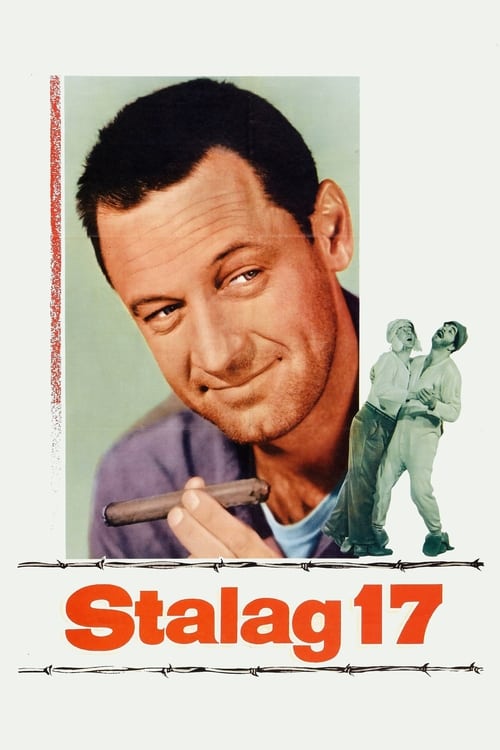
Stalag 17 (1953)
Directed by Billy Wilder
No — Stalag 17 is not woke, scoring 0 out of 100 on our wokeness meter.
Billy Wilder's Stalag 17 arrives from 1953, a prisoner-of-war comedy-drama adapted from Donald Bevan and Edmund Trzcinski's Broadway play, and it carries the dust of its era on every frame.
Consciousness Markers
The cast is entirely white American airmen and German guards; the only non-white presence is off-screen Russian women ogled through a makeshift telescope, with no casting-conscious intent.
No LGBTQ+ characters, themes, or subtext of any kind appear in this 1953 POW comedy-drama.
Women appear only as distant objects of the prisoners' voyeuristic telescope gag; the film is an unapologetically male ensemble war story with no feminist framework.
Race is never addressed or thematized; the narrative concerns nationality (American vs. German) rather than racial identity or consciousness.
No environmental or climate themes are present in this WWII prison-camp story.
Sefton's black-market profiteering and rat-race gambling are treated with cynical ambivalence and ultimately vindicated, not as a critique of capitalism; the mild class friction over Dunbar's wealthy family is a character beat, not an economic thesis.
No body-positivity themes; the barracks clowns' antics are played for slapstick comedy, not body acceptance.
No neurodivergent characters or themes are present.
The film draws on real POW experiences but presents a straightforward fictionalized drama of its own era, without reinterpreting history through a modern ideological lens.
Wilder's film is a wry, morally ambiguous entertainment that shows rather than preaches; it delivers no modern moralizing sermon.
Why it received this score
Billy Wilder's Stalag 17 arrives from 1953, a prisoner-of-war comedy-drama adapted from Donald Bevan and Edmund Trzcinski's Broadway play, and it carries the dust of its era on every frame. William Holden won an Academy Award for his turn as J.J. Sefton, the barracks black marketeer suspected of informing on his fellow airmen. The film is a tight, cynical machine. It builds suspense from a murder mystery inside a German camp, and it resolves that mystery with a wry shrug. No modern framework intrudes on any of it.
The men of Barracks 4 gamble on rat races, brew hooch in a makeshift still, and train a telescope on the Russian women's compound across the way. These are the film's pleasures, and they are unexamined. The cast is a wall of white American sergeants and German guards, and the story never pauses to interrogate that fact. Race appears only as nationality, American against German. The women exist as a punchline viewed from a distance. Sefton's profiteering is treated with ambivalence and then vindicated, which is not an economic thesis but a character study. The barracks clowns, Animal and Shapiro, are slapstick devices, not statements about bodies or minds.
Wilder shows and does not preach. The film's morality is murky on purpose, and it offers no lesson for a modern audience to absorb. There is no environmental lament, no reimagining of the historical record, no sermon at the end. It is a well-made entertainment from a different cultural moment, and it makes no apology for being one.
Analysis generated by our Consciousness Algorithm
Part of


Synopsis
After two American prisoners are killed by guards in the act of escaping from a German POW camp in World War II, barracks black marketeer J.J. Sefton is suspected of being an informer.
Questions about Stalag 17
Is Stalag 17 woke?
No — Stalag 17 is not woke, scoring 0 out of 100 on our wokeness meter. That earns it a verdict of Ultra Based.
Does Stalag 17 have any woke elements?
No. All 10 markers score zero.
How does Stalag 17 compare to other 1953 movies?
It ranks #13 of the 16 films from 1953 we've scored; their average is 6. The wokest is The Wages of Fear (25).
How is the Woke Score calculated?
An AI-assisted process researches the film and its reception, scores it 0–100 on ten markers, then combines those into one 0–100 Woke Score. It measures a specific set of 2020s cultural themes, not film quality.