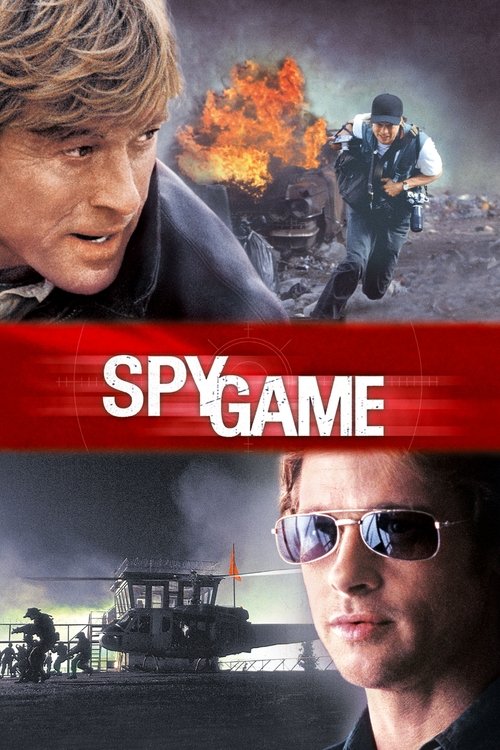
Spy Game (2001)
Directed by Tony Scott
No — Spy Game is not woke, scoring 9 out of 100 on our wokeness meter.
Tony Scott's Spy Game arrives in 2001 with a clean conscience and very little on its mind beyond the mechanics of tradecraft.
Consciousness Markers
The cast is overwhelmingly white, with Marianne Jean-Baptiste and Benedict Wong in supporting roles that exist naturally in the story without any commentary on their identity. Standard pre-2010 Hollywood ensemble casting.
Catherine McCormack's Hadley has some agency as a former bomber and relief worker, and Marianne Jean-Baptiste plays a CIA executive, but the film has no feminist thesis or commentary.
The film gestures at the moral cost of the 'greater good' in spycraft, but this is dramatic tension rather than preachy social instruction.
No LGBTQ+ characters, themes, or subtext anywhere in the film.
The film engages Cold War and Middle East geopolitics but never frames anything through racial consciousness or systemic racial critique.
No environmental or climate themes present.
The film is about intelligence-agency realpolitik and the sacrifice of assets, not economic critique or class warfare.
No body positivity themes or messaging.
No neurodivergent characters or themes.
A wholly fictional espionage narrative; it does not revise or reinterpret historical events.
Why it received this score
Tony Scott's Spy Game arrives in 2001 with a clean conscience and very little on its mind beyond the mechanics of tradecraft. Robert Redford's retiring case officer spends a day being debriefed by men who want a pretext, and we spend that day watching flashbacks assemble into a rescue. The film moves with the director's customary velocity, all jump cuts and backlit steam, and it treats the Cold War as a series of personnel problems. For our purposes, the ledger is thin. The ensemble is white by default, the way studio casting was white by default in that era, with Marianne Jean-Baptiste and Benedict Wong appearing as competent professionals whose identities generate no comment. That is casting, not statement.
The moral friction is genuine and never becomes a sermon. Muir's creed, that assets are expended for the greater good, is presented as a professional position, and Bishop's dissent is presented as a personal one. The film declines to referee. Catherine McCormack's Hadley carries a past, a bomb, and a conscience, and Marianne Jean-Baptiste's executive runs a station without the screenplay pausing to celebrate either. Progressive sensibilities, if present, are ambient, and they register faintly. No environmental sermon, no class warfare, no interpretive revision of actual events. The geopolitics are scenery for a story about two men and a debt.
The result is a competent thriller about loyalty priced in dollars and bodies, which gestures at the cost of the greater good and then goes back to the helicopters. The gesture is dramatic tension, not instruction. We classify it accordingly, with the fatigue of a sommelier tasting a perfectly ordinary Bordeaux and finding nothing to argue with. It is not a bad film. It simply has no ambitions beyond its own machinery, and in this ledger, an absence of ambition reads as restraint.
Analysis generated by our Consciousness Algorithm


Synopsis
On the day of his retirement, a veteran CIA agent learns that his former protégé has been arrested in China, is sentenced to die the next morning in Beijing, and that the CIA is considering letting that happen to avoid an international scandal.
Questions about Spy Game
Is Spy Game woke?
No — Spy Game is not woke, scoring 9 out of 100 on our wokeness meter. That earns it a verdict of Ultra Based.
Does Spy Game have any woke elements?
Very few. None of the 10 markers reaches 30, the level where a marker counts as present; the highest is Representation Casting at 18.
How does Spy Game compare to other 2001 movies?
It ranks #58 of the 148 films from 2001 we've scored; their average is 12. The wokest is Monster's Ball (60).
How is the Woke Score calculated?
An AI-assisted process researches the film and its reception, scores it 0–100 on ten markers, then combines those into one 0–100 Woke Score. It measures a specific set of 2020s cultural themes, not film quality.