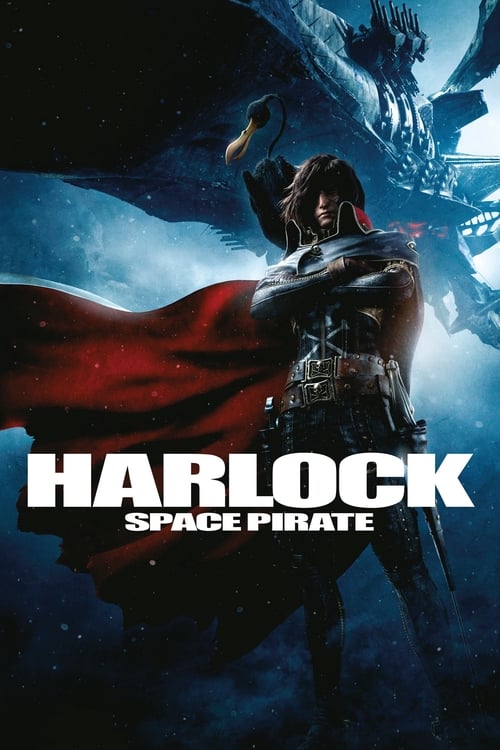
Space Pirate Captain Harlock (2013)
Directed by Shinji Aramaki
No — Space Pirate Captain Harlock is not woke, scoring 0 out of 100 on our wokeness meter.
Space Pirate Captain Harlock arrived in 2013 as the most expensive Japanese CG anime feature ever assembled, a thirty-million-dollar monument to a franchise older than much of its audience, and it promptly lost money.
Consciousness Markers
The cast is entirely Japanese, reflecting the film's origin rather than a deliberate modern diversity initiative; no evidence of representation casting as a woke marker.
No LGBTQ+ characters, themes, or subtext.
Female characters exist (Nami, Miime, Kei) but the narrative does not advance a feminist agenda or critique patriarchy.
No engagement with racial identity, systemic racism, or racial justice themes.
Earth's uninhabitable state stems from war and resource conflict, not a climate-change crusade or environmentalist lecture.
The antagonist is an authoritarian quasi-religious regime, not capitalism or wealth inequality; no eat-the-rich messaging.
No body-positivity themes or plus-size representation.
No neurodivergent characters or themes.
No revisionist historical narrative; the story is fictional sci-fi.
The film has thematic musings on war and Earth, but it does not preach modern social-justice lessons.
Why it received this score
Space Pirate Captain Harlock arrived in 2013 as the most expensive Japanese CG anime feature ever assembled, a thirty-million-dollar monument to a franchise older than much of its audience, and it promptly lost money. The film concerns dwindling resources, a Homecoming War, and an authoritarian regime called the Gaia Sanction that declares Earth sacred and forbidden in order to keep power. These are old anxieties wearing new polygons. A crew of pirates steals warheads to reset the timestream. A young man named Yama infiltrates the ship to kill its captain and instead inherits his myth.
For the purposes of cultural classification, the film offers almost nothing to seize upon. The cast is entirely Japanese, which reflects the production's origin and not a diversity initiative. Women appear, Nami and Miime and Kei, and are granted interior lives, though the story never organizes itself around their grievances. Nami's death is a private act of love and expiation, not a thesis. The antagonist is a theocratic state apparatus, so the rebellion has no quarrel with capital. Earth is uninhabitable because of war and resource conflict, and no character pauses to deliver a sermon about the environment. There is no racial reckoning, no queer subtext, no disability politics, no gesture toward any of the contemporary categories we are obliged to track. The whole affair is stubbornly mythological.
What remains is a story about atonement and the usefulness of legends. Harlock wants to end the universe; a meadow of flowers changes his mind. The film closes by handing the detonator, and the title, to a younger man. It muses on war and home without instructing anyone. Every marker sits at zero, and the film seems content there.
Analysis generated by our Consciousness Algorithm

Synopsis
Space Pirate Captain Harlock and his fearless crew face off against the space invaders who seek to conquer the planet Earth.
Questions about Space Pirate Captain Harlock
Is Space Pirate Captain Harlock woke?
No — Space Pirate Captain Harlock is not woke, scoring 0 out of 100 on our wokeness meter. That earns it a verdict of Ultra Based.
Does Space Pirate Captain Harlock have any woke elements?
No. All 10 markers score zero.
How does Space Pirate Captain Harlock compare to other 2013 movies?
It ranks #249 of the 274 films from 2013 we've scored; their average is 14. The wokest is Belle (76).
How is the Woke Score calculated?
An AI-assisted process researches the film and its reception, scores it 0–100 on ten markers, then combines those into one 0–100 Woke Score. It measures a specific set of 2020s cultural themes, not film quality.