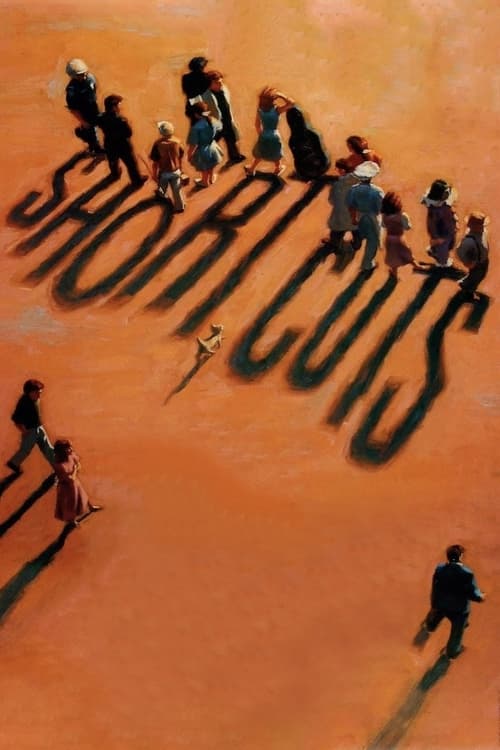
Short Cuts (1993)
Directed by Robert Altman
No — Short Cuts is not woke, scoring 4 out of 100 on our wokeness meter.
Robert Altman's Short Cuts arrives from 1993 with twenty-two principal characters, a fleet of medfly helicopters, a comatose child, a suicide, a murder, and an earthquake.
Consciousness Markers
A sprawling ensemble of 22 principals, but the cast is overwhelmingly white and reflects 1993 Hollywood norms rather than any deliberate diversity initiative. No modern representation-casting intent is present.
The film surveys modern anomie and moral drift, but its critique is existential rather than economic. No eat-the-rich posture.
Altman observes his characters with detached, wry irony rather than sermonizing; the film offers no explicit moral instruction to the audience.
No LGBTQ+ characters, themes, or subtext appear anywhere in the interlocking storylines.
The film was actually panned by Rita Kempley as 'sexist,' and Kenneth Turan flagged an 'overreliance on female nudity that borders on the exploitative.' There is no feminist agenda here.
Race is essentially absent as a subject; the malaise on display is suburban and universalized, with no racial consciousness at work.
The medfly-spraying helicopters and climactic earthquake are atmospheric devices, not ecological commentary. No climate crusade.
Bodies appear chiefly as objects of voyeurism and violence; there is no body-positivity framework whatsoever.
No neurodivergent characters or themes are present or addressed.
The film is a contemporary slice-of-life adaptation of Carver's fiction, with no historical revisionism of any kind.
Why it received this score
Robert Altman's Short Cuts arrives from 1993 with twenty-two principal characters, a fleet of medfly helicopters, a comatose child, a suicide, a murder, and an earthquake. It is an adaptation of Raymond Carver stories relocated to Los Angeles. The film surveys modern anomie with a large ensemble, but the cast is overwhelmingly white and reflects the hiring norms of its era. There is no LGBTQ presence, no racial consciousness, and no effort to frame its suburban despair through identity. The characters simply drift, cheat, drink, and wound each other. That absence is not a hidden statement. It is the film's plain texture.
On the question of social agendas, the film offers little comfort to contemporary expectations. Feminist readings are not merely unsupported; the movie was criticized in its own time for sexist attitudes and an exploitative reliance on female nudity. Bodies appear as sites of voyeurism and violence, never as material for a body-positivity framework. Neurodivergence is absent. The medfly spraying and the climactic earthquake function as atmosphere, not as ecological warning. A faint critique of modern moral drift exists, but it is existential, not economic. Nobody eats the rich here. The film has no interest in revising history, because it is adapting contemporary fiction. Its gaze stays on personal failure and random catastrophe.
Altman observes his people with detached, wry irony. He does not lecture. The film presents cruelty, indifference, and bad luck without telling us how to feel or vote. That restraint is its saving grace. Short Cuts won the Golden Lion, earned Altman an Oscar nomination, and remains a critical favorite. It is a serious, bleak, beautifully acted mosaic. It is also a product of its moment, with a social consciousness that is humanist, fatalistic, and entirely uninterested in the cultural battles that would arrive decades later. We classify it accordingly, with respect and a sigh.
Analysis generated by our Consciousness Algorithm
Synopsis
Many loosely connected characters cross paths in this film, based on the stories of Raymond Carver. Waitress Doreen Piggot accidentally runs into a boy with her car. Soon after walking away, the child lapses into a coma. While at the hospital, the boy's grandfather tells his son, Howard, about his past affairs. Meanwhile, a baker starts harassing the family when they fail to pick up the boy's birthday cake.
Questions about Short Cuts
Is Short Cuts woke?
No — Short Cuts is not woke, scoring 4 out of 100 on our wokeness meter. That earns it a verdict of Ultra Based.
Does Short Cuts have any woke elements?
Very few. None of the 10 markers reaches 30, the level where a marker counts as present; the highest is Representation Casting at 8.
How does Short Cuts compare to other 1993 movies?
It ranks #58 of the 97 films from 1993 we've scored; their average is 11. The wokest is Bound by Honor (60).
How is the Woke Score calculated?
An AI-assisted process researches the film and its reception, scores it 0–100 on ten markers, then combines those into one 0–100 Woke Score. It measures a specific set of 2020s cultural themes, not film quality.