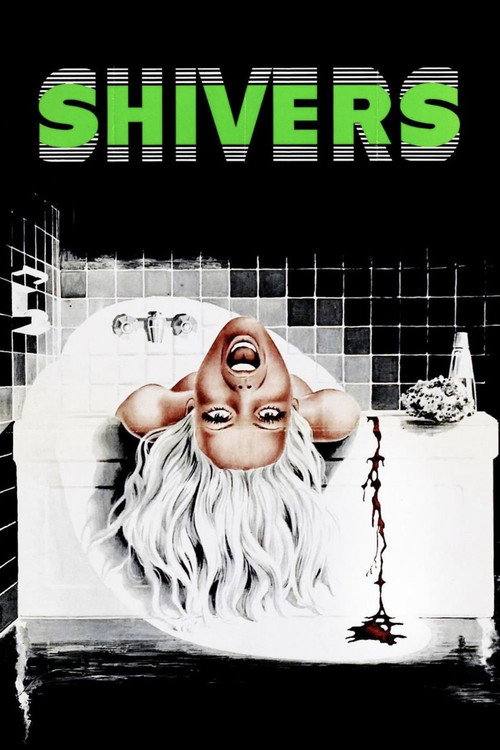
Shivers (1975)
Directed by David Cronenberg
No — Shivers is not woke, scoring 9 out of 100 on our wokeness meter.
Shivers arrives from 1975, a Canadian body horror picture made for a sum that would barely cover catering on a modern production.
Consciousness Markers
A brief same-sex seduction between Betts and Janine occurs, but it is presented as parasitic infection and exploitation rather than an LGBTQ+ theme.
The cast is entirely white and the film makes no effort at diverse or inclusive casting.
Female characters are present, but the film's sexual violence and exploitation framework do not advance a feminist agenda.
No racial themes, commentary, or consciousness are present.
No environmental or climate-related themes appear.
The luxury high-rise setting is not used for an anti-capitalist or eat-the-rich critique.
The film is body horror and treats bodies as sites of infection and revulsion, not positivity.
No neurodivergence themes or representation are present.
The film is fictional and does not revise historical narratives.
Expository dialogue explains the parasite's purpose, but it is not a modern social-justice lecture.
Why it received this score
Shivers arrives from 1975, a Canadian body horror picture made for a sum that would barely cover catering on a modern production. It concerns a Montreal luxury apartment complex whose residents are converted into carriers of a parasitic aphrodisiac. The parasite is described in dialogue as a combination of venereal disease and aphrodisiac, engineered to strip away over-intellectualism and return humanity to its primal appetites. The Parliament of Canada debated the film's social value. This is the sort of reception a director can dine out on for decades.
Viewed through the lens of contemporary social consciousness, the film offers almost nothing to catalogue. The cast is uniformly white, and no effort is made toward inclusive representation. A brief same-sex seduction occurs between Betts and Janine, though it functions as an infection vector, a parasite passed mouth to mouth, and the film frames it as exploitation and contamination instead of anything resembling queer identity. Bodies here are sites of invasion and revulsion, which places the film at some distance from the body positivity movement. The luxury high-rise setting invites an eat-the-rich reading that the screenplay never bothers to supply. There is no racial commentary, no environmental concern, no neurodivergent representation, and no revision of the historical record. The dialogue explains the parasite's purpose, but exposition is not a sermon.
What remains is a lean and genuinely unsettling piece of filmmaking whose transgressions belong to the anxieties of its own decade. It wants to disgust and disturb, and it succeeds on those terms. It does not wish to instruct us in how to live. For that, at least, we can be grateful.
Analysis generated by our Consciousness Algorithm


Synopsis
The residents of a suburban high-rise apartment building are infected by parasites that turn them into mindless nymphomaniac fiends.
Questions about Shivers
Is Shivers woke?
No — Shivers is not woke, scoring 9 out of 100 on our wokeness meter. That earns it a verdict of Ultra Based.
Does Shivers have any woke elements?
Very few. None of the 10 markers reaches 30, the level where a marker counts as present; the highest is LGBTQ+ Themes at 15.
How does Shivers compare to other 1975 movies?
It ranks #11 of the 22 films from 1975 we've scored; their average is 15. The wokest is Dog Day Afternoon (62).
How is the Woke Score calculated?
An AI-assisted process researches the film and its reception, scores it 0–100 on ten markers, then combines those into one 0–100 Woke Score. It measures a specific set of 2020s cultural themes, not film quality.