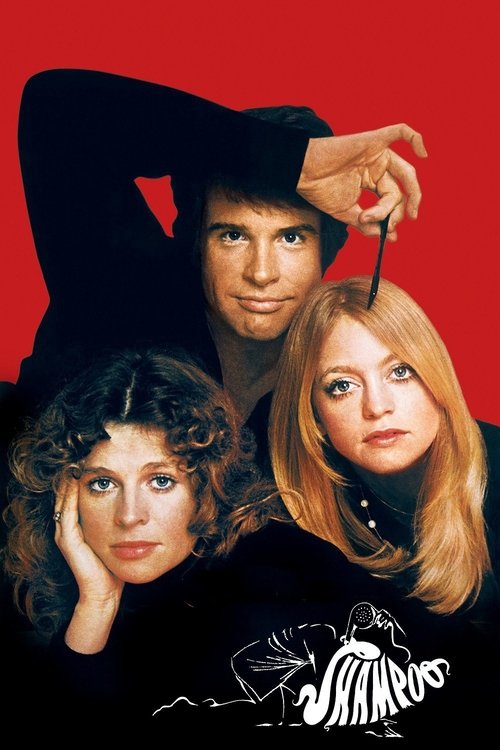
Shampoo (1975)
Directed by Hal Ashby
No · Based
How we score movies →Consciousness Markers
The film contains implicit critique of consumerism, personal ambition, and the hollowness of material success. The Nixon election backdrop adds political dimension to commentary on American corruption and inauthenticity.
The film explores gender politics and critiques sexual double standards of the era. Female characters display agency and complexity, but the narrative remains centered on a male womanizer, limiting its feminist advocacy.
Strong female cast including Julie Christie, Goldie Hawn, and Lee Grant, plus Carrie Fisher's film debut. However, female characters are defined primarily through relationships with the male protagonist rather than representing a conscious commitment to demographic representation.
Political points are conveyed through satirical narrative and visual metaphor rather than preachy dialogue. The approach is artistic and subtle, though some might find the ending somewhat heavy-handed.
The film uses the 1968 election as contemporary backdrop and political commentary rather than rewriting history or centering marginalized historical perspectives.
No significant LGBTQ+ themes or representation. The film focuses entirely on heterosexual relationships and sexual dynamics.
The film does not engage meaningfully with racial issues or demonstrate racial consciousness. Race is not a thematic concern.
No environmental themes or climate-related content whatsoever.
The film is entirely predicated on conventional beauty standards and attractiveness. George's success depends on his looks and charm, with no interrogation of beauty norms.
No representation of neurodivergent characters or engagement with neurodivergence as a theme.


Synopsis
On Election Day, 1968, irresponsible hairdresser and ladies' man George Roundy is too busy cutting hair and dealing with his girlfriends and mistress Felicia Karpf, whose husband Lester is having an affair with his ex-girlfriend Jackie.
Why it received this score
Shampoo arrives from an era before social consciousness became a measurable commodity, yet its preoccupation with gender dynamics and sexual hypocrisy lends it a certain retrospective credibility. Hal Ashby's 1975 comedy uses a hairdresser's relentless bedroom hopping as a vehicle for political allegory, with Warren Beatty's George Roundy serving as a stand-in for American moral bankruptcy during the Nixon election. The film's female characters, played with considerable intelligence by Julie Christie, Goldie Hawn, and Lee Grant, possess genuine agency and complexity, though they remain ultimately defined through their entanglement with the protagonist's narcissism. This is satire about masculine delusion, not a manifesto for progressive values.
The film's critique operates through irony rather than preachiness. As George pursues his various conquests throughout Los Angeles, the television relentlessly broadcasts Nixon's political ascendancy. For audiences in 1975, already versed in Watergate and its aftermath, the parallel between personal deception and national corruption proved cutting. The film suggests that a culture unable to distinguish authenticity from performance produces both unfaithful lovers and corrupt presidents. It is a coherent artistic vision, if occasionally blunt in its symbolism.
What prevents Shampoo from scoring higher in contemporary cultural metrics is its indifference to representation as a conscious political project. The casting of women in substantial roles, the sympathetic portrayal of female desire and frustration, the critique of sexual double standards, all emerge from the film's artistic and thematic concerns rather than from a programmatic commitment to demographic parity or social justice messaging. This is not a deficiency, merely a reminder that films made before the 2020s often grapple with serious social questions without performing their progressivism for institutional approval. Shampoo remains a sharp political comedy, but it belongs to a different era of cultural consciousness altogether.
Analysis generated by our Consciousness Algorithm
Critic Reviews
“Hal Ashby has the deftness to keep us conscious of the whirring pleasures of the carnal-farce structure and yet to give it free play. This was the most virtuoso example of sophisticated, kaleidoscopic face that American moviemakers had yet come up with; frivolous and funny, it carries a sense of heedless activity, of a craze of dissatisfaction.”
“There’s a self-awareness to Shampoo that gives the movie a cleansing sadness and, oddly, makes Beatty an affectingly amoral roue. ”
“Made with all the awareness of hindsight, Shampoo offers a sharp sexual satire and a mature statement on both America and Hollywood in 1968.”
“The parts are better than the whole. [24 Feb 1975, p.58]”