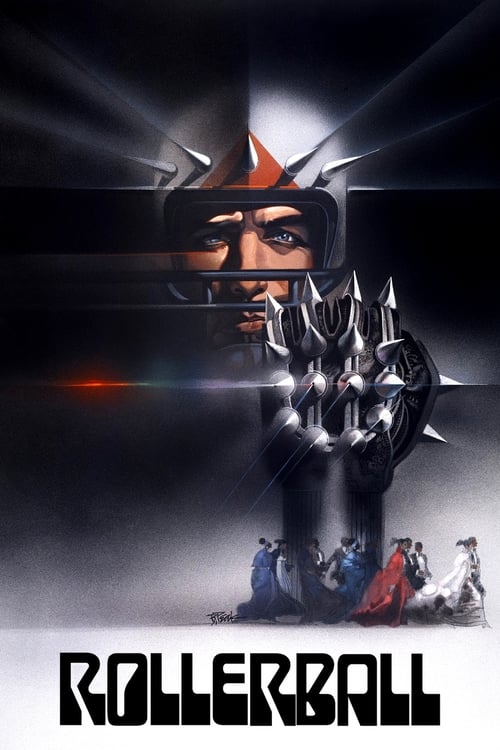
Rollerball (1975)
Directed by Norman Jewison
No — Rollerball is not woke, scoring 19 out of 100 on our wokeness meter.
Norman Jewison's Rollerball arrives from 1975, a moment when a director could still suggest that the corporation is the state and receive a wide release for his trouble.
Consciousness Markers
The entire premise is a corporatocracy that governs society, edits all recorded knowledge, and uses a brutal sport to demonstrate the futility of individualism — a sustained indictment of corporate power.
The film carries a social critique of corporate control and televised violence, but critics noted it delivers this message without much conviction, favoring spectacle over sermon.
The cast is overwhelmingly white, with Moses Gunn and Burt Kwouk appearing in supporting roles that exist naturally within the story and carry no commentary on race or representation.
Women in the film are largely treated as corporate property (Ella is literally taken by an executive), and the narrative offers no feminist critique of this arrangement.
There are no LGBTQ+ characters, relationships, or themes anywhere in the film.
Race is never a subject of the film; the dystopia is framed entirely around corporate power and individualism, not racial dynamics.
No environmental or climate themes appear; the film's anxieties are about corporate control, not ecological collapse.
No body-positivity themes or messaging are present.
No neurodivergent characters or themes are depicted.
The film is set in a fictional future and makes no revisionist claims about real historical events.
Why it received this score
Norman Jewison's Rollerball arrives from 1975, a moment when a director could still suggest that the corporation is the state and receive a wide release for his trouble. The premise is administrative horror: corporate boards govern what remains of society, all recorded knowledge has been digitized and quietly amended by the people who own the servers, and a brutal televised sport exists to prove that the individual does not matter. James Caan's Jonathan E. declines to retire. This is treated by the executives as an emergency, which is the film's sharpest observation and its only fully realized one.
The anger here is economic. It is aimed at the men in the luxury box who own the ball, the players, and the historical record, not at prejudice, identity, or the temperature of the planet. The dystopia is bureaucratic, and the film's thesis, that spectacle pacifies a population while corporate power edits the past to secure the future, holds up better than the staging around it. Characterizations are thin. The script advances its critique without much conviction, more interested in the track than the argument, and reviewers at the time said so plainly. Jewison was reportedly outraged when promoters asked to license the sport for real leagues. The audience had taken the wrong lesson, which is the lesson.
On representation, the cast is white, and the women are passed between executives like seats on a board. The film registers this as one more feature of the arrangement and offers no counterargument. There is no racial argument, no ecological anxiety, no accounting of bodies or minds beyond the injuries the game inflicts. The film offers a machine for producing exhaustion, dressed as a warning about machines for producing exhaustion. The Bach on the organ still lands. The ending, a man scoring one goal and refusing to kill, is a modest rebellion, and in this economy it may be the only kind available.
Analysis generated by our Consciousness Algorithm


Synopsis
In a corporate-controlled future, an ultra-violent sport known as Rollerball represents the world, and one of its powerful athletes is out to defy those who want him out of the game.
Questions about Rollerball
Is Rollerball woke?
No — Rollerball is not woke, scoring 19 out of 100 on our wokeness meter. That earns it a verdict of Ultra Based.
Does Rollerball have any woke elements?
1 of the 10 markers register at 30 or above, led by Eat the Rich (65). On Eat the Rich: The entire premise is a corporatocracy that governs society, edits all recorded knowledge, and uses a brutal sport to demonstrate the futility of individualism — a sustained indictment of corporate power.
How does Rollerball compare to other 1975 movies?
It ranks #7 of the 22 films from 1975 we've scored; their average is 15. The wokest is Dog Day Afternoon (62).
How is the Woke Score calculated?
An AI-assisted process researches the film and its reception, scores it 0–100 on ten markers, then combines those into one 0–100 Woke Score. It measures a specific set of 2020s cultural themes, not film quality.