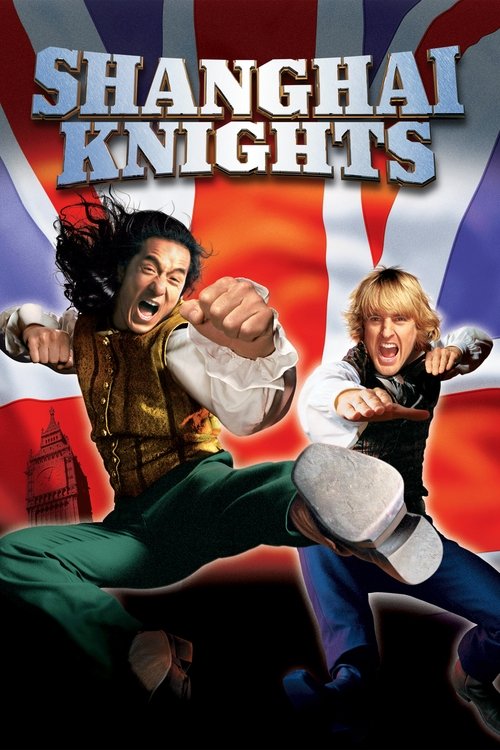
Shanghai Knights (2003)
Directed by David Dobkin
No — Shanghai Knights is not woke, scoring 16 out of 100 on our wokeness meter.
Shanghai Knights arrives as the second installment of a franchise that understood its assignment: pair a Chinese martial artist with a drawling American, point them at Victorian London, and let the furniture absorb the damage.
Consciousness Markers
An East-meets-West buddy comedy headlined by Jackie Chan with Fann Wong as a capable Chinese female lead and Donnie Yen in support, giving the film substantial Asian representation for 2003, though it arises naturally from the premise rather than from any deliberate diversity mandate.
Chon Lin is a competent martial-arts warrior who tracks her father's killer and fights alongside the men, but she is largely defined by Roy's romantic pursuit and the film makes no explicit feminist argument.
The plot touches on Chinese imperial politics, the Boxer rebels, and a Chinese protagonist navigating Victorian London, but these are backdrop for comedy and revenge rather than vehicles for racial commentary.
The film playfully rewrites history by having a young Charlie Chaplin and an Inspector Artie Doyle invent Sherlock Holmes, but this is comedic anachronism rather than ideologically motivated historical revisionism.
A light, genial crowd-pleaser that preaches nothing; any moralizing is limited to a brief closing note about the importance of family.
No LGBTQ+ characters, themes, or subtext of any kind appear in the film.
There is no environmental or climate-related content in the film.
Roy's financial misfortunes are played for laughs; the film offers no critique of wealth, class, or capitalism.
No body-positivity themes or messaging are present.
No neurodivergent characters or themes are depicted.
Why it received this score
Shanghai Knights arrives as the second installment of a franchise that understood its assignment: pair a Chinese martial artist with a drawling American, point them at Victorian London, and let the furniture absorb the damage. The cultural arithmetic is notable mostly for how unremarkable it feels. Jackie Chan headlines, Fann Wong holds her own as the sister with a blade and a grudge, and Donnie Yen lends his customary menace to the periphery. For 2003, that is an international cast carrying a studio comedy. It also arises from the premise, which is to say nobody had to twist an arm to put Asian performers in a movie about China. The distinction matters.
Chon Lin is the closest the film comes to a statement. She tracks her father's killer across continents, fights beside the men, and arranges most of her own escapes. Then the screenplay hands her to Roy O'Bannon's romantic fixation and lets the matter rest. The Boxer uprising, the imperial seal, the scheming Wu Chow: all of it is set dressing for slapstick and revenge. A Chinese protagonist navigating the British class system is a promising foundation for commentary. The film declines to build on it. What it does build is a running gag in which a young pickpocket turns out to be Charlie Chaplin and Inspector Artie Doyle invents Sherlock Holmes on the spot. History gets rearranged for a laugh, not for an argument.
Elsewhere the picture is content to be a genial crowd-pleaser and nothing more. Roy's squandered fortune is a punchline about a man who cannot hold onto money, not an indictment of anything. There is no romantic subtext beyond the heterosexual variety, no environmental hand-wringing, no meditation on bodies or brains, no sermonizing of any stripe. The closing beat, a message from a dead father about the importance of family, is the full extent of the moral instruction on offer. It lasts perhaps ten seconds. We should be grateful for small mercies.
Analysis generated by our Consciousness Algorithm


Synopsis
When a Chinese rebel murders Chon's estranged father and escapes to England, Chon and Roy make their way to London with revenge on their minds.
Questions about Shanghai Knights
Is Shanghai Knights woke?
No — Shanghai Knights is not woke, scoring 16 out of 100 on our wokeness meter. That earns it a verdict of Ultra Based.
Does Shanghai Knights have any woke elements?
1 of the 10 markers register at 30 or above, led by Representation Casting (45). On Representation Casting: An East-meets-West buddy comedy headlined by Jackie Chan with Fann Wong as a capable Chinese female lead and Donnie Yen in support, giving the film substantial Asian representation for 2003, though it arises naturally from the premise rather than from any deliberate diversity mandate.
How does Shanghai Knights compare to other 2003 movies?
It ranks #39 of the 150 films from 2003 we've scored; their average is 12. The wokest is Mona Lisa Smile (60).
How is the Woke Score calculated?
An AI-assisted process researches the film and its reception, scores it 0–100 on ten markers, then combines those into one 0–100 Woke Score. It measures a specific set of 2020s cultural themes, not film quality.