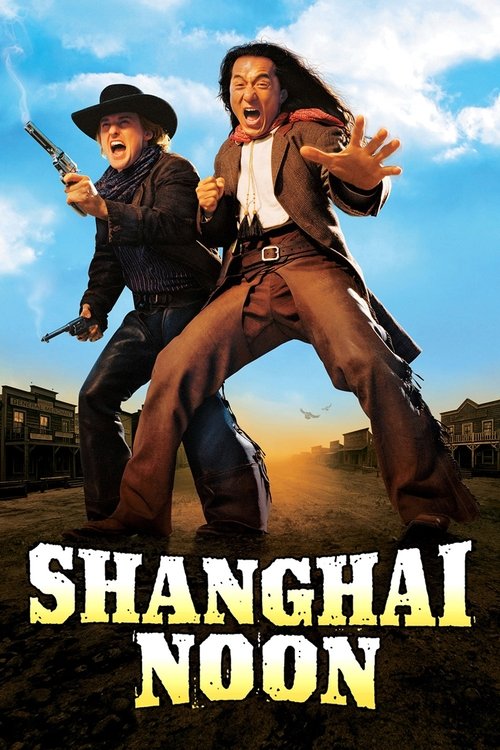
Shanghai Noon (2000)
Directed by Tom Dey
No — Shanghai Noon is not especially woke, scoring 29 out of 100 on our wokeness meter.
Shanghai Noon arrived in the summer of 2000 as a martial arts western buddy comedy, a genre mashup that sounds like a studio executive's fever dream and somehow works.
Consciousness Markers
A Chinese Imperial Guard (Jackie Chan) and Chinese princess (Lucy Liu) anchor the film, with a substantial Sioux subplot featuring Native American characters — notably diverse casting for a 2000 Western.
The film engages the Chinese immigrant experience in the American West, including anti-Chinese slurs ('foreign devils') and a labor camp of exploited Chinese workers, though handled through comedic framing.
The film reimagines the classic Western by centering a Chinese protagonist and Native American characters, and playfully recasts the outlaw Roy O'Bannon as the real Wyatt Earp.
Princess Pei-Pei defies an arranged marriage, escapes captivity, and chooses to remain to help enslaved laborers, giving her notable agency, though the film is not structured around a feminist thesis.
Lo Fong's labor camp of enslaved Chinese workers offers a faint critique of exploitation, but the film has no coherent anti-capitalist or 'eat the rich' message.
A slapstick buddy comedy that prioritizes gags over preaching; its social elements are delivered with humor rather than moral instruction.
No LGBTQ+ characters or themes of any kind appear in the film.
No environmental or climate themes are present.
No body positivity themes or messaging.
No neurodivergence themes or characters.
Why it received this score
Shanghai Noon arrived in the summer of 2000 as a martial arts western buddy comedy, a genre mashup that sounds like a studio executive's fever dream and somehow works. Jackie Chan plays Chon Wang, an Imperial Guard who trails a kidnapped princess to Nevada and falls in with Owen Wilson's genial outlaw. The pairing is the engine, and the film knows it. What distinguishes the picture is the ease with which it assembles a Chinese protagonist, a Chinese princess with a mind of her own, and a Sioux community that participates meaningfully in the plot. None of this is announced. It simply happens, which in retrospect feels like a small miracle of casting and screenplay construction.
Lucy Liu's Princess Pei-Pei does more than wait to be rescued. She flees an arranged marriage, resists her captors, and ultimately elects to stay in Nevada to help the Chinese laborers held in Lo Fong's camp. The film touches the immigrant experience of the American West, including the casual cruelty of the phrase foreign devils and the spectacle of exploited workers behind a villain's enterprise. These gestures are real but modest. They are folded into chases, barroom brawls, and a running joke about chopsticks, which keeps the proceedings light and the sermonizing absent.
The revisionist instinct extends to the ending, where Roy O'Bannon reveals himself as Wyatt Earp, a wink that reorders the mythology of the frontier without much interest in arguing about it. The film's politics are the politics of a crowd-pleaser: inclusive by premise, skeptical of nobody in particular, and content to let a labor camp function as a set piece. It is a pleasant artifact from a moment when a Hollywood comedy could be diverse and unserious at the same time. The result is agreeable, watchable, and entirely without a thesis. Recommended for anyone who wants their history lightly rearranged and their moral instruction withheld.
Analysis generated by our Consciousness Algorithm


Synopsis
Chon Wang, a clumsy imperial guard, trails Princess Pei Pei when she's kidnapped from the Forbidden City and transported to America. Wang follows her captors to Nevada, where he teams up with an unlikely partner, outcast outlaw Roy O'Bannon, and tries to spring the princess from her imprisonment.
Questions about Shanghai Noon
Is Shanghai Noon woke?
No — Shanghai Noon is not especially woke, scoring 29 out of 100 on our wokeness meter. That earns it a verdict of Based.
Does Shanghai Noon have any woke elements?
3 of the 10 markers register at 30 or above, led by Representation Casting (60), Racial Consciousness (40) and Revisionist History (30). On Representation Casting: A Chinese Imperial Guard (Jackie Chan) and Chinese princess (Lucy Liu) anchor the film, with a substantial Sioux subplot featuring Native American characters — notably diverse casting for a 2000 Western.
How does Shanghai Noon compare to other 2000 movies?
It ranks #15 of the 125 films from 2000 we've scored; their average is 13. The wokest is But I'm a Cheerleader (72).
How is the Woke Score calculated?
An AI-assisted process researches the film and its reception, scores it 0–100 on ten markers, then combines those into one 0–100 Woke Score. It measures a specific set of 2020s cultural themes, not film quality.