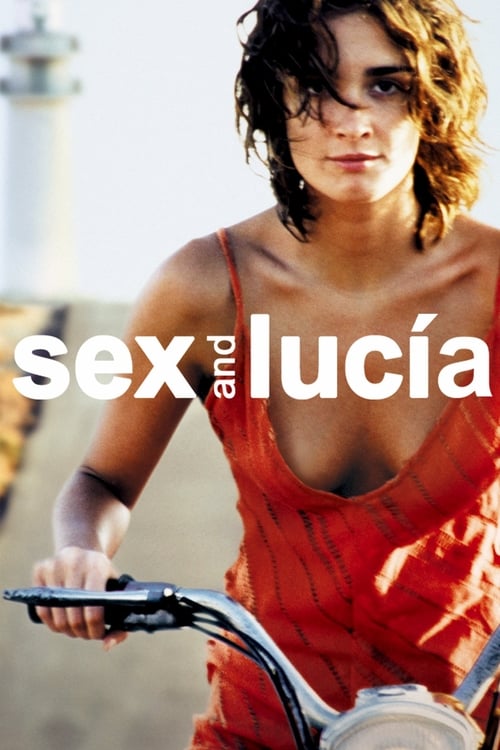
Sex and Lucía (2001)
Directed by Julio Medem
No — Sex and Lucía is not woke, scoring 0 out of 100 on our wokeness meter.
Julio Medem's Sex and Lucía arrives from 2001 carrying the scent of salt water and the faintly embarrassed memory of a decade when European art cinema could still sell tickets on the promise of unclothed Mediterranean people.
Consciousness Markers
The cast is entirely Spanish and European, cast naturally for a Spanish-language production with no diversity-casting agenda or commentary.
The film centers on heterosexual entanglements; there are no LGBTQ+ themes or characters presented as such.
Despite a female protagonist, the film is a male-gaze erotic drama about desire and guilt, not a feminist statement.
No engagement with racial identity or racial politics whatsoever.
The Mediterranean island setting is atmospheric backdrop, not an environmentalist message.
No critique of capitalism, class, or wealth; the concerns are entirely personal and romantic.
Abundant nudity is deployed for eroticism, not as a body-positivity or self-acceptance statement.
No neurodivergent characters or themes are present.
A fictional interwoven romance with no historical revisionism of any kind.
The film is a sensual, elliptical melodrama that never lectures the audience on social or political matters.
Why it received this score
Julio Medem's Sex and Lucía arrives from 2001 carrying the scent of salt water and the faintly embarrassed memory of a decade when European art cinema could still sell tickets on the promise of unclothed Mediterranean people. The plot concerns Lucía, a Madrid waitress who flees to the Balearic island of Formentera after a suspected suicide, and the six years of tangled romantic history she is fleeing from. There is also a novel within the film, a dead child, a lighthouse, and a great deal of swimming. Medem interweaves these strands with genuine formal ambition. The light is beautiful. The bodies are numerous.
For the purposes of classification, we must report that the film carries no social program whatsoever. Its nudity exists to arouse, not to affirm. Its female lead is a vessel for male longing and male guilt, not a vehicle for any argument about autonomy or power. The cast is Spanish because the film is Spanish. The island is photographed because it is pretty, not because the sea is dying. Nobody in this story is poor in a way that indicts anyone, and nobody is rich in a way that requires redistribution. The various infidelities, pregnancies, and illegitimate children are treated as private catastrophes. Not once does a character turn to the camera to explain what the audience ought to think.
This leaves us with a film that is sensual, elliptical, and entirely untroubled by contemporary conscience. It is a melodrama about desire and grief, made by a director more interested in the geometry of coincidence than in the improvement of society. The result is elegant, occasionally preposterous, and free of instruction. We record it accordingly, with the mild professional regret of an inspector who arrives at a building expecting to find violations and discovers only a well-kept garden.
Analysis generated by our Consciousness Algorithm


Synopsis
Lucía is a young waitress in Madrid who seeks refuge on a quiet, secluded Mediterranean island after the loss of her longtime boyfriend. Amidst the fresh air, dazzling sun, and glistening deep blue water, Lucía begins to piece together the dark corners of her past relationship.
Questions about Sex and Lucía
Is Sex and Lucía woke?
No — Sex and Lucía is not woke, scoring 0 out of 100 on our wokeness meter. That earns it a verdict of Ultra Based.
Does Sex and Lucía have any woke elements?
No. All 10 markers score zero.
How does Sex and Lucía compare to other 2001 movies?
It ranks #128 of the 148 films from 2001 we've scored; their average is 12. The wokest is Monster's Ball (60).
How is the Woke Score calculated?
An AI-assisted process researches the film and its reception, scores it 0–100 on ten markers, then combines those into one 0–100 Woke Score. It measures a specific set of 2020s cultural themes, not film quality.