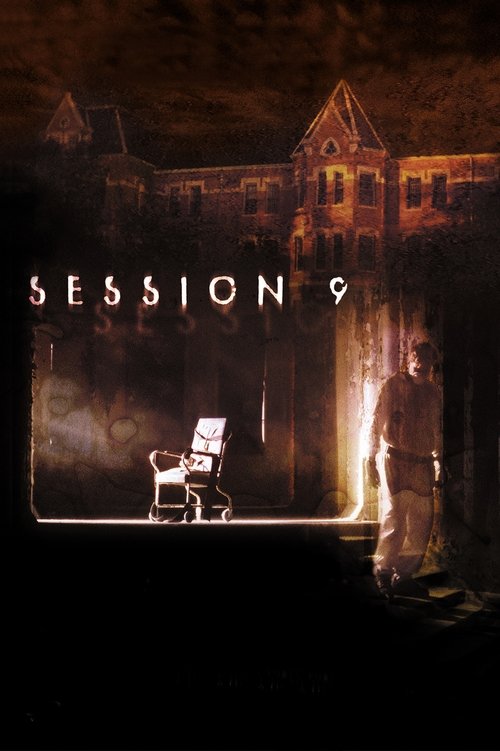
Session 9 (2001)
Directed by Brad Anderson
No — Session 9 is not woke, scoring 0 out of 100 on our wokeness meter.
Session 9 arrives from 2001, a psychological horror film set in Danvers State Hospital, where an asbestos abatement crew scrapes through a week of dangerous labor.
Consciousness Markers
The cast is entirely white and predominantly male, with no meaningful representation of marginalized groups. No diversity casting or inclusive ensemble elements are present.
There are no LGBTQ+ characters, relationships, or themes in the film. The narrative is entirely focused on a male work crew and a historical psychiatric case.
The film does not engage with feminist themes or gender politics. Female characters are limited to a victimized patient's voice and a murdered wife, serving as plot devices rather than agents of feminist commentary.
Race is not a subject of the film. The all-white cast and narrative contain no exploration of racial identity, inequality, or consciousness.
While asbestos abatement is an environmental health issue, the film does not address climate change, ecological crisis, or environmental activism. The asbestos is a backdrop for horror, not a climate crusade.
The film touches on working-class economic desperation and the decline of industry, but it does not advance an anti-capitalist or 'eat the rich' message. The focus is on psychological horror, not systemic economic critique.
There is no body positivity or body acceptance theme. The film's horror relies on bodily mutilation and mental deterioration, not on affirming diverse body types.
Mental illness and dissociative identity disorder are depicted as terrifying and linked to supernatural evil, which is contrary to neurodivergence advocacy. The film does not promote neurodiversity or positive representation of neurodivergent people.
The film is a fictional horror story set in a real abandoned asylum, but it does not revise or reinterpret historical events for ideological purposes. It uses the location for atmosphere, not historical revisionism.
The film is ambiguous and atmospheric, offering no explicit social or political lectures. It aims to unsettle rather than preach.
Why it received this score
Session 9 arrives from 2001, a psychological horror film set in Danvers State Hospital, where an asbestos abatement crew scrapes through a week of dangerous labor. Brad Anderson uses the building's rotting corridors as a character. The men are white, working class, and mostly interchangeable in the eyes of a cultural audit. Their conflicts concern money, ex-wives, gambling debts, and the fear of darkness. The film has no interest in casting as a statement, no LGBTQ subtext, no feminist revision, no racial inquiry. It simply lets a bad place do bad work on fragile people.
The horror is mental illness rendered as a haunted tape. Mary Hobbes and her personalities, including Simon, provide the film's cruelest music. This is not a sympathetic study of dissociative identity disorder. It is a supernatural or psychological puzzle designed to unsettle. The film does not celebrate neurodiversity. It does not affirm body types. It does not preach about climate, though asbestos is an environmental hazard, because the asbestos is only a reason for these men to be inside the hospital. The economic desperation is real enough, but it never becomes a systemic indictment. There is no eat-the-rich energy here. There is only the fear of losing a paycheck and then losing a mind.
The film leaves us with atmosphere: humming fluorescent lights, a lobotomy pick, a coin collection, a final line about living in the weak and the wounded. It is ambiguous, patient, and unwilling to explain itself. It has no lecture to deliver, no social lesson to impose, no historical correction to make. It uses a real asylum as a set and a real murder case as a faint inspiration, but it does not rewrite the past for present-day instruction. This is horror as mood and dread. By the standards of any current cultural inventory, it is a barren landscape. As a viewing experience, it is admirably grim.
Analysis generated by our Consciousness Algorithm


Synopsis
Tensions rise within an asbestos cleaning crew as they work in an abandoned mental hospital with a horrific past that seems to be coming back.
Questions about Session 9
Is Session 9 woke?
No — Session 9 is not woke, scoring 0 out of 100 on our wokeness meter. That earns it a verdict of Ultra Based.
Does Session 9 have any woke elements?
No. All 10 markers score zero.
How does Session 9 compare to other 2001 movies?
It ranks #128 of the 148 films from 2001 we've scored; their average is 12. The wokest is Monster's Ball (60).
How is the Woke Score calculated?
An AI-assisted process researches the film and its reception, scores it 0–100 on ten markers, then combines those into one 0–100 Woke Score. It measures a specific set of 2020s cultural themes, not film quality.