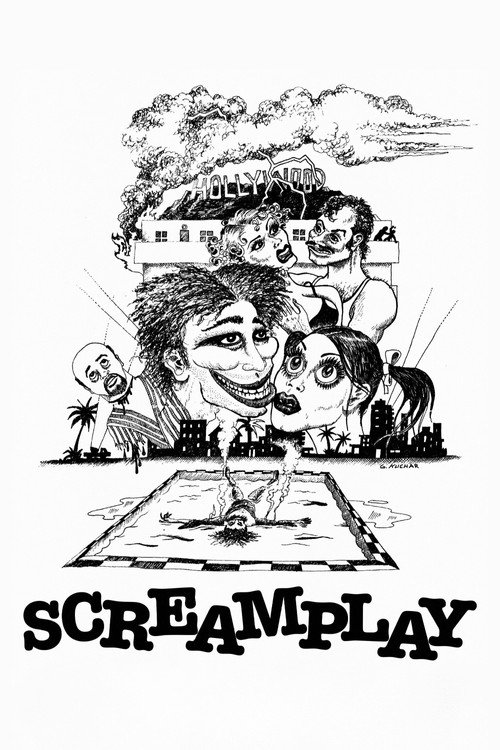
Screamplay (1984)
Directed by Rufus Butler Seder
Rufus Butler Seder's 1984 micro-budget curiosity arrives from the underground like a dispatch from a parallel Hollywood that never existed, shot in black and white for fifty thousand dollars and distributed eventually by Troma, which is either a cautionary tale or a happy ending depending on your tolerance for institutional dignity.
Consciousness Markers
The film does take aim at Hollywood as a machine that chews up the idealistic artist, which carries a faint anti-industry undercurrent. This is closer to the timeless 'showbiz is a meat grinder' tradition than to any modern anti-capitalist framework.
A brief scene involving a transvestite character in a theater restroom exists in the film, and Kuchar's broader underground queer cinema lineage casts a faint halo over the proceedings. Neither element constitutes a meaningful LGBTQ+ thematic engagement, however, so the score remains low.
The film is a micro-budget underground production with a scrappy ensemble cast assembled more by proximity than by any conscious diversity mandate. The presence of George Kuchar, a figure of gay underground cinema, is noteworthy but incidental to any casting philosophy.
There is no discernible feminist agenda at work here. The film is concerned with Expressionist shadows, Hollywood delusion, and murder, not the dismantling of patriarchal structures.
No evidence of racial consciousness as a thematic or structural concern. The film's preoccupations are aesthetic and satirical in the old-fashioned B-movie sense.
The climate crisis does not intrude upon this 1984 black-and-white horror-comedy. Not even metaphorically.
No evidence of body positivity as a theme or concern. The film's bodies are primarily used for horror-comedy purposes.
The protagonist's descent into madness is treated as Gothic horror atmosphere, not as a compassionate portrait of a neurodivergent experience.
The film has no interest in reexamining history. Its nostalgia runs in the opposite direction, lovingly reconstructing the aesthetic of Weimar-era German Expressionism.
Screamplay has no interest in lecturing anyone about anything. It is too busy being strange and low-budget and sincerely committed to its own peculiar vision to pause for a sermon.
Why it received this score
Rufus Butler Seder's 1984 micro-budget curiosity arrives from the underground like a dispatch from a parallel Hollywood that never existed, shot in black and white for fifty thousand dollars and distributed eventually by Troma, which is either a cautionary tale or a happy ending depending on your tolerance for institutional dignity. The film pays homage to German Expressionism with the enthusiasm of a film student who has just discovered The Cabinet of Dr. Caligari and the budget of someone who has just discovered their bank account. It is, in its way, a deeply sincere piece of work, and sincerity of this particular variety is so rare in horror-comedy that we should probably treat it as an endangered species.
On the spectrum of progressive social consciousness, Screamplay registers roughly where you would expect a 1984 Expressionist horror pastiche to register: near the bottom, and contentedly so. The film's satirical energies are directed at Hollywood ambition and the suffering artist archetype, which is a critique as old as the hills and significantly predates any modern ideological framework. George Kuchar appears in a supporting role, bringing with him the entire weight of the 1960s gay underground cinema tradition, though the film itself does not appear to know or care about this context. A brief scene involving a transvestite character exists in the film the way such scenes existed in 1984 films: as a quick comic beat, unexamined and unremarked upon, a relic of a different era's relationship to transgression.
The film is, in the final accounting, a love letter to a specific strain of cinematic madness that has nothing to do with contemporary cultural anxieties. It wants to be Nosferatu crossed with a Hollywood backlot nightmare, and it achieves something in that general vicinity. We are not here to praise its social consciousness, because there is none to praise. We are here to note its absence, file the appropriate paperwork, and move on.
Analysis generated by our Consciousness Algorithm

Synopsis
A talented writer, Edgar Allen, arrives in Hollywood with big dreams but is quickly pulled into a world of madness and depravity. A detective investigating a series of murders discovers that they are similar to the murders that occur in the new script by Edgar. Who will survive and what parts will be left for them?