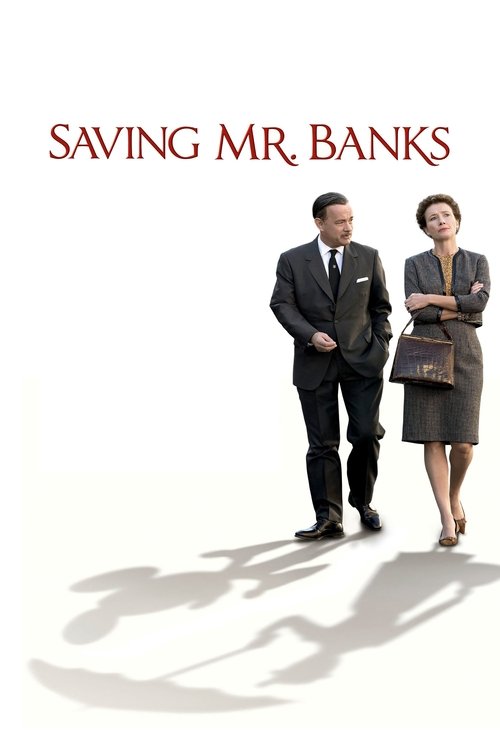
Saving Mr. Banks (2013)
Directed by John Lee Hancock
No — Saving Mr. Banks is not woke, scoring 11 out of 100 on our wokeness meter.
Saving Mr. Banks arrives in 2013 as a gentle two-track biography, cutting between P. L. Travers's alcohol-haunted Queensland childhood in 1906 and her 1961 standoff with Walt Disney over the film rights to Mary Poppins.
Consciousness Markers
P. L. Travers is a fiercely stubborn female author asserting creative control against a powerful male studio head, but the film frames this as personal eccentricity and trauma rather than any explicit feminist argument.
The film softens the real Travers-Disney relationship into a heartwarming reconciliation and burnishes the Disney brand, but this is corporate mythmaking rather than a modern progressive reframing of history.
The cast is overwhelmingly white, reflecting the period setting and the real figures involved; Paul Giamatti's chauffeur Ralph is the only notable non-white presence, and he exists naturally in the story without comment.
The film is a gentle character drama that aims to move rather than preach; its lessons about grief and letting go are delivered through story, not sermon.
There is a faint art-versus-commerce friction between Travers's authorial integrity and Disney's commercial machine, but Disney is portrayed warmly and the studio's profit motive is never indicted.
No LGBTQ+ characters, themes, or subtext appear anywhere in the film.
The film engages no racial themes whatsoever; its 1906 Queensland and 1961 Hollywood settings are entirely white spaces.
No environmental or climate content of any kind.
No body-image or body-positivity themes are present.
No neurodivergent characters or themes; Travers's difficulty is attributed to childhood grief, not any condition.
Why it received this score
Saving Mr. Banks arrives in 2013 as a gentle two-track biography, cutting between P. L. Travers's alcohol-haunted Queensland childhood in 1906 and her 1961 standoff with Walt Disney over the film rights to Mary Poppins. Emma Thompson plays Travers as a woman of eye-watering complexity, all stiff umbrellas and buried grief, while Tom Hanks essays Disney as a benevolent uncle who just wants to make a deal. The film is warm, well made, and entirely comfortable in its skin. It aims to move, not to instruct, and it largely succeeds on those modest terms.
On the question of social consciousness, the picture is a period piece that behaves like one. The cast is white to a person, which is faithful to the real figures and the era, with Paul Giamatti's chauffeur Ralph the lone notable exception, present without commentary. There is no engagement with race, no environmental content, no body-image discourse, no neurodivergent framing, and no LGBTQ presence of any kind. Travers's stubbornness reads as personal eccentricity shaped by trauma, not as a feminist argument, though a viewer so inclined could extract a mild assertion of authorial control against a male studio machine. The art-versus-commerce friction flickers briefly and then dissolves, because Disney is portrayed fondly and the profit motive never faces indictment.
The film does soften the historical record, folding a famously acrimonious negotiation into a heartwarming reconciliation that flatters its own corporate sponsor. That is brand management, not a progressive reframing of the past, and the two impulses should not be confused. What remains is a handsome, sentimental drama about grief and letting go, delivered through story instead of sermon. It preaches nothing. It simply wants you to cry at the right moments, and it has the good manners not to explain why you should.
Thematic tags: true_story, book_adaptation.
Analysis generated by our Consciousness Algorithm
Part of


Synopsis
Author P.L. Travers looks back on her childhood while reluctantly meeting with Walt Disney, who seeks to adapt her Mary Poppins books for the big screen.
Questions about Saving Mr. Banks
Is Saving Mr. Banks woke?
No — Saving Mr. Banks is not woke, scoring 11 out of 100 on our wokeness meter. That earns it a verdict of Ultra Based.
Does Saving Mr. Banks have any woke elements?
Very few. None of the 10 markers reaches 30, the level where a marker counts as present; the highest is Feminist Agenda at 22.
How does Saving Mr. Banks compare to other 2013 movies?
It ranks #111 of the 274 films from 2013 we've scored; their average is 14. The wokest is Belle (76).
How is the Woke Score calculated?
An AI-assisted process researches the film and its reception, scores it 0–100 on ten markers, then combines those into one 0–100 Woke Score. It measures a specific set of 2020s cultural themes, not film quality.