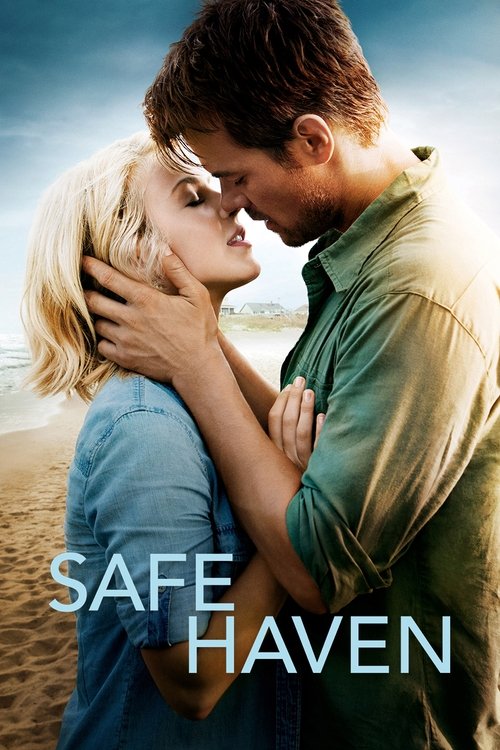
Safe Haven (2013)
Directed by Lasse Hallström
No — Safe Haven is not woke, scoring 0 out of 100 on our wokeness meter.
Safe Haven arrives from 2013, a year when the Nicholas Sparks adaptation was still a reliable February commodity, and it does precisely what such a commodity is designed to do.
Consciousness Markers
The cast is predominantly white with no deliberate diverse or inclusive casting choices; minority characters are absent or incidental.
No LGBTQ+ characters, relationships, or themes appear in the film.
Although the plot involves a woman escaping an abusive husband, it is framed as a romantic thriller rather than a feminist statement; no explicit gender-equality agenda is present.
The film is set in a white small-town milieu and does not engage with racial identity, inequality, or social justice.
No environmental or climate-change themes appear in the film.
No critique of wealth, capitalism, or class inequality is offered.
No body-positivity themes are present; characters conform to conventional romantic-lead beauty standards.
No neurodivergent characters or themes are depicted.
The film is not a historical work and offers no revisionist historical narrative.
The film does not deliver social or political lectures; it is a sentimental romance-thriller.
Why it received this score
Safe Haven arrives from 2013, a year when the Nicholas Sparks adaptation was still a reliable February commodity, and it does precisely what such a commodity is designed to do. A woman with blood on her hands boards a bus. She lands in Southport, North Carolina, a town of friendly shopkeepers and no visible economic activity, and rents a cottage on the edge of things. Lasse Hallström directs with the soft, honeyed competence of a man who has photographed many sunsets and intends to photograph several more. Julianne Hough is asked to look haunted. Josh Duhamel is asked to look like a widower. Both comply.
The film concerns an abusive alcoholic husband, a woman who stabs him in self-defense, and her flight to safety, which sounds like material for a serious picture about domestic violence. It is not that. The abuse functions as a plot engine, a reason for the heroine to be sad in a picturesque location until a good man with a boat arrives. The town is white, comfortable, and untroubled by anything resembling a social question. There is no argument to make, no thesis to advance, no lecture to deliver. The movie wants only to make us feel a warm, unearned ache and then sell us a soundtrack.
Then comes the twist, in which the friendly neighbor Jo is revealed to be the ghost of the dead wife, a development that critics met with genuine alarm. Richard Roeper called it crazy. Peter Travers gave it zero stars and expressed hatred. That is a strong reaction to a film this harmless. Its sins are sentimentality, implausible geography, and a climax involving gasoline and a Fourth of July firework. Nothing more sinister than that.
Analysis generated by our Consciousness Algorithm


Synopsis
A young woman with a mysterious past lands in Southport, North Carolina where her bond with a widower forces her to confront the dark secret that haunts her.
Questions about Safe Haven
Is Safe Haven woke?
No — Safe Haven is not woke, scoring 0 out of 100 on our wokeness meter. That earns it a verdict of Ultra Based.
Does Safe Haven have any woke elements?
No. All 10 markers score zero.
How does Safe Haven compare to other 2013 movies?
It ranks #249 of the 274 films from 2013 we've scored; their average is 14. The wokest is Belle (76).
How is the Woke Score calculated?
An AI-assisted process researches the film and its reception, scores it 0–100 on ten markers, then combines those into one 0–100 Woke Score. It measures a specific set of 2020s cultural themes, not film quality.