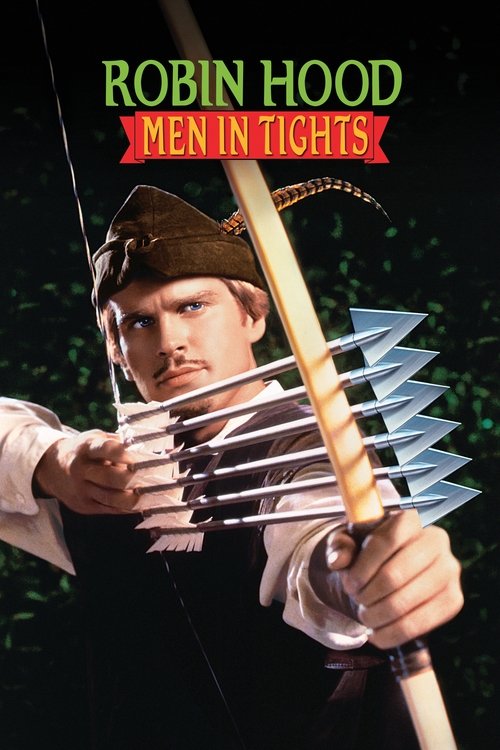
Robin Hood: Men in Tights (1993)
Directed by Mel Brooks
No — Robin Hood: Men in Tights is not woke, scoring 14 out of 100 on our wokeness meter.
Mel Brooks returned to the Robin Hood legend in 1993 with a spoof that owes its largest debts to Robin Hood: Prince of Thieves and the 1938 Errol Flynn picture.
Consciousness Markers
Dave Chappelle and Isaac Hayes appear in prominent roles as Ahchoo and Asneeze, giving the film a notably integrated cast for 1993, though the casting is played for broad comedy rather than as a statement.
Ahchoo's status as the lone Black Merry Man generates a handful of self-aware race gags, but these are throwaway spoof beats rather than any consciousness-raising.
Prince John's oppressive taxation and the repossession of Loxley Hall gesture at class grievance, but the film has no interest in economic critique beyond a plot device.
Maid Marian has some agency in the chastity-belt plot and Broomhilde is a presence, but the film is a bawdy spoof that treats its women largely as punchlines.
This is a gag-a-minute Mel Brooks spoof with no didactic agenda; it lectures no one about anything.
No LGBTQ+ characters, themes, or subtext of any kind; the humor is squarely heterosexual and locker-room in register.
No environmental themes whatsoever; the forest is a setting for archery gags, not an ecological statement.
Broomhilde's size is mined for mockery rather than affirmation; there is no body-positive framing here.
Blinkin is blind, a physical disability played for slapstick; no neurodivergent characters or themes are present.
The film spoofs prior Robin Hood movies rather than rewriting history; no revisionist historical project is undertaken.
Why it received this score
Mel Brooks returned to the Robin Hood legend in 1993 with a spoof that owes its largest debts to Robin Hood: Prince of Thieves and the 1938 Errol Flynn picture. The film's cultural awareness is largely a matter of casting arithmetic. Dave Chappelle and Isaac Hayes appear in substantial roles, and a 1993 comedy with an integrated band of Merry Men registers as quietly notable, even when the material around them is content to be silly. Nobody involved appears to have intended a statement. Intentions, however, are not the metric.
The racial humor is self-aware and disposable. Ahchoo's position as the lone Black Merry Man generates a few knowing jokes, then the film moves on to the next gag. Prince John's punitive taxes and the repossession of Loxley Hall supply a plot engine, though the film shows no appetite for economic argument. Maid Marian does get to scheme and sneak and warn, which is more than the genre usually permits, but the chastity belt is the real punchline, and Broomhilde exists mainly to be mocked for her size. The bawdy register leaves little room for anything else.
The rest of the ledger is bare. There is no queer material, no environmental conscience, no body-affirming framework, no neurodivergent characters. Blinkin's blindness is slapstick furniture, not representation. The film spoofs earlier Robin Hood movies instead of revising any history, and it lectures no one about anything, which may be its most admirable quality. It is a gag machine that occasionally trips over a social insight on its way to the next joke. The result is amiable, uneven, and almost entirely innocent of agenda.
Analysis generated by our Consciousness Algorithm


Synopsis
Robin Hood comes home after fighting in the Crusades to learn that the noble King Richard is in exile and that the despotic King John now rules England, with the help of the Sheriff of Rottingham. Robin Hood assembles a band of fellow patriots to do battle with King John and the Sheriff.
Questions about Robin Hood: Men in Tights
Is Robin Hood: Men in Tights woke?
No — Robin Hood: Men in Tights is not woke, scoring 14 out of 100 on our wokeness meter. That earns it a verdict of Ultra Based.
Does Robin Hood: Men in Tights have any woke elements?
1 of the 10 markers register at 30 or above, led by Representation Casting (45). On Representation Casting: Dave Chappelle and Isaac Hayes appear in prominent roles as Ahchoo and Asneeze, giving the film a notably integrated cast for 1993, though the casting is played for broad comedy rather than as a statement.
How does Robin Hood: Men in Tights compare to other 1993 movies?
It ranks #28 of the 97 films from 1993 we've scored; their average is 11. The wokest is Bound by Honor (60).
How is the Woke Score calculated?
An AI-assisted process researches the film and its reception, scores it 0–100 on ten markers, then combines those into one 0–100 Woke Score. It measures a specific set of 2020s cultural themes, not film quality.