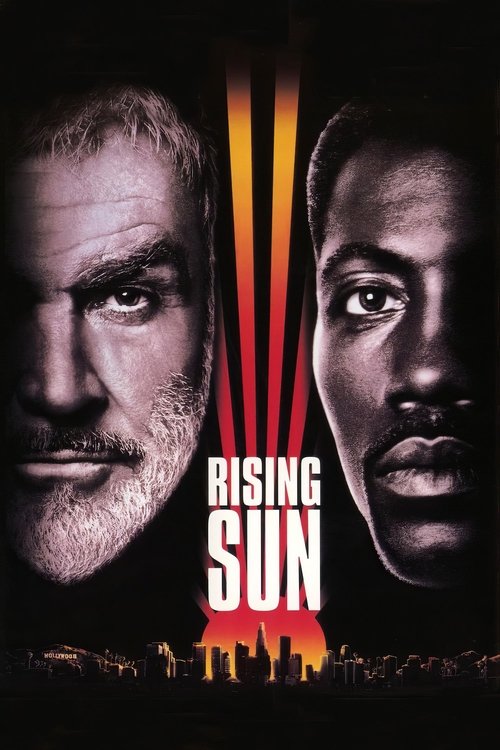
Rising Sun (1993)
Directed by Philip Kaufman
No — Rising Sun is not especially woke, scoring 26 out of 100 on our wokeness meter.
Rising Sun arrives from 1993, a year when a studio could still build a thriller around a trade imbalance and expect a paying audience.
Consciousness Markers
Wesley Snipes was cast as the co-lead, a character changed from Caucasian in the source novel, and the film features a substantial Japanese/Asian ensemble. However, the casting was not framed as modern inclusive representation and drew protests over stereotyping.
The villain is a corporation covering up a murder to protect a semiconductor merger, and the film critiques corporate power and corruption. It is more anti-corporate than systemic anti-capitalist.
Sean Connery's character frequently delivers exposition on Japanese business culture and U.S.-Japan relations, giving the thriller a didactic streak. It is not modern social-justice lecturing.
The plot engages U.S.-Japan cultural friction and places a Black detective in a Japanese corporate setting, but its racial politics are more geopolitical and xenophobic than progressive racial consciousness.
No LGBTQ+ characters, themes, or subtext are present.
Female characters appear, including a computer expert, but the film does not advance a feminist agenda or critique gender power structures.
No environmental or climate-related themes are present.
No body-positivity themes or messaging are present.
No neurodivergence themes or characters are present.
The film is a fictional thriller and does not revise or reinterpret historical events.
Why it received this score
Rising Sun arrives from 1993, a year when a studio could still build a thriller around a trade imbalance and expect a paying audience. Michael Crichton's novel about Japanese capital sinking its teeth into Los Angeles is trimmed to two hours, and the result is a murder investigation that keeps pausing to explain corporate structure to a homicide detective. Philip Kaufman cast Wesley Snipes as the co-lead, a role written as Caucasian, a change Crichton publicly disliked on the grounds that it introduced a second racial tension into a film already about one. That reads as representation by accident, not by design, and it did not spare the production from organized protest by Asian-American groups who found its portrait of Japanese business conduct hostile. A substantial Asian and Asian-American ensemble is present. The film is not thoughtful about any of it.
The villainy is corporate. A semiconductor merger, a doctored surveillance disc, a senator compromised by footage: the cover-up runs on institutional self-interest, and the picture is content to let an American lawyer take the fall so the keiretsu can close its deal. This is anti-corporate sentiment of a sturdy, pre-millennial variety, aimed at specific boardrooms. Sean Connery, who also produced, spends much of the running time lecturing on Japanese etiquette, honor, and the mechanics of doing business in Tokyo. The film stops dead for these seminars. They are the closest thing to sermonizing on offer, and the sermon concerns trade policy.
Everything else is missing. There is a female computer expert, and she is competent, and the film has no further interest in her or in whatever produced her. No queer characters. No environmental dread. No body politics. No neurodivergent reading of anyone's conduct. No rewriting of the historical record. The remainder is a muddled thriller that mistakes cultural friction for insight and exposition for drama, and it was reviewed accordingly.
Analysis generated by our Consciousness Algorithm


Synopsis
When a prostitute is found dead in a Los Angeles skyscraper occupied by a large Japanese corporation, detectives John Connor and Web Smith are called in to investigate. Although Connor has previous experience working in Japan, cultural differences make their progress difficult until a security disc showing the murder turns up. Close scrutiny proves the disc has been doctored, and the detectives realize they're dealing with a cover-up as well.
Questions about Rising Sun
Is Rising Sun woke?
No — Rising Sun is not especially woke, scoring 26 out of 100 on our wokeness meter. That earns it a verdict of Based.
Does Rising Sun have any woke elements?
3 of the 10 markers register at 30 or above, led by Representation Casting (45), Eat the Rich (35) and Lecture Energy (30). On Representation Casting: Wesley Snipes was cast as the co-lead, a character changed from Caucasian in the source novel, and the film features a substantial Japanese/Asian ensemble.
How does Rising Sun compare to other 1993 movies?
It ranks #10 of the 97 films from 1993 we've scored; their average is 11. The wokest is Bound by Honor (60).
How is the Woke Score calculated?
An AI-assisted process researches the film and its reception, scores it 0–100 on ten markers, then combines those into one 0–100 Woke Score. It measures a specific set of 2020s cultural themes, not film quality.