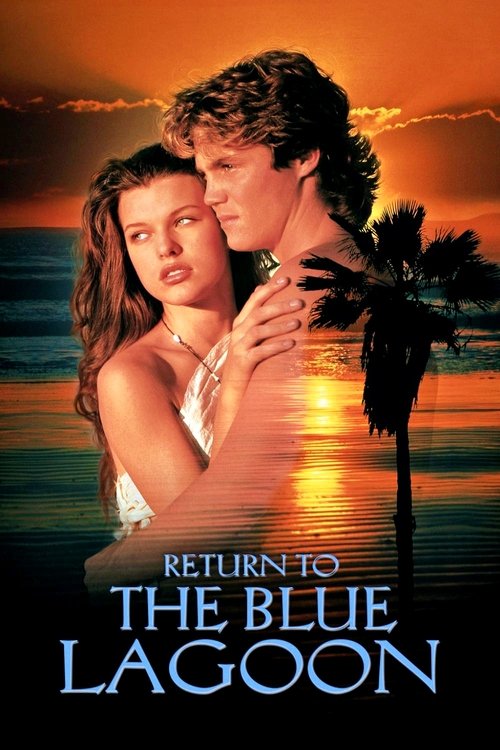
Return to the Blue Lagoon (1991)
Directed by William A. Graham
No — Return to the Blue Lagoon is not woke, scoring 0 out of 100 on our wokeness meter.
Return to the Blue Lagoon arrives from 1991 with the confidence of a film that believes tropical scenery and two attractive teenagers constitute a narrative.
Consciousness Markers
The cast is entirely white, with no meaningful representation of minority groups; native islanders appear only as anonymous threats.
No LGBTQ+ characters, themes, or subtext.
The film follows a conventional romantic adventure narrative without feminist critique or female empowerment themes.
No engagement with racial justice or consciousness; indigenous characters are depicted as generic sacrificial savages.
No environmental or climate change themes.
No critique of capitalism or wealth inequality.
No body positivity themes; the film focuses on conventionally attractive young leads.
No neurodivergent characters or themes.
No revisionist historical narrative; it is a romantic adventure set in the 19th century.
No preachy or didactic messaging; the film is a straightforward romantic adventure.
Why it received this score
Return to the Blue Lagoon arrives from 1991 with the confidence of a film that believes tropical scenery and two attractive teenagers constitute a narrative. It does not. Two children are marooned in the South Pacific after their guardian beats a sailor to death with a harpoon and later dies of pneumonia, leaving them to mature into Milla Jovovich and Brian Krause. They fish, they swim, they quarrel about a shark, they discover one another. A ship arrives, a passenger attempts a seduction, a sailor attempts something worse, and the villain is dispatched by the same shark. The film grossed under three million dollars against an eleven million dollar budget and holds a zero percent approval rating, a difficult figure to achieve and a testament to purity of purpose.
What the film does not contain is any of the cultural furniture a modern viewer might expect. Its cast is uniformly white. The indigenous islanders on the forbidden side of the island exist only to perform human sacrifice at a stone idol, offered without a flicker of self-awareness. The romance is conventional to the point of being geological. There is no environmental sermon, no critique of wealth, no inclination to lecture the audience about anything. The film wants to show beautiful people on a beautiful beach, and it pursues that goal with a single-mindedness that borders on the admirable.
We are left with a curio. It is simultaneously a sequel and something closer to a remake, adapted loosely from novels few have read, and it carries no message beyond the notion that civilization has guns and therefore the island is preferable. The attempted assault on Lilli is a plot complication to be resolved by a shark. Sarah Hargrave's religious instruction is a device for explaining menstruation. Nothing here is argued. Nothing is interrogated. The film is a warm, empty vessel, and in an era that demands its entertainment explain itself, that emptiness reads almost as a period artifact. Almost.
Analysis generated by our Consciousness Algorithm


Synopsis
In this sequel to the 1980 classic, two children are stranded on a beautiful island in the South Pacific. With no adults to guide them, the two make a simple life together and eventually become tanned teenagers in love.
Questions about Return to the Blue Lagoon
Is Return to the Blue Lagoon woke?
No — Return to the Blue Lagoon is not woke, scoring 0 out of 100 on our wokeness meter. That earns it a verdict of Ultra Based.
Does Return to the Blue Lagoon have any woke elements?
No. All 10 markers score zero.
How does Return to the Blue Lagoon compare to other 1991 movies?
It ranks #61 of the 68 films from 1991 we've scored; their average is 14. The wokest is Paris Is Burning (77).
How is the Woke Score calculated?
An AI-assisted process researches the film and its reception, scores it 0–100 on ten markers, then combines those into one 0–100 Woke Score. It measures a specific set of 2020s cultural themes, not film quality.