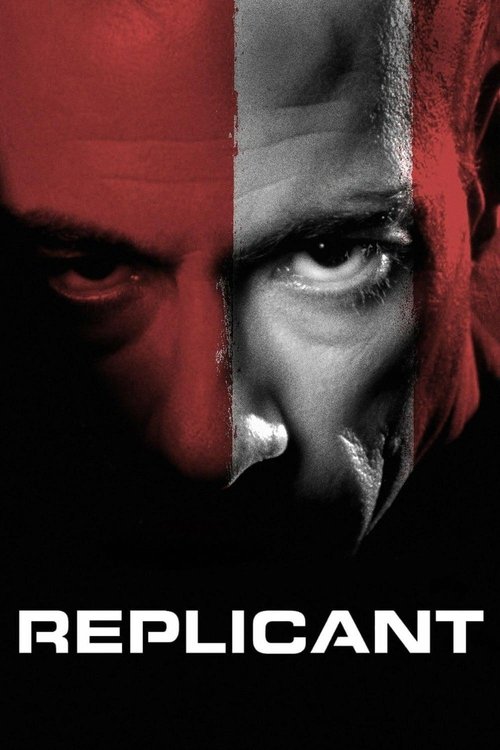
Replicant (2001)
Directed by Ringo Lam Ling-tung
No — Replicant is not woke, scoring 0 out of 100 on our wokeness meter.
Replicant arrives in 2001 with a premise that reads like a dare: clone a serial killer from DNA recovered at a crime scene, hand the resulting adult with the mind of a child to a burnt-out Seattle detective, and let the two of them track the original through the Pacific Northwest.
Consciousness Markers
The cast is overwhelmingly white, led by Jean-Claude Van Damme and Michael Rooker, with no deliberate diverse casting or commentary on representation.
No LGBTQ+ characters, themes, or subtext appear anywhere in the film.
The killer's backstory involves an abusive mother, and the film's female characters are largely victims or a romantic footnote; no feminist framework is present.
Race is never addressed or thematized; the film is a straightforward manhunt thriller with no racial consciousness.
No environmental or climate themes appear in this cloning/serial-killer action film.
The film has no economic critique or anti-capitalist messaging; the secret government agency is a plot device, not a target of satire.
Body image, size, or self-acceptance are not themes of the film.
The Replicant's childlike mind is a sci-fi plot conceit about genetic memory, not a depiction of neurodivergence or neurodiversity advocacy.
The film invents a fictional cloning program and serial killer; it makes no revisionist claims about real history.
The film delivers action and suspense rather than moral instruction; there is no preachy messaging or social lecture.
Why it received this score
Replicant arrives in 2001 with a premise that reads like a dare: clone a serial killer from DNA recovered at a crime scene, hand the resulting adult with the mind of a child to a burnt-out Seattle detective, and let the two of them track the original through the Pacific Northwest. Jean-Claude Van Damme plays both the killer and the copy, a dual role he had already attempted twice before, and Ringo Lam directs with the functional efficiency of a man who has staged better chases in Hong Kong. The film went straight to video in the United States. Eleven critics on Rotten Tomatoes gave it a 27 percent approval, which is roughly the enthusiasm level of a Tuesday afternoon screening.
For a film preoccupied with genetic duplication and the question of whether a man is his biology, Replicant has no interest in saying anything about the world. Race never surfaces. Neither does sexuality, gender politics, or the climate. The killer's rage is traced to an abusive mother, which makes the film's women victims and little else, and the script never stops to consider what that pattern might mean. The clone's childlike affect is a science-fiction device about genetic memory, not a portrait of a mind that thinks differently. The shadowy agency that funds the experiment exists to move the plot, and the film never turns its lens on the money behind it. There is no sermon here, no lesson, no moral to carry home. Just a man in a raincoat, a music box, and a lot of running.
This is a vintage of pure 2001 action, decanted without ceremony. It pairs a martial artist in his physical prime with a script that has no agenda beyond the next set piece, and it delivers exactly that. We classify it without hesitation. Zero. A clean zero, the kind that comes along less often than the culture would have us believe. The cellar is full of films straining to mean something. This one just wants to catch a killer.
Analysis generated by our Consciousness Algorithm


Synopsis
Scientists create a genetic clone of a serial killer in order to help catch the killer, teaming up with two cops.
Questions about Replicant
Is Replicant woke?
No — Replicant is not woke, scoring 0 out of 100 on our wokeness meter. That earns it a verdict of Ultra Based.
Does Replicant have any woke elements?
No. All 10 markers score zero.
How does Replicant compare to other 2001 movies?
It ranks #128 of the 148 films from 2001 we've scored; their average is 12. The wokest is Monster's Ball (60).
How is the Woke Score calculated?
An AI-assisted process researches the film and its reception, scores it 0–100 on ten markers, then combines those into one 0–100 Woke Score. It measures a specific set of 2020s cultural themes, not film quality.