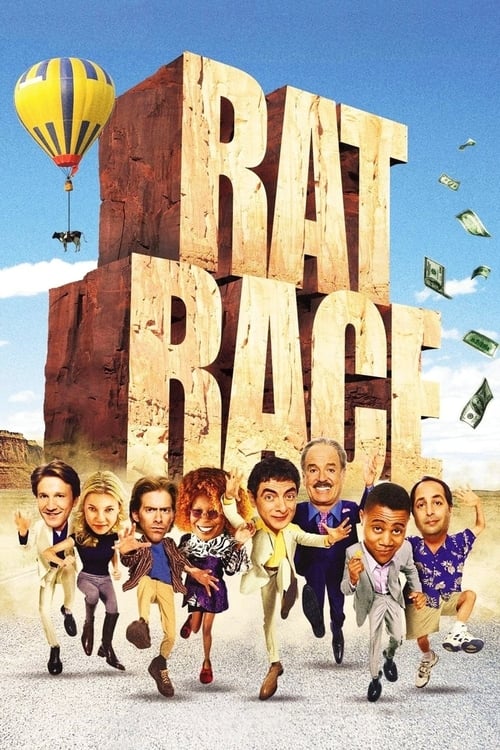
Rat Race (2001)
Directed by Jerry Zucker
No — Rat Race is not woke, scoring 12 out of 100 on our wokeness meter.
Rat Race arrives from 2001, a year in which a studio could still assemble a dozen comedians, point them toward New Mexico, and call the result a motion picture.
Consciousness Markers
The ensemble is genuinely diverse for 2001, with Cuba Gooding Jr., Whoopi Goldberg, and Lanei Chapman anchoring major storylines, but this is natural star-driven casting rather than any self-conscious representation agenda.
The premise satirizes decadent casino tycoons betting on ordinary people's desperation, and the finale has the racers donate the winnings to charity, but it's toothless slapstick rather than genuine class critique.
The film is a relentless gag machine with no preaching; the charitable-change-of-heart ending is a punchline, not a sermon.
Enrico is narcoleptic and a busload of mental patients appears, but these are punchlines rather than any celebration of neurodivergent identity.
Women appear as businesswomen, a helicopter pilot, and an all-female biker gang, but they exist as gag delivery systems rather than vehicles for any feminist argument.
No LGBTQ characters, themes, or subtext appear anywhere in the film.
Race is never remarked upon; the diverse cast simply exists within the story without comment or thematic weight.
No environmental themes whatsoever; the film's only concern is a duffel bag of cash.
No body-positivity themes; physical comedy here is aimed at humiliation, not acceptance.
The Hitler staff car and Klaus Barbie museum gags are pure farce, not historical revisionism.
Why it received this score
Rat Race arrives from 2001, a year in which a studio could still assemble a dozen comedians, point them toward New Mexico, and call the result a motion picture. The premise concerns a casino tycoon named Sinclair, played by John Cleese with visible delight, who wagers his wealthiest patrons on the progress of six strangers chasing two million dollars across the desert. Jerry Zucker directs with the weary efficiency of a man who helped invent this sort of thing and knows precisely how much mileage a dangling cow and a hot air balloon can provide. The film's politics are those of a whoopee cushion, which is to say it has none and is not embarrassed about it.
The ensemble is diverse in the unself-conscious manner of its era. Cuba Gooding Jr., Whoopi Goldberg, and Lanei Chapman carry substantial storylines, and the screenplay never pauses to congratulate itself for this. Race goes unmentioned. So does sexuality, in any form. Women fly helicopters, run businesses, and command a biker gang, though each of these exists to service a gag, and the gags are not making arguments. Enrico the narcoleptic tourist and a busload of mental patients supply laughs at the expense of their conditions. The film treats neurodivergence as a prop and moves along.
The class satire is present but soft. Wealthy men betting on the desperation of ordinary people is a fine target, and the film takes aim before losing its nerve. The racers end by donating the money to a Smash Mouth charity concert, a resolution that gestures at generosity without costing anyone a dime. There is no sermon, no lecture, no moment where the audience is instructed in how to feel. It is a machine for producing pratfalls, and it runs until it stops. We are left holding a document of what a broad studio comedy looked like before anyone thought to ask it questions. The answer is loud, amiable, and entirely without a message.
Analysis generated by our Consciousness Algorithm
Part of


Synopsis
In an ensemble film about easy money, greed, manipulation and bad driving, a Las Vegas casino tycoon entertains his wealthiest high rollers -- a group that will bet on anything -- by pitting six ordinary people against each other in a wild dash for $2 million jammed into a locker hundreds of miles away. The tycoon and his wealthy friends monitor each racer's every move to keep track of their favorites. The only rule in this race is that there are no rules.
Questions about Rat Race
Is Rat Race woke?
No — Rat Race is not woke, scoring 12 out of 100 on our wokeness meter. That earns it a verdict of Ultra Based.
Does Rat Race have any woke elements?
Very few. None of the 10 markers reaches 30, the level where a marker counts as present; the highest is Eat the Rich at 25.
How does Rat Race compare to other 2001 movies?
It ranks #50 of the 148 films from 2001 we've scored; their average is 12. The wokest is Monster's Ball (60).
How is the Woke Score calculated?
An AI-assisted process researches the film and its reception, scores it 0–100 on ten markers, then combines those into one 0–100 Woke Score. It measures a specific set of 2020s cultural themes, not film quality.