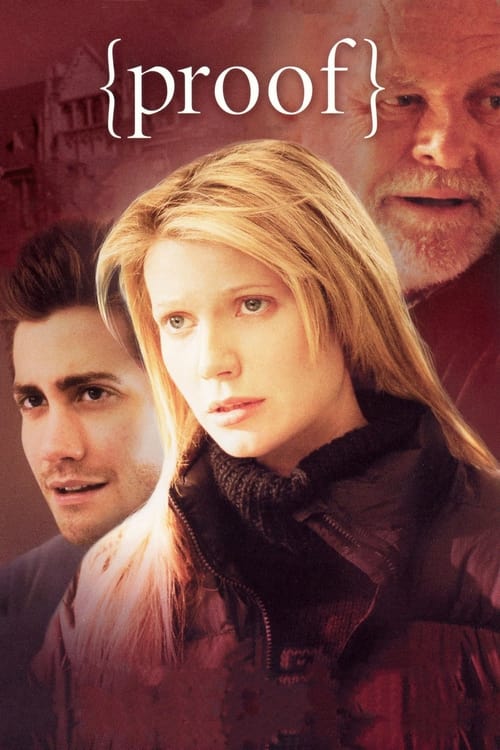
Proof (2005)
Directed by John Madden
No — Proof is not woke, scoring 14 out of 100 on our wokeness meter.
Proof arrives from 2005, a year when a film could still be about mathematicians and grief without pausing to explain itself.
Consciousness Markers
Catherine is a female mathematician whose own proof is disbelieved and attributed to her father by the men around her, giving the film a genuine, if understated, feminist undercurrent about women's intellectual credibility.
The film seriously humanizes mental illness through Robert's decline and Catherine's fear of inheriting it, though it frames it as tragedy rather than as a celebrated neurodivergent identity.
The cast is overwhelmingly white, with Roshan Seth's Professor Bhandari a brief supporting presence. No deliberate representation agenda is evident.
The film is a quiet character drama that shows rather than preaches; there is little didactic messaging.
Race is not a thematic concern; the lone non-white character is incidental and unremarked upon.
No LGBTQ+ characters or themes appear anywhere in the narrative.
No environmental or climate themes are present.
Claire's role as a financial analyst and her desire to sell the family home are plot mechanics, not a critique of capitalism.
Body image and body positivity are not addressed.
The film is a fictional family drama with no historical revisionism.
Why it received this score
Proof arrives from 2005, a year when a film could still be about mathematicians and grief without pausing to explain itself. John Madden directs a four-character stage play that has been opened up just enough to include a campus, a funeral, and a great deal of rain on windows. Gwyneth Paltrow plays Catherine, a woman in her late twenties who has spent years caring for her father Robert, a celebrated mathematician played by Anthony Hopkins, as his mind comes apart. The film is quiet, sad, and largely uninterested in instructing anyone about anything, which in the present climate registers as a small act of restraint.
Where the film does carry a social charge is in its treatment of Catherine's intellect. She writes a proof. The men around her, a former graduate student and her own sister, refuse to believe a woman of her age and history produced it, and the mathematics gets handed back to her dead father by default. The film never stages a speech about this. It lets the doubt sit there, unspoken and corrosive, and that understatement gives the material a genuine feminist edge a louder film would have squandered. The cast is otherwise a study in whiteness, with Roshan Seth drifting through as a colleague and no one remarking on it. Race is not a subject here, and neither is capital, the body, or the planet.
The film's real preoccupation is mental illness, handled with a seriousness that humanizes Robert's decline and Catherine's fear of inheriting it. It treats the condition as tragedy, not identity, which keeps it well clear of contemporary celebration. The result is a well-mannered drama that shows rather than lectures. Its progressive credentials are modest, real where they exist, and absent where they do not.
Analysis generated by our Consciousness Algorithm


Synopsis
Catherine is a woman in her late twenties who is strongly devoted to her father, Robert, a brilliant and well-known mathematician whose grip on reality is beginning to slip away. As Robert descends into madness, Catherine begins to wonder if she may have inherited her father's mental illness along with his mathematical genius.
Questions about Proof
Is Proof woke?
No — Proof is not woke, scoring 14 out of 100 on our wokeness meter. That earns it a verdict of Ultra Based.
Does Proof have any woke elements?
1 of the 10 markers register at 30 or above, led by Feminist Agenda (30). On Feminist Agenda: Catherine is a female mathematician whose own proof is disbelieved and attributed to her father by the men around her, giving the film a genuine, if understated, feminist undercurrent about women's intellectual credibility.
How does Proof compare to other 2005 movies?
It ranks #57 of the 181 films from 2005 we've scored; their average is 13. The wokest is The Constant Gardener (72).
How is the Woke Score calculated?
An AI-assisted process researches the film and its reception, scores it 0–100 on ten markers, then combines those into one 0–100 Woke Score. It measures a specific set of 2020s cultural themes, not film quality.