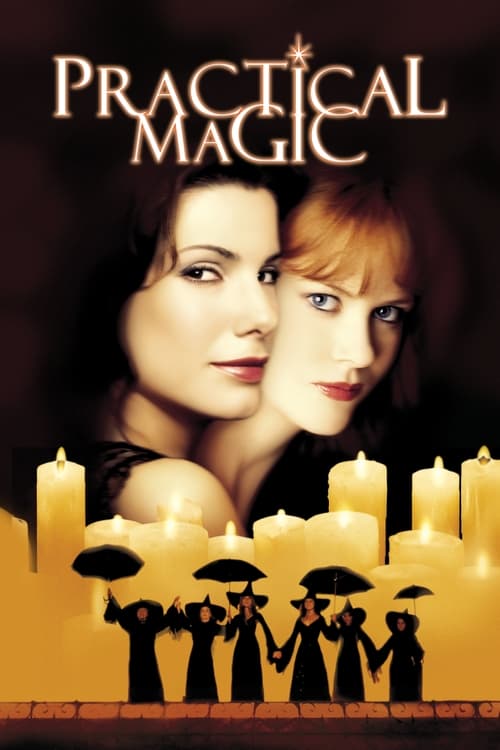
Practical Magic (1998)
Directed by Griffin Dunne
No — Practical Magic is not especially woke, scoring 26 out of 100 on our wokeness meter.
Practical Magic arrived in 1998 to a critical drubbing and a respectable $94 million worldwide, then spent the following decades quietly accruing a cult.
Consciousness Markers
The story centers on sisterhood, a matriarchal witch lineage, female solidarity against an abusive male spirit, and women uniting as a coven to reclaim their power.
The film is female-led with two major stars and prominent older actresses, but the cast is otherwise uniformly white and lacks meaningful racial or ethnic diversity.
The film embeds themes of sisterhood and female empowerment in its story rather than delivering explicit ideological lectures.
There are no LGBTQ+ characters, relationships, or themes in the film.
The film does not engage with racial identity, racism, or racial justice themes.
There is no environmental or climate-related content in the film.
The film contains no critique of capitalism, wealth inequality, or economic exploitation.
There is no body positivity or fat-acceptance messaging in the film.
The film does not depict or discuss neurodivergence or neurodiverse characters.
The witch-trial backstory is fantastical and not a revisionist historical narrative about real events.
Why it received this score
Practical Magic arrived in 1998 to a critical drubbing and a respectable $94 million worldwide, then spent the following decades quietly accruing a cult. The tone wobbles between romantic comedy, domestic horror, and something like a wine commercial shot at golden hour. Sandra Bullock and Nicole Kidman play the Owens sisters, raised by aunts in a Massachusetts town that treats their lineage as a tourist attraction and a curse in equal measure. The film is based on Alice Hoffman's novel and opened at number one, facts that its detractors and its devotees both tend to forget.
The gender politics are the point, and they are woven into the plot instead of announced from a pulpit. A matriarchal bloodline, a sisterhood sealed by a childhood blood oath, an abusive boyfriend whose spirit must be expelled by a convened coven of local women: the movie builds its case for female solidarity through incident and imagery. It rarely stops to explain itself, which keeps the sermonizing to a minimum. The empowerment is structural, not spoken.
Elsewhere the ledger is thin. The cast is overwhelmingly white, with two movie stars and two venerable character actresses carrying a town that offers no racial texture whatsoever. There is no engagement with queerness, economic grievance, climate, body image, or neurodiversity. The witch trials invoked in the backstory are fantasy furniture, not historical argument. What remains is a modest, uneven film that treats female kinship as its engine and lets the audience draw its own conclusions. The cult following, it seems, came for the atmosphere and stayed for the sisters.
Analysis generated by our Consciousness Algorithm
Part of


Synopsis
Sally and Gillian Owens, born into a magical family, have mostly avoided witchcraft themselves. But when Gillian's vicious boyfriend, Jimmy Angelov, dies unexpectedly, the Owens sisters give themselves a crash course in hard magic. With policeman Gary Hallet growing suspicious, the girls struggle to resurrect Angelov -- and unwittingly inject his corpse with an evil spirit that threatens to end their family line.
Questions about Practical Magic
Is Practical Magic woke?
No — Practical Magic is not especially woke, scoring 26 out of 100 on our wokeness meter. That earns it a verdict of Based.
Does Practical Magic have any woke elements?
1 of the 10 markers register at 30 or above, led by Feminist Agenda (55). On Feminist Agenda: The story centers on sisterhood, a matriarchal witch lineage, female solidarity against an abusive male spirit, and women uniting as a coven to reclaim their power.
How does Practical Magic compare to other 1998 movies?
It ranks #11 of the 118 films from 1998 we've scored; their average is 12. The wokest is Show Me Love (60).
How is the Woke Score calculated?
An AI-assisted process researches the film and its reception, scores it 0–100 on ten markers, then combines those into one 0–100 Woke Score. It measures a specific set of 2020s cultural themes, not film quality.