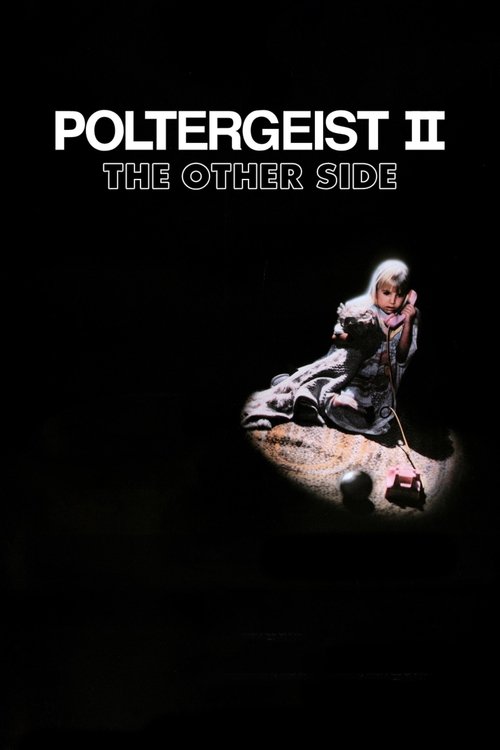
Poltergeist II: The Other Side (1986)
Directed by Brian Gibson
No — Poltergeist II: The Other Side is not woke, scoring 13 out of 100 on our wokeness meter.
Poltergeist II: The Other Side arrives four years after its predecessor, minus Tobe Hooper, minus Steven Spielberg, and minus any lingering reason for the Freeling family to remain interesting.
Consciousness Markers
The film features Native American actor Will Sampson as Taylor, a shaman who aids the family, and Zelda Rubinstein as the psychic Tangina. However, the casting is not framed as a modern diversity initiative.
The plot incorporates a Native American shaman and Hopi rituals as mystical plot devices, but it does not engage with racial justice or modern racial consciousness.
No LGBTQ+ characters, themes, or subtext are present.
Diane is a mother with psychic abilities, but the film does not advance a feminist agenda or critique patriarchy.
No environmental or climate themes are present.
No anti-capitalist or eat-the-rich themes are present.
No body positivity themes or messaging are present.
No neurodivergence themes or characters are present.
The film's 19th-century cult leader is fictional and does not revise real historical events.
The film is a supernatural horror sequel and does not contain preachy or lecture-like messaging.
Why it received this score
Poltergeist II: The Other Side arrives four years after its predecessor, minus Tobe Hooper, minus Steven Spielberg, and minus any lingering reason for the Freeling family to remain interesting. The house is gone. The neighborhood has become an archaeological dig. Left behind are a family crammed into a Phoenix bungalow with Grandma Jess, a television-free living room, and a nineteenth-century preacher named Henry Kane who wants the youngest child for reasons the screenplay explains at length and with visible strain. This is a sequel in the purest commercial sense: the same people, the same problems, a larger budget, a worse script. Critics at the time were unkind. The Rotten Tomatoes consensus has since been unkinder.
For the purposes of cultural classification, the film offers a modest and largely incidental inventory. Will Sampson appears as Taylor, a Native American shaman who supplies the family with smoke spirits, charmed spears, and a Hopi obelisk out in the Arizona desert. Zelda Rubinstein returns as Tangina, the psychic who has apparently been traversing the spirit world in her spare time. Both performances are sincere and both characters are functional. The film has no interest in interrogating what it means to borrow Hopi ritual for a monster movie, and no interest in anything else either. No romantic subtext, no gender politics, no economic grievance, no climate anxiety, no body-image discourse, no neurodivergent coding. The 1980s had other concerns, most of them involving practical effects.
Where the film does exert itself is in the design of its villain. Julian Beck plays Kane with a hollowed-out fervor that is genuinely unsettling, and H. R. Giger contributed creature designs the production largely squandered, a fact Giger himself noted with characteristic bluntness. Kane's backstory, a doomsday cult led into a cavern and left to die when the prophecy failed, is the closest the film comes to a thesis, and that thesis concerns religious delusion, not social reform. Nothing here lectures. Nothing here instructs. The film wants to frighten teenagers and sell tickets, and it managed the latter. On the ledger of contemporary cultural signifiers this is a lean entry: a shaman, a psychic, and a worm that possesses a man through a bottle of mezcal. The mezcal worm, at least, has aged well.
Analysis generated by our Consciousness Algorithm


Synopsis
The Freeling family move in with Diane's mother in an effort to escape the trauma and aftermath of Carol Anne's abduction by the Beast. But the Beast is not to be put off so easily and appears in a ghostly apparition as the Reverend Kane, a religious zealot responsible for the deaths of his many followers. His goal is simple - he wants the angelic Carol Anne.
Questions about Poltergeist II: The Other Side
Is Poltergeist II: The Other Side woke?
No — Poltergeist II: The Other Side is not woke, scoring 13 out of 100 on our wokeness meter. That earns it a verdict of Ultra Based.
Does Poltergeist II: The Other Side have any woke elements?
Very few. None of the 10 markers reaches 30, the level where a marker counts as present; the highest is Representation Casting at 25.
How does Poltergeist II: The Other Side compare to other 1986 movies?
It ranks #10 of the 62 films from 1986 we've scored; their average is 7. The wokest is Star Trek IV: The Voyage Home (42).
Is Poltergeist II: The Other Side the most woke Poltergeist movie?
Yes. It scores highest of the 3 Poltergeist films we've scored.