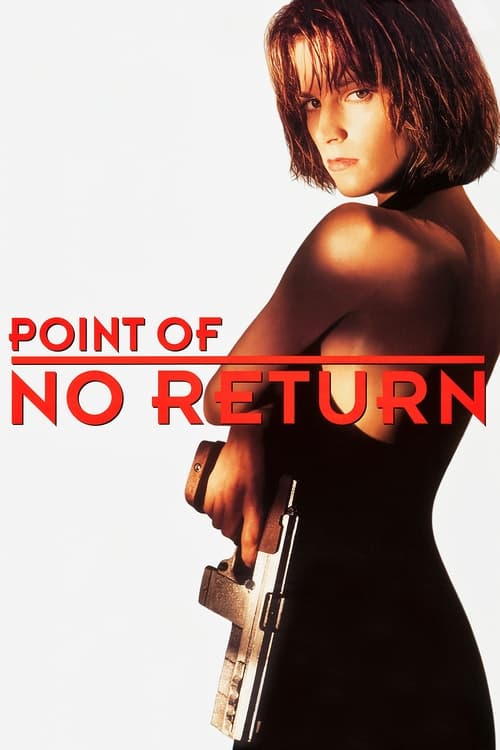
Point of No Return (1993)
Directed by John Badham
No — Point of No Return is not woke, scoring 8 out of 100 on our wokeness meter.
Point of No Return arrives in 1993 with a premise that had already been executed once, and better, by Luc Besson.
Consciousness Markers
The cast is led by Bridget Fonda with supporting turns from Lorraine Toussaint and Olivia D'Abo, but diversity is incidental to a 1993 genre picture rather than a deliberate representational statement.
A female assassin protagonist is notable for 1993, but the story frames her as a controlled asset shaped and managed by men, with no articulated feminist critique.
No LGBTQ+ characters, themes, or subtext appear anywhere in the film.
The Middle Eastern arms-dealer antagonist is a stock villain trope rather than any engagement with racial consciousness.
No environmental or climate themes are present.
The film is a government-assassin thriller with no economic critique or anti-capitalist messaging.
No body-positivity themes or messaging appear in the film.
No neurodivergence themes or characters are present.
The film is a straightforward genre remake with no historical revisionism.
The film delivers its premise as pure action-thriller entertainment with no moralizing or preachy messaging.
Why it received this score
Point of No Return arrives in 1993 with a premise that had already been executed once, and better, by Luc Besson. Bridget Fonda plays Maggie Hayward, a convicted cop killer pulled from the lethal injection table by a clandestine agency that fakes her death and rebuilds her as a contract assassin. She learns posture, cutlery, and computer terminals. She kills a man in a restaurant and escapes down a laundry chute. It is brisk, competent, and entirely content to be a genre picture. The film has no interest in interrogating the arrangement at its center, in which a woman is owned, trained, and deployed by men who regard her as equipment. That arrangement is simply the plot.
The supporting cast includes Lorraine Toussaint and Olivia D'Abo, and the presence of a Black actress and a woman in operational roles registers as ordinary 1993 casting practice, not as a statement. The antagonist is an Iranian arms magnate, a stock figure of the era's villain economy, offered without a syllable of reflection. Nina Simone's recordings thread through the soundtrack, a choice that flatters the film's taste without asking anything of its conscience. Anne Bancroft's etiquette coach is a pleasant turn. None of it accumulates into an argument.
The film's omissions instruct as much as its inclusions. There is no sermon on the prison system that produced Maggie, no reckoning with the economics of the military-industrial apparatus that employs her, no environmental anxiety, no meditation on embodiment, no neurological taxonomy. The screenplay delivers its premise and gets out of the way. Roger Ebert noted a persistent deja vu, and he was right, though the sensation comes from fidelity to the source. This is a well-made thriller about a woman with a gun and a handler with a clipboard. It asks nothing of the audience beyond attention, and in 1993 that was still considered sufficient.
Analysis generated by our Consciousness Algorithm
Part of


Synopsis
Hardened criminal Maggie Hayward's consistent violence, even in police custody, ends in the execution chamber. However, top-secret US government agent 'Bob' arranges a staged death, so Maggie can be elaborately trained as a phantom killer and subdued into obedience.
Questions about Point of No Return
Is Point of No Return woke?
No — Point of No Return is not woke, scoring 8 out of 100 on our wokeness meter. That earns it a verdict of Ultra Based.
Does Point of No Return have any woke elements?
Very few. None of the 10 markers reaches 30, the level where a marker counts as present; the highest is Feminist Agenda at 15.
How does Point of No Return compare to other 1993 movies?
It ranks #37 of the 97 films from 1993 we've scored; their average is 11. The wokest is Bound by Honor (60).
How is the Woke Score calculated?
An AI-assisted process researches the film and its reception, scores it 0–100 on ten markers, then combines those into one 0–100 Woke Score. It measures a specific set of 2020s cultural themes, not film quality.