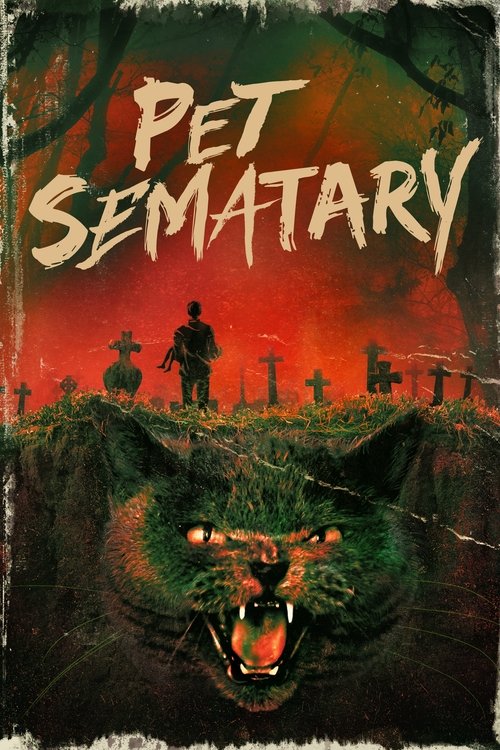
Pet Sematary (1989)
Directed by Mary Lambert
No — Pet Sematary is not woke, scoring 8 out of 100 on our wokeness meter.
Pet Sematary arrives from 1989, a year when a horror film could still be about a man digging up his own child and nothing else.
Consciousness Markers
The cast is overwhelmingly white, with Kavi Raz as the lone notable minority in a small supporting role. A woman director (Mary Lambert) is a mild distinction for 1989 horror, but the film makes no representational statement.
Mary Lambert directed, which was unusual for the genre, but the film's content is a straightforward grief-and-resurrection horror with no feminist argument or commentary.
No LGBTQ+ characters, themes, or subtext of any kind appear in the film.
The Mi'kmaq burial ground is deployed as the classic 'ancient Indian burial ground' horror trope, a device of menace rather than any racial consciousness or critique.
No environmental or climate themes are present; the woods and highway serve purely as instruments of dread.
No economic critique or class commentary; the Creed family's affluence is incidental backdrop.
Zelda's deformity is used for shock and revulsion, the opposite of any body-positive framing.
No neurodivergent characters or themes are explored.
The film is a faithful adaptation of King's novel with no historical revisionism.
The film delivers scares rather than sermons; there is no moralizing or didactic messaging.
Why it received this score
Pet Sematary arrives from 1989, a year when a horror film could still be about a man digging up his own child and nothing else. Mary Lambert directs with a music-video veteran's eye for the striking image, and she remains a modest curiosity in the genre's history: a woman behind the camera on a Paramount horror picture, hired on the strength of her Madonna videos. That fact earns a footnote at most. The film itself makes no argument of any kind about it.
The cast is white, rural, and unbothered by the question. Kavi Raz appears briefly as a colleague and is gone. The ancient Mi'kmaq burial ground functions exactly as the trope demands, a source of menace rather than a people with a history. Zelda, the dying sister, is realized by casting a grown man in the role and dressing the result in prosthetics designed to repel. The film wants us to recoil from her body, and we do. No counterargument is offered, and none is sought.
What remains is grief, and the awful arithmetic of refusing to accept it. Louis Creed buries his son, then his wife, and the film watches him do it without a single lesson attached. There is no economic critique in the Creed family's comfortable Maine life, no environmental lament in the trucks that keep killing, no vocabulary of identity anywhere in the script. Fred Gwynne says "sometimes, dead is better" and means it as a warning. The Ramones play over the credits. It is a nasty, efficient machine for scaring people, and it has no interest whatsoever in improving them.
Analysis generated by our Consciousness Algorithm
Part of


Synopsis
After the Creed family's cat is accidentally killed, a friendly neighbor advises its burial in a mysterious nearby cemetery.
Questions about Pet Sematary
Is Pet Sematary woke?
No — Pet Sematary is not woke, scoring 8 out of 100 on our wokeness meter. That earns it a verdict of Ultra Based.
Does Pet Sematary have any woke elements?
Very few. None of the 10 markers reaches 30, the level where a marker counts as present; the highest is Representation Casting at 15.
How does Pet Sematary compare to other 1989 movies?
It ranks #28 of the 68 films from 1989 we've scored; their average is 10. The wokest is Do the Right Thing (72).
How is the Woke Score calculated?
An AI-assisted process researches the film and its reception, scores it 0–100 on ten markers, then combines those into one 0–100 Woke Score. It measures a specific set of 2020s cultural themes, not film quality.