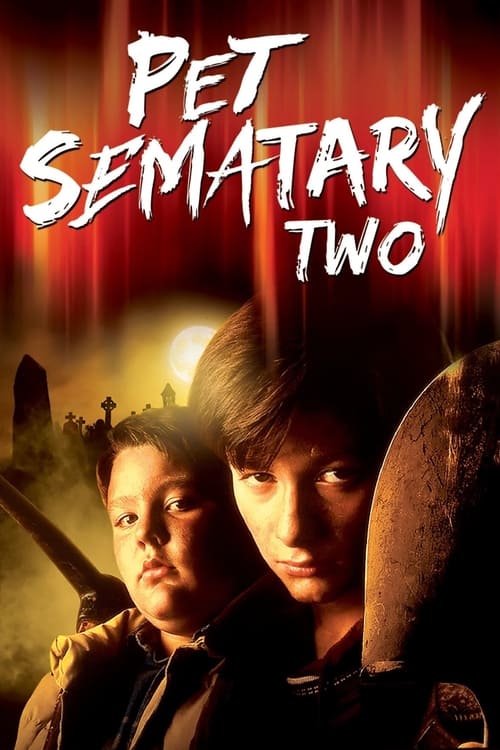
Pet Sematary II (1992)
Directed by Mary Lambert
No — Pet Sematary II is not woke, scoring 4 out of 100 on our wokeness meter.
Three years after the first film, Mary Lambert returns to direct a sequel that Paramount wanted and Stephen King quietly declined to endorse, his name removed before release.
Consciousness Markers
The film is directed by a woman, Mary Lambert, and features a powerful, albeit undead, female character (Renee) who asserts her own violent agency.
The film utilizes standard 1990s horror casting, featuring a white teenage protagonist and supporting cast, with no notable efforts toward diverse representation.
The plot references a Mi'kmaq Indian burial ground, but this is used purely as a supernatural plot device rather than for genuine racial commentary or consciousness.
There are no discernible LGBTQ+ themes, characters, or subtext present in the narrative or character development.
The film contains no commentary, imagery, or thematic elements related to environmentalism or climate change.
The central conflicts are rooted in supernatural horror, personal tragedy, and abuse, not systemic economic critique or anti-capitalist messaging.
There is no focus on body image, diverse body types, or body-positive messaging within the film's scope.
No characters are portrayed with neurodivergent traits or conditions.
The film deals with supernatural legends and personal tragedy, not the revision of established human or political history.
As a horror film, its primary goal is suspense and terror, not didactic social commentary or lecturing the audience on modern social issues.
Why it received this score
Three years after the first film, Mary Lambert returns to direct a sequel that Paramount wanted and Stephen King quietly declined to endorse, his name removed before release. The studio reportedly balked at a teenage girl in the lead, so Edward Furlong, newly famous from Terminator 2, was installed as Jeff Matthews, a boy relocated to Ludlow, Maine, where the local burial ground still raises the dead. The premise is a machine, and the machine runs on grief, abuse, and a sheriff who shoots a dog. The film is not subtle about any of this, nor does it need to be.
The progressive sensibilities on display are faint and largely structural. A woman directs, and the undead Renee is granted genuine violent agency before she burns, though the screenplay never organizes itself around that fact. The Mi'kmaq burial ground reappears as a device for resurrection, carrying no racial argument. Casting follows the 1992 horror playbook without comment. There is no LGBTQ content, no economic critique, no environmental concern, no body-image discourse, no neurodivergent characterization, and no revision of the historical record. The film has no sermon to deliver and no audience to instruct. It wants to unsettle us and then send us home.
Clancy Brown skins rabbits, mauls a bicycle, and rampages through the back half with real menace. Critics were unkind at the time; Dave Kehr used the occasion to make a remark about women and violence that reflects poorly on him and not on Lambert. A cult following has since formed. The film is crude, mean, and occasionally effective, and it makes no claim to moral instruction. We classify it accordingly, with the mild fatigue such an exercise always produces. Dead is better, the film insists. It is not wrong about the sequel.
Thematic tags: sequel, remake (no), book adaptation (no). Final: ["sequel"].
{"review": "Three years after the first film, Mary Lambert returns to direct a sequel that Paramount wanted and Stephen King quietly declined to endorse, his name removed before release. The studio reportedly balked at a teenage girl in the lead, so Edward Furlong, newly famous from Terminator 2, was installed as Jeff Matthews, a boy relocated to Ludlow, Maine, where the local burial ground still raises the dead. The premise is a machine, and the machine runs on grief, abuse, and a sheriff who shoots a dog. The film is not subtle about any of this, nor does it need to be.
The progressive sensibilities on display are faint and largely structural. A woman directs, and the undead Renee is granted genuine violent agency before she burns, though the screenplay never organizes itself around that fact. The Mi'kmaq burial ground reappears as a device for resurrection, carrying no racial argument. Casting follows the 1992 horror playbook without comment. There is no LGBTQ content, no economic critique, no environmental concern, no body-image discourse, no neurodivergent characterization, and no revision of the historical record. The film has no sermon to deliver and no audience to instruct. It wants to unsettle us and then send us home.
Clancy Brown skins rabbits, mauls a bicycle, and rampages through the back half with real menace. Critics were unkind at the time; Dave Kehr used the occasion to make a remark about women and violence that reflects poorly on him and not on Lambert. A cult following has since formed. The film is crude, mean, and occasionally effective, and it makes no claim to moral instruction. We classify it accordingly, with the mild fatigue such an exercise always produces. Dead is better, the film insists. It is not wrong about the sequel.", "thematic_tags": ["sequel"]}
Analysis generated by our Consciousness Algorithm
Part of


Synopsis
The "sematary" is up to its old zombie-raising tricks again. This time, the protagonists are Jeff Matthews, whose mother died in a Hollywood stage accident, and Drew Gilbert, a boy coping with an abusive stepfather.
Questions about Pet Sematary II
Is Pet Sematary II woke?
No — Pet Sematary II is not woke, scoring 4 out of 100 on our wokeness meter. That earns it a verdict of Ultra Based.
Does Pet Sematary II have any woke elements?
Very few. None of the 10 markers reaches 30, the level where a marker counts as present; the highest is Feminist Agenda at 10.
How does Pet Sematary II compare to other 1992 movies?
It ranks #52 of the 74 films from 1992 we've scored; their average is 12. The wokest is The Crying Game (62).
How is the Woke Score calculated?
An AI-assisted process researches the film and its reception, scores it 0–100 on ten markers, then combines those into one 0–100 Woke Score. It measures a specific set of 2020s cultural themes, not film quality.