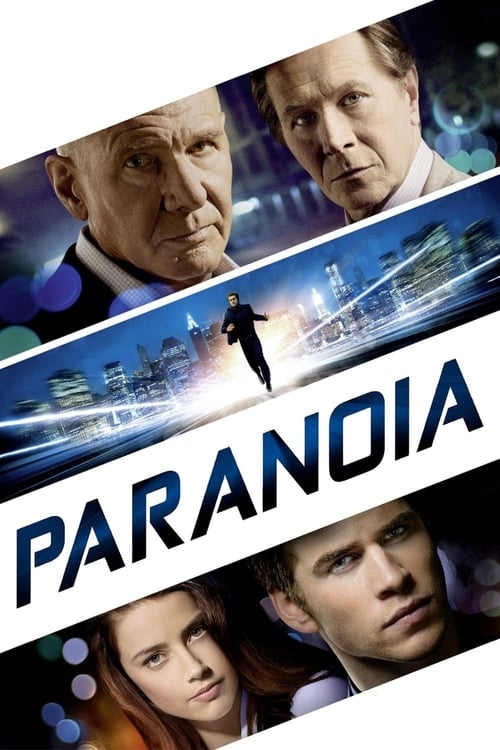
Paranoia (2013)
Directed by Robert Luketic
No — Paranoia is not woke, scoring 7 out of 100 on our wokeness meter.
Paranoia arrives in 2013 as a corporate espionage thriller assembled from parts so familiar they might have been ordered from a catalog.
Consciousness Markers
The plot centers on duplicitous corporate titans (Ford and Oldman) destroying each other for profit, and the hero ultimately renounces big business to found a scrappy Brooklyn startup; a mild anti-corporate streak, but framed as individual villainy rather than systemic critique.
The cast is overwhelmingly white with the few non-white performers (Angela Sarafyan, Nickson Ruto) in incidental supporting roles; no diversity-driven casting imperative is evident.
Amber Heard's Emma Jennings holds a marketing director title, but she exists chiefly as a romantic target whose thumbprint is exploited by the hero; her agency is entirely instrumental to Adam's scheme.
The film is content to be a slick genre exercise and never pauses to deliver social messaging or moral instruction.
No LGBTQ+ characters, themes, or subtext of any kind appear in this corporate espionage thriller.
No engagement with racial politics, systemic racism, or racial identity; the corporate villainy is colorblind in the most literal sense.
No environmental themes whatsoever.
No body positivity themes; the cast is uniformly conventionally attractive and physique is never addressed.
No neurodivergent characters or themes.
No historical revisionism; the film is a contemporary corporate thriller.
Why it received this score
Paranoia arrives in 2013 as a corporate espionage thriller assembled from parts so familiar they might have been ordered from a catalog. Liam Hemsworth plays Adam Cassidy, a bright young inventor who is fired, blackmailed, and then installed as a spy inside a rival firm run by Harrison Ford. Gary Oldman glowers from the other corner of the boardroom. Two titans of industry destroy each other over a prototype. The film treats this as tragedy, though mostly it plays as a showroom for glass elevators.
The picture's progressive credentials are thin to the point of transparency. The cast is white in the way that studio casting often was, with Angela Sarafyan and Nickson Ruto drifting through incidental roles and little else. Amber Heard's Emma holds a marketing director title, but the screenplay assigns her one job: to be kissed, then betrayed, then kissed again. Her thumbprint, lifted from a spoon, becomes the key to the vault. She is a credential, not a character. No other social currents stir here. No racial reckoning, no environmental worry, no inquiry into bodies or minds that deviate from the glossy norm. Even the corporate critique stays personal. The villains are bad men, not a bad system, and the hero's reward is a scrappy Brooklyn startup, which is the gentlest possible rebuke to the boardroom.
What remains is craft without conviction. The film never stops to instruct us, which is a small mercy, and it never asks us to feel anything beyond the mild tension of a stolen phone. Critics were unkind. Audiences shrugged. The whole enterprise suggests a movie made by people who had seen other movies and assumed that was sufficient. It was not.
Analysis generated by our Consciousness Algorithm


Synopsis
An entry-level employee at a powerful corporation finds himself occupying a corner office, but at a dangerous price—he must spy on his boss's old mentor to secure for him a multi-billion dollar advantage.
Questions about Paranoia
Is Paranoia woke?
No — Paranoia is not woke, scoring 7 out of 100 on our wokeness meter. That earns it a verdict of Ultra Based.
Does Paranoia have any woke elements?
Very few. None of the 10 markers reaches 30, the level where a marker counts as present; the highest is Eat the Rich at 22.
How does Paranoia compare to other 2013 movies?
It ranks #173 of the 274 films from 2013 we've scored; their average is 14. The wokest is Belle (76).
How is the Woke Score calculated?
An AI-assisted process researches the film and its reception, scores it 0–100 on ten markers, then combines those into one 0–100 Woke Score. It measures a specific set of 2020s cultural themes, not film quality.