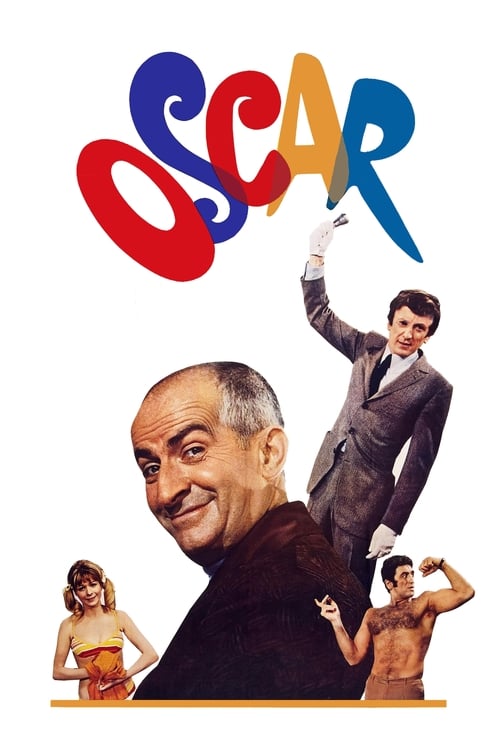
Oscar (1967)
Directed by Édouard Molinaro
No — Oscar is not woke, scoring 0 out of 100 on our wokeness meter.
Édouard Molinaro's Oscar arrived in 1967, adapted from Claude Magnier's stage play, and it concerns itself with a single catastrophic day in the life of Bertrand Barnier, an industrialist played by Louis de Funès with the twitchy grandeur of a man whose nervous system has declared independence.
Consciousness Markers
The cast is entirely white French performers of the era, with no diversity casting or commentary on representation.
No LGBTQ+ characters, themes, or subtext appear anywhere in this farce of mistaken identities and marriage plots.
The daughter is a bargaining chip in her father's schemes, but the film plays this for comedy rather than advancing any feminist critique; the women are largely plot devices.
No engagement with race, racism, or racial identity whatsoever.
No environmental or climate themes present.
A wealthy industrialist is swindled, but the film treats fraud and money as farcical mechanics, not as a critique of capitalism or class.
No body-positive themes or messaging; physical comedy is the only bodily concern.
No neurodivergent characters or themes.
No historical revisionism; the film is a contemporary (1960s) domestic comedy.
A pure comedy of errors with no didactic or preachy messaging; it aims only to amuse.
Why it received this score
Édouard Molinaro's Oscar arrived in 1967, adapted from Claude Magnier's stage play, and it concerns itself with a single catastrophic day in the life of Bertrand Barnier, an industrialist played by Louis de Funès with the twitchy grandeur of a man whose nervous system has declared independence. An accountant named Christian Martin has embezzled sixty million francs, then demands a raise and a vice-presidency to keep quiet. A daughter is pregnant, or says she is. A masseur is offered a bride. A suitcase full of jewels is swapped, repeatedly, with a suitcase full of clothes. That is the entire apparatus, and it runs like a Swiss watch wound too tight.
The film is a machine for producing laughter, and it has no other ambition. Barnier's daughter Colette exists to be bargained over, passed from suitor to suitor like the suitcase itself, and the screenplay treats this as a structural convenience, not a grievance. Money is swindled, fortunes reverse, and nobody pauses to reflect on the ethics of accumulation. The industrialist is fleeced by his own employees and we are invited to enjoy it as farce, not as indictment. There is no lesson waiting at the end, no moment where a character turns to the lens and explains how we ought to live. The cast is French, white, and entirely of its moment, and the film never once stops to consider who is missing from the room.
An English-language version followed in 1991 under John Landis, with Sylvester Stallone, which is its own kind of cultural artifact. What remains of the original is craftsmanship: mime, timing, the exquisite misery of a man watching his affairs collapse in real time. We classify it, therefore, as a clean specimen. Zero instructional content. Zero sermonizing. It wants only to amuse, and it does, which in the present climate feels almost reckless.
Analysis generated by our Consciousness Algorithm


Synopsis
This film originated as a play in Paris. The story focuses on the one-day adventures of Bertrand Barnier played with a genius of French cinema, Louis de Funes. In the same morning he learns that his daughter is pregnant, an employee stole a large amount of money from his company, his maid is about to resign in order to marry a wealthy neighbor and his body builder is interested in marrying his daughter. The seemingly complicated story-line is full of comedy or errors and some of the most hilarious mime scenes of the French cinema.
Questions about Oscar
Is Oscar woke?
No — Oscar is not woke, scoring 0 out of 100 on our wokeness meter. That earns it a verdict of Ultra Based.
Does Oscar have any woke elements?
No. All 10 markers score zero.
How does Oscar compare to other 1967 movies?
It ranks #15 of the 19 films from 1967 we've scored; their average is 10. The wokest is In the Heat of the Night (60).
How is the Woke Score calculated?
An AI-assisted process researches the film and its reception, scores it 0–100 on ten markers, then combines those into one 0–100 Woke Score. It measures a specific set of 2020s cultural themes, not film quality.