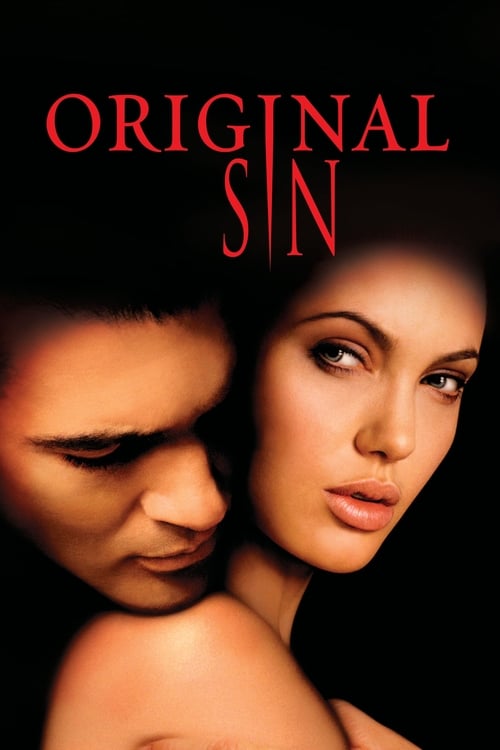
Original Sin (2001)
Directed by Michael Cristofer
No — Original Sin is not woke, scoring 0 out of 100 on our wokeness meter.
"Original Sin" arrives in 2001 as a sweaty, gorgeous, deeply silly piece of work, drawn from Cornell Woolrich's 1947 novel Waltz into Darkness, in which Antonio Banderas plays a Cuban coffee magnate who orders a bride from Delaware and receives Angelina Jolie instead.
Consciousness Markers
No deliberate inclusive or diverse casting. The leads are established white/European stars, and the Cuban setting is not used to showcase underrepresented actors.
No LGBTQ+ themes, characters, or subtext are present in the film.
The femme fatale trope is deployed for erotic thriller purposes, not as a feminist statement or critique of patriarchy.
The film is set in colonial Cuba but does not engage with racial inequality, colonialism, or racial identity as themes.
No environmental or climate-related themes appear in the film.
No critique of capitalism, wealth inequality, or class struggle is present.
No body positivity themes or challenges to conventional beauty standards are present.
No neurodivergent characters or themes are depicted.
The historical Cuban setting is purely backdrop for a fictional melodrama, with no revisionist historical narrative.
The film does not preach or deliver social or political lectures to the audience.
Why it received this score
"Original Sin" arrives in 2001 as a sweaty, gorgeous, deeply silly piece of work, drawn from Cornell Woolrich's 1947 novel Waltz into Darkness, in which Antonio Banderas plays a Cuban coffee magnate who orders a bride from Delaware and receives Angelina Jolie instead. She is not who she claims. He is not who he claims. Neither is remotely trustworthy, and the film spends two hours watching them lie to each other with great enthusiasm and minimal clothing. Michael Cristofer directs as though the camera itself were perspiring.
The story unfolds in late nineteenth century Cuba under Spanish rule, which sounds like raw material for a searching look at colonial power, race, and empire. It is not. Cuba functions as wallpaper, a humid backdrop for stolen money and slow poison, and the closest the screenplay comes to a political thought is the observation that wealthy men own plantations. The con at the center is personal, not systemic. Jolie's Julia is a femme fatale in the classical mold, deployed for erotic suspense and nothing else. As the priest, the detective, and the bodies accumulate, the film offers no thesis beyond the suggestion that desire makes people stupid.
There is no lesson here, no sermon, no moment where a character turns to the audience to explain how they ought to feel about the world. That absence is, in its way, restful. The film's only agenda is getting Jolie and Banderas into a room together, and it pursues that agenda with the single-minded devotion of a much better movie. Ebert admired it. Most everyone else did not. The Razzie nomination stands. We are left with a lush, incoherent, entirely unserious melodrama whose cultural consciousness registers as a flat line. Some vintages are simply meant to be drunk quickly and forgotten.
Analysis generated by our Consciousness Algorithm


Synopsis
A young man is plunged into a life of subterfuge, deceit and mistaken identity in pursuit of a femme fatale whose heart is never quite within his grasp.
Questions about Original Sin
Is Original Sin woke?
No — Original Sin is not woke, scoring 0 out of 100 on our wokeness meter. That earns it a verdict of Ultra Based.
Does Original Sin have any woke elements?
No. All 10 markers score zero.
How does Original Sin compare to other 2001 movies?
It ranks #128 of the 148 films from 2001 we've scored; their average is 12. The wokest is Monster's Ball (60).
How is the Woke Score calculated?
An AI-assisted process researches the film and its reception, scores it 0–100 on ten markers, then combines those into one 0–100 Woke Score. It measures a specific set of 2020s cultural themes, not film quality.