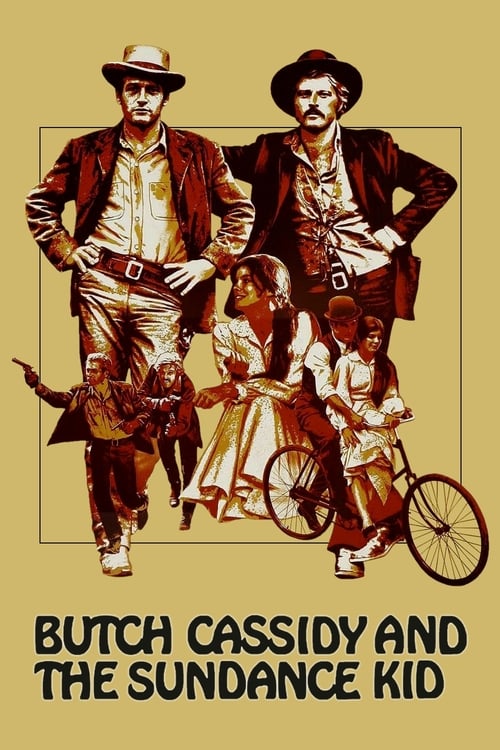
Butch Cassidy and the Sundance Kid (1969)
Directed by George Roy Hill
No · Ultra Based
How we score movies →Consciousness Markers
While the protagonists are criminals who reject conventional law, the film romanticizes their pursuit of wealth and treats capitalism as backdrop rather than systemic critique.
Katharine Ross portrays an independent schoolteacher, yet her character primarily serves the narrative needs of the male leads rather than pursuing her own agency or arc.
The cast consists entirely of white actors in all significant roles. Etta Place represents the only female character of note, and she exists primarily in relation to the male leads.
The film presents a romanticized version of outlaw history that prioritizes entertainment over historical accuracy, though it does not actively rewrite history with modern sensibilities.
No LGBTQ+ themes or representation present. The film focuses exclusively on heterosexual romantic and male-bonding dynamics.
The film shows no consciousness of racial dynamics. Latin American characters appear as background elements, and the story contains no engagement with colonial or racial themes.
Climate themes are entirely absent from this period crime drama set in the 1890s.
No body positivity themes are present. The film focuses on traditionally attractive leading men without commentary on physical appearance or diversity.
Neurodivergence is not addressed or represented in any meaningful way.
The film contains no preachy elements or moralizing. It presents its story as entertainment without attempting to educate or lecture the audience on social issues.


Synopsis
As the west rapidly becomes civilized, a pair of outlaws in 1890s Wyoming find themselves pursued by a posse and decide to flee to South America in hopes of evading the law.
Why it received this score
Butch Cassidy and the Sundance Kid arrives as a Western that has aged into something approaching historical curiosity rather than cultural artifact. The film presents its outlaws with considerable charm and humor, positioning them as sympathetic rogues fleeing an encroaching civilization. This antihero narrative was progressive for its moment, though not in the manner modern audiences might expect. The central relationship between Newman and Redford occupies most of the film's emotional real estate, leaving little room for complex characterization of anyone else. Katharine Ross appears as Etta Place, a schoolteacher and romantic interest whose primary function remains supporting the male leads through their exploits and eventual downfall.
The film's engagement with historical realities proves minimal. The depiction of South America and Latin American characters functions as mere backdrop, with the narrative showing no consciousness of colonial extraction or indigenous perspectives. The story treats the pursuit of wealth and escape from law enforcement as fundamentally romantic instead of examining the systems these men operate within. What emerges is a carefully constructed aesthetic of masculine charm and period detail, all in service of making crime entertaining.
By contemporary measures of cultural representation, this film registers as a product of its era. The cast is uniformly white, the supporting female character exists primarily in relation to male desires, and the treatment of non-American settings reflects the casual dismissal typical of 1960s Hollywood. None of this renders the film immoral or poorly made, but it does locate it firmly in a period before modern progressive sensibilities became incorporated into mainstream filmmaking. The picture succeeds entirely on its own terms as entertainment, which is precisely what it aimed to be.
Analysis generated by our Consciousness Algorithm
Critic Reviews
“Note-perfect performances, a screenplay steeped in both nostalgia and a timely sense of insight, and anti-heroes you can't help but love.”
“It's hard to imagine now just how astonishing it was to interrupt the action with a sun-lit frolic on a new-fangled bicycle as the whimsical Raindrops Keep Fallin' on My Head burbles away in the background.”
“It is a great film and will be an exceptionally popular and profitable one. ”
“Every character, every scene, is marred by the film's double view, which oscillates between sympathy and farce.”