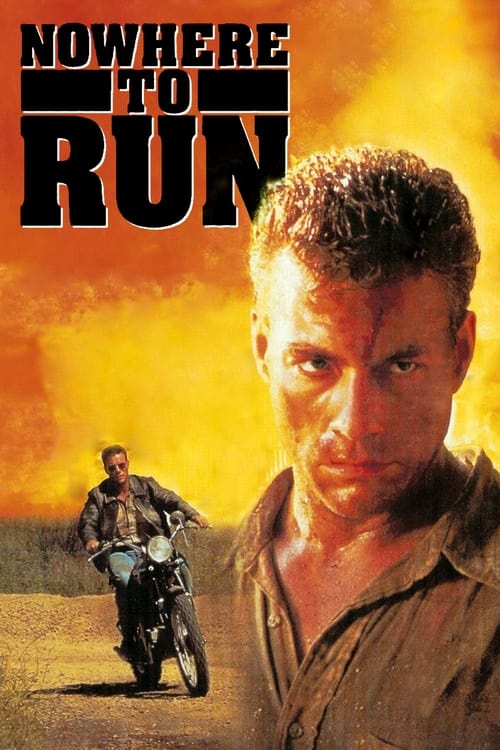
Nowhere to Run (1993)
Directed by Robert Harmon
No — Nowhere to Run is not woke, scoring 2 out of 100 on our wokeness meter.
The prevailing sensibility of this 1993 action piece feels like a cultural artifact from a time when social commentary was reserved for the background noise of a gunfight.
Consciousness Markers
The antagonist is a corrupt real estate developer scheming to seize a widow's land, a stock 'evil developer' trope that carries mild eat-the-rich flavor without any systemic critique.
Clydie owns and defends her land, but she is fundamentally a damsel whose crisis is resolved by a male savior; no feminist framework is present.
The cast is uniformly white, led by Jean-Claude Van Damme, Rosanna Arquette, and Joss Ackland, with no diverse casting choices made or commented upon.
There are no LGBTQ+ characters, themes, or subtext anywhere in this 1993 action programmer.
Race is entirely absent as a subject; the conflict is purely a land dispute between white characters.
The villain's oil-dumping and land development are personal villainy, not an environmentalist message.
The film trades on Van Damme's chiseled physique as conventional action-star eye candy, the opposite of body-positivity messaging.
No neurodivergent characters or themes appear.
The film is a contemporary fictional thriller with no historical subject matter to revise.
This is a straightforward action-revenge vehicle with no preachy monologues or moral instruction.
Why it received this score
The prevailing sensibility of this 1993 action piece feels like a cultural artifact from a time when social commentary was reserved for the background noise of a gunfight. We find ourselves in a landscape where the primary conflict is a straightforward skirmish between a wandering fugitive and a corrupt developer. The thematic engagement with societal structures is almost non-existent, a stark contrast to modern cultural mandates. The narrative offers no examination of contemporary social anxieties, instead relying on the classic trope of a powerful man protecting a fragile homestead. The attempt at an anti-capitalist framework is merely the standard cinematic depiction of a bad businessman, a trope that lacks any real systemic critical weight.
We observe a remarkably uniform lack of progressive sensibilities across the entire production. The cast is entirely homogeneous, presenting a visual tapestry of conventional action stardom without any consideration for diverse representation. LGBTQ+ identities, racial consciousness, and even modern discussions of body positivity are entirely absent from the story. The female characters, while possessing agency in defending their property, remain fundamentally defined by their relationships with the male protagonists, offering little deviation from a traditional damsel archetype. The director commits to the genre completely, delivering a pure revenge vehicle without resorting to heavy-handed social instruction. It is a film that does not ask us to rethink the status quo, which is perhaps its most telling characteristic.
This film functions solely as a kinetic exercise in avoidance. It avoids historical revision, environmental messages, or any deep dive into neurodivergent experience. We receive a predictable plot of a fugitive seeking peace and finding love amidst land disputes. It is a straightforward piece of escapism, designed for a specific demographic. While it achieves its goal as a pulse-pounding thriller, its complete lack of contemporary cultural awareness renders it somewhat inert as a piece of modern cinematic discourse. We are left with a loud, competent exercise in the action formula, offering nothing that challenges the audience to consider the world beyond the next confrontation.
Analysis generated by our Consciousness Algorithm


Synopsis
Escaped convict Sam Gillen single-handedly takes on ruthless developers who are determined to evict a widow with two young children.
Questions about Nowhere to Run
Is Nowhere to Run woke?
No — Nowhere to Run is not woke, scoring 2 out of 100 on our wokeness meter. That earns it a verdict of Ultra Based.
Does Nowhere to Run have any woke elements?
Very few. None of the 10 markers reaches 30, the level where a marker counts as present; the highest is Eat the Rich at 20.
How does Nowhere to Run compare to other 1993 movies?
It ranks #69 of the 97 films from 1993 we've scored; their average is 11. The wokest is Bound by Honor (60).
How is the Woke Score calculated?
An AI-assisted process researches the film and its reception, scores it 0–100 on ten markers, then combines those into one 0–100 Woke Score. It measures a specific set of 2020s cultural themes, not film quality.