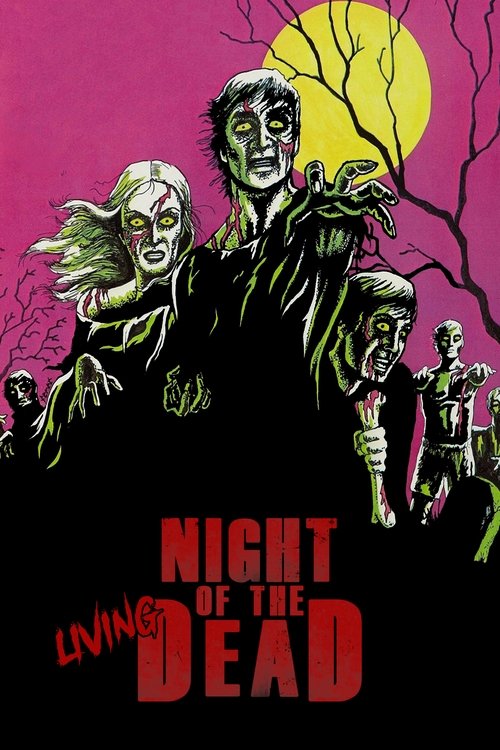
Night of the Living Dead (1968)
Directed by George A. Romero
No — Night of the Living Dead is not especially woke, scoring 27 out of 100 on our wokeness meter.
George Romero's Night of the Living Dead arrives from 1968 with a budget near one hundred thousand dollars, a rented farmhouse scheduled for demolition, and chocolate syrup standing in for blood.
Consciousness Markers
Duane Jones, a Black actor, was cast as the lead hero Ben in a predominantly white cast in 1968, a rare and historically significant choice for American cinema. The script was not altered to comment on his race, but the casting itself remains a landmark of representation.
The film does not explicitly discuss race, but the casting of a Black lead and his killing by a white posse have invited enduring racial readings. This subtext is retrospective rather than an overt theme.
No LGBTQ+ characters, themes, or subtext are present in the film.
Female characters are largely passive, traumatized, or killed; the film offers no feminist critique or agenda.
No environmental or climate-related themes appear in the film.
The film contains no critique of capitalism, wealth inequality, or class exploitation.
No body-positive themes or messaging are present.
No neurodivergent characters or themes are depicted.
The film is not a historical narrative and does not revise or reinterpret historical events.
The film is a straightforward horror narrative and does not lecture or preach to the audience.
Why it received this score
George Romero's Night of the Living Dead arrives from 1968 with a budget near one hundred thousand dollars, a rented farmhouse scheduled for demolition, and chocolate syrup standing in for blood. The ghouls shuffle, the survivors bicker in a cellar, and the whole enterprise carries the texture of a regional commercial shoot that escaped its handlers. It also carries Duane Jones, a Black actor placed at the center of a predominantly white cast as the capable, level-headed Ben, a choice that was rare in American cinema of the period. That is the film's one live wire on our ledger. The script was never rewritten to remark upon his race, and Romero maintained that Jones simply gave the best audition. The casting stands on its own, quiet and structural.
Ben's killing by a white posse in the final minutes has drawn decades of racial reading. The film never says the word. Scholars supply the meaning after the fact, and that retrospective quality is why the racial register scores as subtext rather than text. Everything else on the ledger sits at zero, and it sits there honestly. Barbra spends the picture catatonic before her undead brother drags her into the horde. No feminist argument is made, and none is attempted. The ghouls are not a metaphor for capital, nor for the climate, nor for anything the film troubles to name. Radiation from a returning space probe is offered as the cause, a science fiction convenience with no sermon attached. There are no LGBTQ themes, no body-positive messaging, no neurodivergent characters, no revisionist history, and no lecturing.
What remains is a lean and enormously influential horror picture that earned its reputation through craft, timing, and an appetite for gore that unsettled reviewers at the time. Its cultural weight comes from the documentary flatness of the photography and from that single casting decision, which did more than any speech could have. The film instructs nobody. It simply kills everyone, in order, and lets the audience sort through the remains. We file it as a landmark of the genre and a modest entry in the other columns.
Analysis generated by our Consciousness Algorithm
Part of


Synopsis
A ragtag group barricade themselves in an old Pennsylvania farmhouse to remain safe from a horde of flesh-eating ghouls ravaging the Northeast.
Questions about Night of the Living Dead
Is Night of the Living Dead woke?
No — Night of the Living Dead is not especially woke, scoring 27 out of 100 on our wokeness meter. That earns it a verdict of Based.
Does Night of the Living Dead have any woke elements?
2 of the 10 markers register at 30 or above, led by Representation Casting (70) and Racial Consciousness (40). On Representation Casting: Duane Jones, a Black actor, was cast as the lead hero Ben in a predominantly white cast in 1968, a rare and historically significant choice for American cinema.
How does Night of the Living Dead compare to other 1968 movies?
It is the wokest of the 23 films from 1968 we've scored; their average is 7.
Is Night of the Living Dead the most woke Living Dead movie?
No. It ranks #3 of the 4 Living Dead films we've scored; the wokest is Land of the Dead (36).