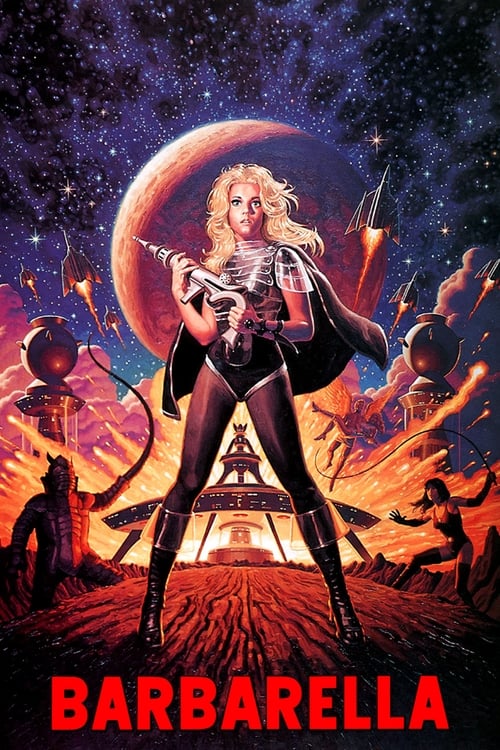
Barbarella (1968)
Directed by Roger Vadim
No — Barbarella is not woke, scoring 17 out of 100 on our wokeness meter.
Barbarella arrives from 1968 as a glossy bauble of space-age camp, a film more concerned with the curve of a plastic set than the arc of a moral argument.
Consciousness Markers
The film is overtly focused on the body and sexual spectacle, celebrating the physical form as a powerful, non-shameful entity.
Barbarella is a sexually autonomous figure who rejects societal norms, which was radical for 1968, but it does not engage with modern systemic feminist critiques.
The plot involves challenging a tyrannical regime and overthrowing an established order, offering a mild anti-establishment sentiment.
The cast is overwhelmingly white and the futuristic setting offers no meaningful exploration of diverse human or alien representation.
The film features highly stylized and often absurd sexual encounters, but they lack any specific or modern LGBTQ+ thematic development.
The film deals with alien races and futuristic societies, but offers no commentary on real-world racial dynamics or injustice.
The environmental concerns of the film are purely speculative and do not constitute a modern climate crusade.
No characters are defined or explored through the lens of neurodivergence.
As a pure science fiction fantasy, it does not attempt to revise or re-examine any real-world historical events.
The film is a visual spectacle and a campy adventure, lacking any didactic or lecture-style social commentary.
Why it received this score
Barbarella arrives from 1968 as a glossy bauble of space-age camp, a film more concerned with the curve of a plastic set than the arc of a moral argument. Its future is a playground of soft surfaces and stranger appetites, and its heroine drifts through it with a cheerful lack of agenda. The cast is almost entirely white, and the alien societies never become a mirror for real-world racial hierarchies. Whatever sexual politics the film possesses are rooted in an older bohemian impulse, not a contemporary systemic critique. Barbarella is sexually autonomous, curious, and unashamed, which carried a charge in its moment, yet the movie treats her freedom as a personal style instead of a political thesis. There is no modern LGBTQ framework here, no racial reckoning, no climate sermon, no neurological vocabulary. The film simply is not built to lecture.
Where the movie does show a pulse of rebellion, it is mild and theatrical. The city of Sogo is a tyrant's pleasure dome, and the underground rebels who oppose it give the plot a faint anti-establishment flavor. That flavor never sharpens into an economic argument. The body, by contrast, receives constant attention. Flesh is displayed, celebrated, and treated as a source of power and comedy, with shame nowhere in sight. This is not a modern body-positivity program. It is 1960s erotic spectacle, unburdened by guilt and happy to stare. Jane Fonda's performance keeps Barbarella innocent even when the production around her is leering, and the tension between her lightness and Vadim's ornamental instincts gives the film its odd, durable charm.
For a story about a weapon that could destroy humanity, Barbarella shows almost no interest in persuading anyone of anything. It wants to be a comic strip come to life, and it succeeds at that limited ambition. The result is a relic of a different cultural conversation, something that can be admired for its visual nerve and its refusal of shame without being mistaken for a blueprint of present-day social consciousness. It preaches nothing. It merely poses, and it poses beautifully. That may be the most honest thing about it.
Analysis generated by our Consciousness Algorithm


Synopsis
In the far future, a highly sexual woman is tasked with finding and stopping the evil Durand-Durand. Along the way she encounters various unusual people.
Questions about Barbarella
Is Barbarella woke?
No — Barbarella is not woke, scoring 17 out of 100 on our wokeness meter. That earns it a verdict of Ultra Based.
Does Barbarella have any woke elements?
2 of the 10 markers register at 30 or above, led by Body Positivity (40) and Feminist Agenda (30). On Body Positivity: The film is overtly focused on the body and sexual spectacle, celebrating the physical form as a powerful, non-shameful entity.
How does Barbarella compare to other 1968 movies?
It ranks #4 of the 23 films from 1968 we've scored; their average is 7. The wokest is Night of the Living Dead (27).
How is the Woke Score calculated?
An AI-assisted process researches the film and its reception, scores it 0–100 on ten markers, then combines those into one 0–100 Woke Score. It measures a specific set of 2020s cultural themes, not film quality.