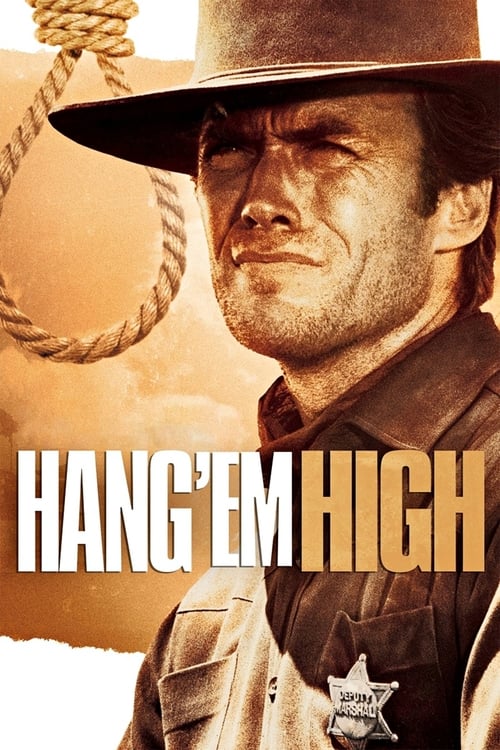
Hang 'em High (1968)
Directed by Ted Post
No — Hang 'em High is not woke, scoring 6 out of 100 on our wokeness meter.
Ted Post's Hang 'Em High arrives from 1968, a year when a lynching could still open a picture without a content warning and a man could be hanged twice before the first act resolved.
Consciousness Markers
Judge Fenton delivers speeches justifying hangings as a means of hastening statehood, and the film debates territorial justice, but the moralizing is dramatic rather than preachy modern sermonizing.
The film is a genre 'revisionist Western' and loosely mirrors the real 'Hanging Judge' Isaac Parker, but this is period-set genre deconstruction rather than modern ideological rewriting of history.
Inger Stevens' Rachel Warren is a widow with her own revenge quest against her husband's killers and rapists, giving her slightly more agency than a typical Western damsel, but the film remains a male-driven revenge narrative with no feminist argument.
The cast is entirely white, with no meaningful minority roles or representation casting choices. A 1968 Western with a conventional studio-era ensemble.
No LGBTQ+ characters, themes, or subtext of any kind appear in the film.
A character named Charlie Blackfoot exists, but the film engages no racial themes or commentary whatsoever.
No environmental or climate content is present.
The film concerns frontier justice, cattle rustling, and law enforcement, with no critique of capitalism or wealth.
No body positivity themes or body-diverse representation appear.
No neurodivergent characters or themes are depicted.
Why it received this score
Ted Post's Hang 'Em High arrives from 1968, a year when a lynching could still open a picture without a content warning and a man could be hanged twice before the first act resolved. Clint Eastwood plays Jed Cooper, wrongly strung up by nine vigilantes, rescued, deputized, and set loose to collect the men who did it. The cast is a wall of familiar studio faces, all of them white, none of them asked to carry a cultural argument. There is a character named Charlie Blackfoot, and the film does nothing with him beyond the name. The picture has no interest in the interior lives of anyone outside its hero's grudge.
Inger Stevens is the closest thing to a counterweight. Her Rachel Warren is a widow hunting the men who killed her husband and assaulted her, and she gets a scar of her own to nurse. That is more agency than the genre typically allowed a woman in 1968. It is still not an argument. She exists to heal the marshal and share his bed, and the film's engine remains one man's ledger of vengeance.
Where the film raises its voice, it does so through Pat Hingle's Judge Fenton, who hangs men to hurry Oklahoma toward statehood and lectures Cooper about the machinery of territorial law. The sermonizing is dramatic, rooted in character and period, not the sort of modern finger-wagging that assumes an audience in need of correction. The revisionist label attached to the picture refers to its deconstruction of Western myth, not to any rewriting of history for present-day comfort. The verdict, then, is a lean and efficient revenge Western with a conscience it keeps mostly to itself. The sommelier finds little to detain him. A dry vintage. Correct, serviceable, and ideologically unbothered by the present century.
A note on the year's temperatures: no climate anxiety, no body politics, no neurological self-examination, no critique of capital, no queer subtext, and no casting gesture toward a broader America. The frontier here is a closed set. It remains, for the sommelier's ledger, an honest bottle and nothing more.
{"thematic_tags": []}
Wait, I have appended a non-JSON fragment. Let me correct and return a single valid JSON object.
{"review": "Ted Post's Hang 'Em High arrives from 1968, a year when a lynching could still open a picture without a content warning and a man could be hanged twice before the first act resolved. Clint Eastwood plays Jed Cooper, wrongly strung up by nine vigilantes, rescued, deputized, and set loose to collect the men who did it. The cast is a wall of familiar studio faces, all of them white, none of them asked to carry a cultural argument. There is a character named Charlie Blackfoot, and the film does nothing with him beyond the name. The picture has no interest in the interior lives of anyone outside its hero's grudge.\n\nInger Stevens is the closest thing to a counterweight. Her Rachel Warren is a widow hunting the men who killed her husband and assaulted her, and she gets a scar of her own to nurse. That is more agency than the genre typically allowed a woman in 1968. It is still not an argument. She exists to heal the marshal and share his bed, and the film's engine remains one man's ledger of vengeance.\n\nWhere the film raises its voice, it does so through Pat Hingle's Judge Fenton, who hangs men to hurry Oklahoma toward statehood and lectures Cooper about the machinery of territorial law. The sermonizing is dramatic, rooted in character and period, not the sort of modern finger-wagging that assumes an audience in need of correction. The revisionist label attached to the picture refers to its deconstruction of Western myth, not to any rewriting of history for present-day comfort. The verdict, then, is a lean and efficient revenge Western with a conscience it keeps mostly to itself. The sommelier finds little to detain him. A dry vintage. Correct, serviceable, and ideologically unbothered by the present century.", "thematic_tags": []}
Analysis generated by our Consciousness Algorithm


Synopsis
Marshall Jed Cooper survives a hanging, vowing revenge on the lynch mob that left him dangling. To carry out his oath for vengeance, he returns to his former job as a lawman. Before long, he's caught up with the nine men on his hit list and starts dispensing his own brand of Wild West justice.
Questions about Hang 'em High
Is Hang 'em High woke?
No — Hang 'em High is not woke, scoring 6 out of 100 on our wokeness meter. That earns it a verdict of Ultra Based.
Does Hang 'em High have any woke elements?
Very few. None of the 10 markers reaches 30, the level where a marker counts as present; the highest is Lecture Energy at 15.
How does Hang 'em High compare to other 1968 movies?
It ranks #9 of the 23 films from 1968 we've scored; their average is 7. The wokest is Night of the Living Dead (27).
How is the Woke Score calculated?
An AI-assisted process researches the film and its reception, scores it 0–100 on ten markers, then combines those into one 0–100 Woke Score. It measures a specific set of 2020s cultural themes, not film quality.