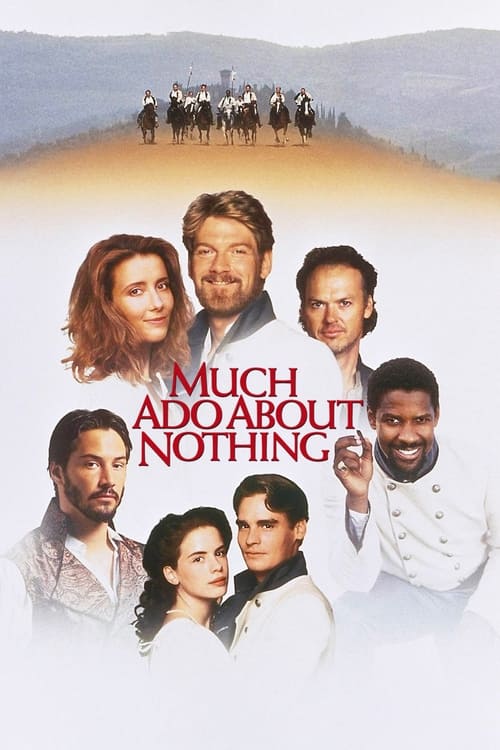
Much Ado About Nothing (1993)
Directed by Kenneth Branagh
No — Much Ado About Nothing is not especially woke, scoring 22 out of 100 on our wokeness meter.
Kenneth Branagh's 1993 adaptation of Much Ado About Nothing arrives as a sun-drenched Tuscan idyll, all linen and lute music, and it remains one of the more agreeable Shakespeare films ever assembled.
Consciousness Markers
The production's most notable modern marker is its deliberate non-traditional casting, placing Denzel Washington as Don Pedro, Prince of Aragon, in an otherwise period-faithful Shakespeare ensemble.
Beatrice is a sharp-tongued, strong-willed woman who out-wits the men around her, but this is Shakespeare's own 1598 characterization rather than an imposed modern feminist agenda.
The colorblind casting of a Black actor as a prince carries a mild representational charge, but the film engages no racial themes or commentary whatsoever.
The film is an exuberant romantic comedy that prioritizes accessibility and fun over moral instruction; any didacticism is Shakespeare's, not the director's.
No LGBTQ+ characters, themes, or subtext are present; the romantic plotting is entirely heterosexual.
No environmental or climate content of any kind.
No economic critique or class-based messaging; the concerns are courtship, honor, and mistaken identity.
No body-image or body-acceptance themes.
Dogberry's malapropistic bumbling is played purely for farce, not as any neurodivergence advocacy or representation.
A faithful, text-respecting adaptation of the play with no historical revisionism.
Why it received this score
Kenneth Branagh's 1993 adaptation of Much Ado About Nothing arrives as a sun-drenched Tuscan idyll, all linen and lute music, and it remains one of the more agreeable Shakespeare films ever assembled. Branagh trims the text for pace, keeps the prose light on the ear, and lets his cast romp through the gardens of Villa Vignamaggio with an exuberance that critics at the time found contagious. The picture is a romantic comedy about courtship, honor, and mistaken identity. It has no other business on its mind.
The production's most visible concession to modern sensibilities is its casting. Denzel Washington plays Don Pedro, Prince of Aragon, a Black actor in a role written for an Elizabethan company, and the choice is made without comment or fuss. The film proceeds as though this were unremarkable, which in 1993 it was not, and the effect is a quiet representational charge rather than a statement. Emma Thompson's Beatrice supplies the other mild jolt. She is sharp-tongued and quick, out-witting the men around her at every turn, though this is Shakespeare's own 1598 invention and not an agenda smuggled in by the director. The romantic plotting is entirely heterosexual. There is no economic critique, no environmental concern, no meditation on the body or the mind's varied wiring. Michael Keaton's Dogberry bumbles through his malapropisms for laughs alone.
What remains is a film that trusts its source and its audience in equal measure. The pleasures here are Elizabethan, delivered with Italian sunshine and a composer's score. Branagh wants us to enjoy ourselves, and mostly we do. Any instruction the play offers is Shakespeare's, four centuries old and gently worn. The movie has the good sense not to lecture, and the wedding dances at the end ask nothing of us but a smile. It is a rare thing: a literary adaptation with no sermon in its pocket and no ledger to balance. The couples pair off, the villain is marched away, and Don Pedro stands alone, content. The camera pulls back. Nobody has been taught anything, and that is the point.
{"thematic_tags": ["book_adaptation"]}
Analysis generated by our Consciousness Algorithm


Synopsis
In this Shakespearean farce, Hero and her groom-to-be, Claudio, team up with Claudio's commanding officer, Don Pedro, the week before their wedding to hatch a matchmaking scheme. Their targets are sharp-witted duo Benedick and Beatrice -- a tough task indeed, considering their corresponding distaste for love and each other. Meanwhile, meddling Don John plots to ruin the wedding.
Questions about Much Ado About Nothing
Is Much Ado About Nothing woke?
No — Much Ado About Nothing is not especially woke, scoring 22 out of 100 on our wokeness meter. That earns it a verdict of Based.
Does Much Ado About Nothing have any woke elements?
1 of the 10 markers register at 30 or above, led by Representation Casting (45). On Representation Casting: The production's most notable modern marker is its deliberate non-traditional casting, placing Denzel Washington as Don Pedro, Prince of Aragon, in an otherwise period-faithful Shakespeare ensemble.
How does Much Ado About Nothing compare to other 1993 movies?
It ranks #13 of the 97 films from 1993 we've scored; their average is 11. The wokest is Bound by Honor (60).
How is the Woke Score calculated?
An AI-assisted process researches the film and its reception, scores it 0–100 on ten markers, then combines those into one 0–100 Woke Score. It measures a specific set of 2020s cultural themes, not film quality.