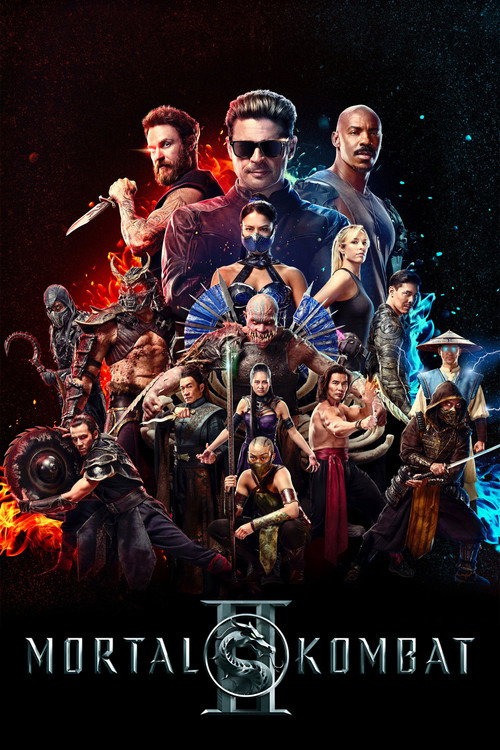
Mortal Kombat II (2026)
Directed by Simon McQuoid
No — Mortal Kombat II is not especially woke, scoring 24 out of 100 on our wokeness meter.
Mortal Kombat II arrives with the confidence of a sequel that knows exactly what its audience wants, which is to say a great deal of viscera and very little introspection.
Consciousness Markers
The ensemble is genuinely multiracial—Ludi Lin, Tati Gabrielle, Mehcad Brooks, Tadanobu Asano, Chin Han, Adeline Rudolph—but this diversity is inherited directly from the video-game roster rather than deployed as a casting statement.
Kitana defies Shao Kahn, denounces him, kills him, and is crowned queen of Edenia, while Sonya Blade kills Sindel—strong female combatants, though these beats are faithful to the source games rather than a feminist thesis.
No LGBTQ+ characters, themes, or subtext appear anywhere in the interdimensional tournament.
The film contains no engagement with race, racism, or racial identity as a theme; the diverse cast exists without comment.
No environmental or climate themes whatsoever; the stakes are purely martial and dimensional.
Kano's preference for Earthrealm's 'luxuries and riches' is a character gag, not a critique of capital; Johnny Cage's washed-up-actor arc is showbiz satire, not class warfare.
The film is a cavalcade of shredded, hyper-muscular fighters; no body-positivity messaging is present.
No neurodivergent characters or themes are depicted or referenced.
The film is set in fictional realms (Earthrealm, Outworld, Edenia) and makes no claims about real history.
This is a gory, self-aware fan-service slugfest with groan-worthy one-liners; it preaches nothing and lectures no one.
Why it received this score
Mortal Kombat II arrives with the confidence of a sequel that knows exactly what its audience wants, which is to say a great deal of viscera and very little introspection. The ensemble is genuinely multiracial, drawing Ludi Lin, Tati Gabrielle, Mehcad Brooks, Tadanobu Asano, Chin Han, and Adeline Rudolph from the game's established roster. That breadth is inherited, not argued. Nobody in the film remarks on it, and the film has no interest in making it a theme. The same holds for the broader cultural register: the interdimensional tournament concerns itself with conquest and finishing moves, and the Earthrealm defenders are too busy being punched into acid to contemplate anything else.
There is a feminist reading available, if we are being generous. Kitana defies Shao Kahn, denounces him, kills him, and takes the throne of Edenia, while Sonya Blade dispatches Sindel in the opening round. These are sturdy beats, though they arrive straight from the source material, which has been staging them for three decades. Kano's fondness for Earthrealm's luxuries and riches registers as a running gag about a thug with expensive taste. Johnny Cage's arc, a washed-up actor clawing back his confidence, is showbiz satire of the mildest vintage. None of it coheres into an argument about anything.
The remaining categories are barren. No environmental anxieties intrude on the dimensional stakes. The cast is a cavalcade of shredded, hyper-muscular combatants, and body-positivity messaging is nowhere in evidence. Neurodivergence goes unmentioned. The realms are fictional, so history is not revised. This is a gory, self-aware fan-service slugfest with groan-worthy one-liners and a 63 percent approval rating. It preaches nothing. It lectures no one. It simply hits, and hits, and hits. We file it accordingly, under spectacle, with no further annotations required of us or of it.
Thematic tags: sequel. A continuation of the 2021 reboot, and nothing more ambitious than that.
{"thematic_tags": ["sequel"]}
Analysis generated by our Consciousness Algorithm


Synopsis
The fan favorite champions—now joined by Johnny Cage himself—are pitted against one another in the ultimate, no-holds barred, gory battle to defeat the dark rule of Shao Kahn that threatens the very existence of the Earthrealm and its defenders.
Questions about Mortal Kombat II
Is Mortal Kombat II woke?
No — Mortal Kombat II is not especially woke, scoring 24 out of 100 on our wokeness meter. That earns it a verdict of Based.
Does Mortal Kombat II have any woke elements?
2 of the 10 markers register at 30 or above, led by Representation Casting (45) and Feminist Agenda (30). On Representation Casting: The ensemble is genuinely multiracial—Ludi Lin, Tati Gabrielle, Mehcad Brooks, Tadanobu Asano, Chin Han, Adeline Rudolph—but this diversity is inherited directly from the video-game roster rather than deployed as a casting statement.
How does Mortal Kombat II compare to other 2026 movies?
It ranks #286 of the 800 films from 2026 we've scored; their average is 23. The wokest is Between Us (89).
How is the Woke Score calculated?
An AI-assisted process researches the film and its reception, scores it 0–100 on ten markers, then combines those into one 0–100 Woke Score. It measures a specific set of 2020s cultural themes, not film quality.