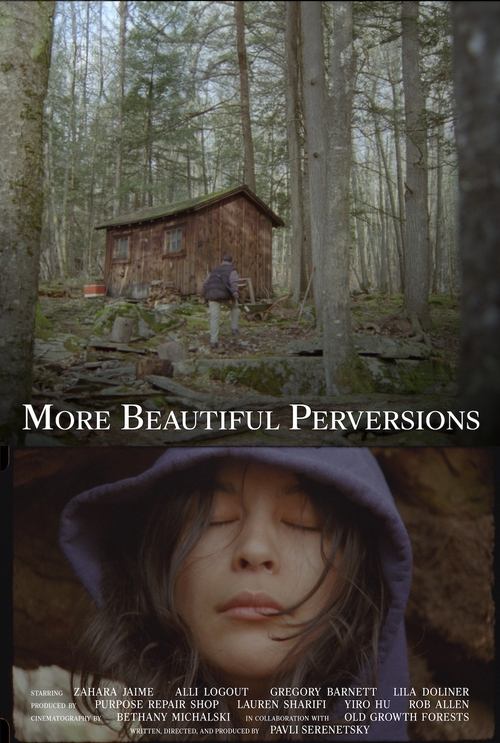
More Beautiful Perversions (2026)
Directed by Pavli Serenetsky
Yes · Peak Woke
How we score movies →Consciousness Markers
The film is self-described as an eco-parable, the director is a professional conservationist, and the filmmaking process itself uses plant-based hand-processing as an environmental statement. The entire plot is structured around ecological awakening.
The film is explicitly framed as a queer coming-of-age narrative, described in official materials as an environmental and queer awakening. The director's previous feature won the Grand Jury Prize at Outfest, and queer identity is a central, not incidental, thematic pillar.
An eco-parable produced by activists, screened with post-film Q&As explicitly designed to engage audiences on the film's thematic content. The official framing leaves little room for interpretation: the film intends to teach, and it knows it.
Distributed by The Future of Film is Female, co-directed by over fifteen collaborators in a deliberately non-hierarchical collective structure, and centered on a non-binary protagonist. The production model itself reflects feminist organizing principles.
Produced by a mutual aid collective, distributed outside mainstream channels, and structured with over fifteen co-directors in a non-hierarchical model. The production's organizational logic is explicitly anti-capitalist in form and stated ethos.
The cast is diverse and the film is distributed by The Future of Film is Female, a distributor explicitly focused on women and non-binary filmmakers. The protagonist is referred to with they/them pronouns, signaling intentional representation choices throughout.
The cast is visibly diverse, but no specific evidence emerges of racial consciousness as an explicit narrative or thematic focus. The film's stated concerns are environmental and queer identity rather than race.
The protagonist is described as a reject teenager, which gestures toward outsider identity, but no concrete evidence of neurodivergence as an explicit theme or character trait appears in the available research.
No evidence of body positivity as a theme or narrative element appears in any available materials or descriptions of the film.
The film has no apparent historical setting or engagement with historical revisionism. It is a contemporary coming-of-age narrative.
Synopsis
A reject teenager follows some hot radicals and finds themself in the woods. An eco-parable produced by a mutual aid collective, shot on 16mm and portions hand-processed with plants.
Why it received this score
There are films that carry their ideological commitments lightly, tucking them beneath plot and character like a note slipped under a door. "More Beautiful Perversions" is not one of those films. Director Pavli Serenetsky, a working conservationist and co-founder of an activist collective, has made a queer eco-parable shot on 16mm and hand-processed with rosemary, pine, and orange. The film's production methodology is itself the thesis statement. We are not watching a movie so much as attending a pamphlet.
The narrative follows a "reject teenager" who falls in with hot radicals and undergoes a dual awakening, environmental and queer, in the woods. This is a premise that would have satisfied two separate grant applications simultaneously, and one suspects it did. The film is distributed by The Future of Film is Female, produced by a mutual aid collective with over fifteen co-directors, and screened with post-film Q&As designed to ensure no subtext escapes unexamined. The forest, in Serenetsky's telling, is not merely a forest. It is a space of queer becoming, ecological communion, and implicit critique of the systems that have estranged us from both our identities and our watershed. The trees are doing a lot of work.
To score this film is to confront a document of almost total ideological coherence. The climate consciousness is not a subplot; it is the soil in which every other theme is rooted. The LGBTQ coming-of-age arc is not incidental; it is the trunk. The anti-capitalist production model, the activist distributor, the literal use of backyard plants as a filmmaking medium: these are not accidents. Serenetsky has made a film in which the how of making it is inseparable from the what of its meaning. This is either admirable artistic integrity or the most thorough conflation of medium and message since someone printed a manifesto on recycled paper. Possibly both.
Analysis generated by our Consciousness Algorithm