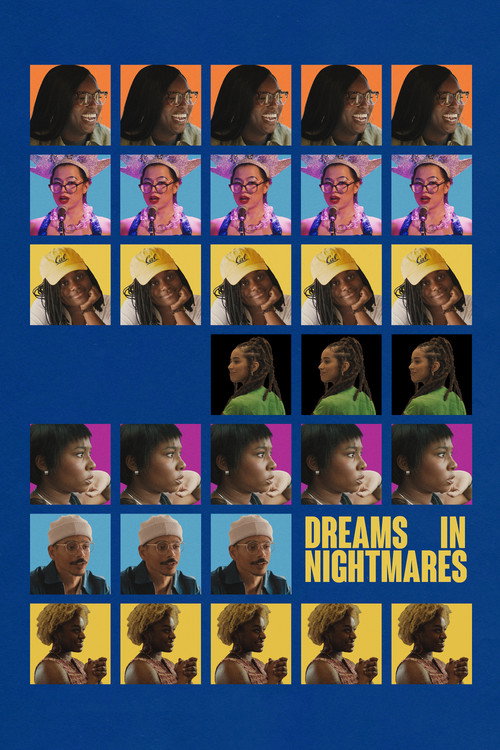
Dreams in Nightmares (2026)
Directed by Shatara Michelle Ford
The American road trip film has historically been the province of white men having existential crises in automobiles, and Shatara Michelle Ford has apparently found this situation unacceptable.
Consciousness Markers
The cast is composed largely of Black queer and trans actors, selected with explicit intentionality documented in production notes. The director described this not as incidental but as the structural premise of the film's existence.
The protagonist is explicitly identified as a queer Black woman, the ensemble centers non-binary and trans experiences, and the film engages themes of chosen family, polyamory, misgendering by relatives, and LGBTQ+ safety in non-metropolitan America. This is not a subplot.
Racial identity is woven into every layer: the Midwestern setting is chosen to interrogate Black queer safety in hostile geography, microaggressions function as plot mechanics, and the characters intentionally patronize Black-owned businesses as a narrative beat.
The film consciously subverts the traditionally white and male American road trip genre, and critics note its framing of survival outside patriarchal and corporate structures. The lens is feminist in architecture, if not in explicit manifesto.
The inciting incident is a corporate layoff framed as systemic precarity rather than personal misfortune, and the film's critical orbit includes commentary on surviving outside corporate structures. The critique is present, though not the film's primary engine.
Critics praised the film's restraint in not leaning into trauma or sermonizing, which is itself an acknowledgment that the sermon was available and declined. The 'ideological fractures' within the group suggest the film stages debates between characters about the correct way to navigate systemic oppression, which is a seminar in dramatic clothing.
The film explicitly reimagines the American road trip as a genre, reclaiming it from its white male cultural mythology. Critics used the word 'radical' to describe this reframing. It is revisionist in genre terms, if not in strict historical ones.
No specific body positivity themes are documented, though the film's general ethos of affirming marginalized identities creates a faint ambient signal. This is not a scored element so much as atmospheric residue.
No evidence of climate or environmental themes in the research or film synopsis.
No evidence of neurodivergence themes in the research or film synopsis.
Why it received this score
The American road trip film has historically been the province of white men having existential crises in automobiles, and Shatara Michelle Ford has apparently found this situation unacceptable. "Dreams in Nightmares" corrects the record by placing a queer Black woman and her companions at the wheel, traversing a Midwest that the film treats less as scenery and more as a diagnostic instrument for measuring the ambient hostility of the republic. The inciting layoff is not an accident of plot but a thesis statement: corporate structures shed people, and the people the film cares about are the ones who were already holding on by less. Ford, whose previous film "Test Pattern" audited the healthcare system with similar prosecutorial focus, has built a career out of dramatizing systemic failure for audiences who already know the system has failed.
What the research describes as "ideological fractures within the group" is, in practical terms, a road trip during which the characters disagree about how best to be oppressed. This is a rich vein. The film's intentional patronage of Black-owned businesses as a narrative beat is the kind of detail that announces its own politics with the quiet confidence of someone who has already won the argument in their head. The cast, assembled with the curatorial care of a museum acquiring a collection, is composed largely of Black queer and trans actors, a fact documented not as trivia but as a production philosophy. Community Guidelines were distributed on set. The set had guidelines.
To Ford's credit, critics across multiple outlets note that the film does not collapse into sermonizing, which places it above a significant portion of its ideological cohort. The restraint is genuine and earns the film something. The "deep ideological fractures" of the synopsis suggest the film is at least willing to let its characters be wrong about things, which is a more sophisticated position than most films operating at this frequency. It is a road trip movie, a queer film, a Black film, a labor critique, a genre deconstruction, and a chosen-family drama, all traveling together in one vehicle. The suspension must be exceptional.
Analysis generated by our Consciousness Algorithm
Synopsis
Following an abrupt layoff, a queer Black woman embarks on a Midwestern road trip with her two best friends to find a missing companion, only for shapeshifting urban threats to expose deep ideological fractures within their group.