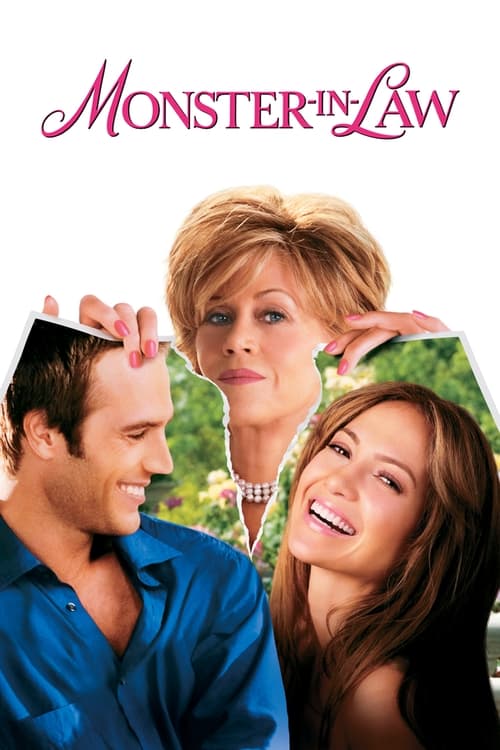
Monster-in-Law (2005)
Directed by Robert Luketic
No — Monster-in-Law is not woke, scoring 9 out of 100 on our wokeness meter.
Monster-in-Law arrives as a tidy specimen of the mid-2000s studio romantic comedy, a machine assembled from familiar parts and lubricated by Jane Fonda's return to the screen after fifteen years away.
Consciousness Markers
Jennifer Lopez headlines and Wanda Sykes appears in support, but this is 2005 star-vehicle casting rather than any deliberate diversity mandate; Sykes' sassy-assistant role is a stock comedic type.
Two women drive the plot and Viola's ouster by a younger anchor gestures at media ageism, but the film's engine is a conventional bride-versus-mother-in-law rom-com, not a feminist agenda.
The rich-family/poor-temp friction is played as snobbery and social awkwardness rather than any eat-the-rich critique of capital.
The only gay content is a running gag in which Charlie is misled into believing Kevin is gay; it is a comedic misunderstanding, not LGBTQ+ representation or themes.
Viola's breakdown and antipsychotic medication are plot mechanics and punchlines, not neurodivergence awareness or representation.
The film is a broad farce that never lectures; the closing 'boundaries and ground rules' beat is a tidy resolution, not a sermon.
Race is never a subject; the Latina lead and Black supporting player exist without any racial commentary or consciousness.
No environmental content whatsoever.
A comedic allergic-reaction swelling gag is the opposite of body-positive messaging.
No historical revisionism; the film is a contemporary domestic comedy.
Why it received this score
Monster-in-Law arrives as a tidy specimen of the mid-2000s studio romantic comedy, a machine assembled from familiar parts and lubricated by Jane Fonda's return to the screen after fifteen years away. Jennifer Lopez plays Charlie, a Venice Beach temp and aspiring fashion designer who falls for a surgeon, and Fonda plays Viola, the mother who would sooner see the wedding cancelled than surrender her son. The plotting is broad, the pacing is brisk, and the whole enterprise carries the faint odor of a contract negotiation. It grossed $155 million against a $43 million budget, which tells us what the critics could not: audiences were content.
On the question of modern social consciousness, the film offers flickers and nothing more. Lopez headlines and Wanda Sykes appears in support, yet the casting reads as star-vehicle arithmetic from 2005, and Sykes is handed the sassy assistant, a comedic type with a long and weary pedigree. The only gay content is a misunderstanding in which Charlie is led to believe Kevin is gay, a gag rather than a theme. Viola's ouster from her anchor chair by a younger woman gestures at media ageism, though the film's engine remains the bride against the mother-in-law. Race is never a subject. The rich-family, poor-temp friction is played for snobbery and social awkwardness, not as any indictment of capital.
Where the film is silent, it is entirely silent. No environmental content, no historical revisionism, no meditation on the body beyond an allergic-reaction swelling gag that works in precisely the opposite direction. Viola's breakdown and her antipsychotic medication are plot mechanics and punchlines. The closing beat, in which the women set boundaries and ground rules, resolves the farce without ever climbing onto a soapbox. This is a comedy that wants nothing from us but a laugh and a ticket stub, and it pursues that goal with a single-mindedness that borders on the admirable. The sommelier's note: thin, fizzy, faintly synthetic, best served cold.
Analysis generated by our Consciousness Algorithm


Synopsis
Office temp Charlotte Cantilini thinks she's found Mr. Right when she starts dating gorgeous surgeon Dr. Kevin Fields. But there's a problem standing in the way of everlasting bliss: Kevin's overbearing and controlling mother, Viola. Fearing she'll lose her son's affections forever, Viola decides to break up the happy couple by becoming the world's worst mother-in-law.
Questions about Monster-in-Law
Is Monster-in-Law woke?
No — Monster-in-Law is not woke, scoring 9 out of 100 on our wokeness meter. That earns it a verdict of Ultra Based.
Does Monster-in-Law have any woke elements?
Very few. None of the 10 markers reaches 30, the level where a marker counts as present; the highest is Representation Casting at 22.
How does Monster-in-Law compare to other 2005 movies?
It ranks #83 of the 181 films from 2005 we've scored; their average is 13. The wokest is The Constant Gardener (72).
How is the Woke Score calculated?
An AI-assisted process researches the film and its reception, scores it 0–100 on ten markers, then combines those into one 0–100 Woke Score. It measures a specific set of 2020s cultural themes, not film quality.