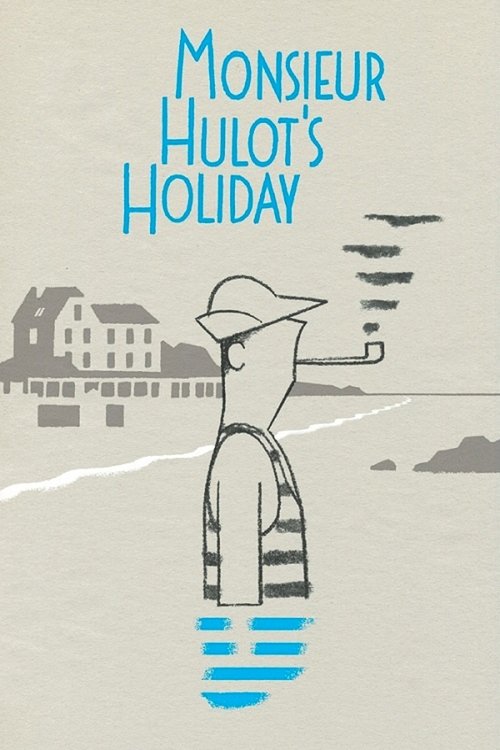
Monsieur Hulot's Holiday (1953)
Directed by Jacques Tati
No — Monsieur Hulot's Holiday is not woke, scoring 0 out of 100 on our wokeness meter.
The 1953 French comedy Monsieur Hulot's Holiday deposits its pipe-smoking protagonist at a seaside resort populated entirely by white European vacationers.
Consciousness Markers
The cast is entirely white European, with no multicultural casting or commentary on representation.
No LGBTQ+ characters, themes, or subtext are present.
Women appear as vacationers and figures of mild comedy, but the film advances no feminist critique or agenda.
The film shows no engagement with race, racism, or racial identity.
No environmental or climate-related themes are present.
It gently satirizes bourgeois holiday habits, but this is social comedy rather than an anti-capitalist or eat-the-rich message.
No body-positivity themes or diverse body representation are present.
Hulot is an eccentric slapstick figure, not a depiction of neurodivergence or neurodiversity advocacy.
No historical revisionism is present; the film is a contemporary comic snapshot.
Dialogue is minimal and the film communicates through sight gags rather than moral instruction.
Why it received this score
The 1953 French comedy Monsieur Hulot's Holiday deposits its pipe-smoking protagonist at a seaside resort populated entirely by white European vacationers. Jacques Tati's alter ego stumbles through a series of meticulously choreographed sight gags involving boats, firecrackers, and a malfunctioning kayak. The film offers no commentary on representation. No LGBTQ+ subtext surfaces. No feminist critique emerges from the women who drift through the background as mild objects of comedy. Race is absent as a subject. The environment serves as a picturesque backdrop, not a cause for alarm. The bourgeoisie are gently mocked, but the satire aims at manners, not economic systems. There is no body positivity campaign. No neurodivergence advocacy. Hulot is a clown, not a diagnosis. History remains untouched. And the dialogue, sparse as it is, never lectures. It simply observes.
Tati's method relies on long shots and natural sound. He builds comedy from the collision of order and chaos. The film's cultural awareness is nil by contemporary standards. It does not seek to educate or improve its audience. It seeks to amuse. The result is a work of pure visual wit, unburdened by ideological instruction. We might call it refreshing, if we were not so exhausted by the endless taxonomy of modern virtue. But our task is classification, not enjoyment. On every metric that matters to the current discourse, this film registers a flat zero.
What remains is a charming relic. A bronze statue of Hulot overlooks the beach at Saint-Marc-sur-Mer, a monument to a simpler comic sensibility. The film was entered at Cannes, praised by critics, and later echoed in the work of Rowan Atkinson. It endures as a masterpiece of slapstick. It does not endure as a vehicle for social change. That is not a flaw. It is simply a fact. We record it without judgment. The score is what it is.
Analysis generated by our Consciousness Algorithm


Synopsis
Monsieur Hulot, Jacques Tati’s endearing clown, takes a holiday at a seaside resort, where his presence provokes one catastrophe after another. Tati’s masterpiece of gentle slapstick is a series of effortlessly well-choreographed sight gags involving dogs, boats, and firecrackers; it was the first entry in the Hulot series and the film that launched its maker to international stardom.
Questions about Monsieur Hulot's Holiday
Is Monsieur Hulot's Holiday woke?
No — Monsieur Hulot's Holiday is not woke, scoring 0 out of 100 on our wokeness meter. That earns it a verdict of Ultra Based.
Does Monsieur Hulot's Holiday have any woke elements?
No. All 10 markers score zero.
How does Monsieur Hulot's Holiday compare to other 1953 movies?
It ranks #13 of the 16 films from 1953 we've scored; their average is 6. The wokest is The Wages of Fear (25).
How is the Woke Score calculated?
An AI-assisted process researches the film and its reception, scores it 0–100 on ten markers, then combines those into one 0–100 Woke Score. It measures a specific set of 2020s cultural themes, not film quality.