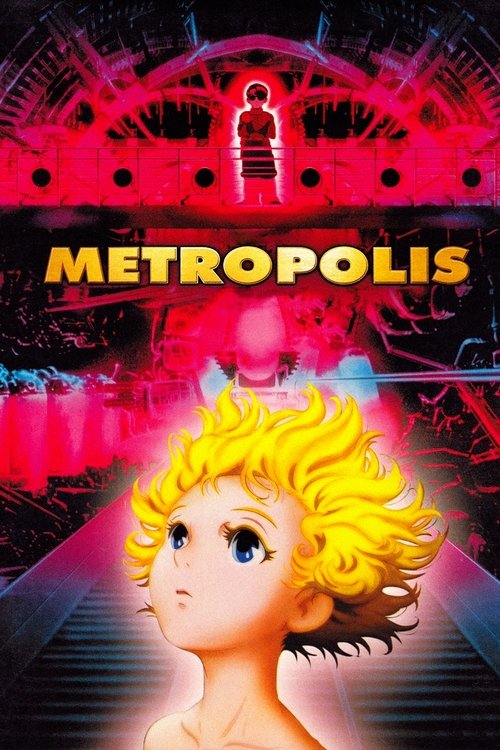
Metropolis (2001)
Directed by Rintaro
No — Metropolis is not especially woke, scoring 24 out of 100 on our wokeness meter.
Rintaro's Metropolis arrives dressed as a cyberpunk spectacle, all Art Deco towers and brass-lit machinery, but its true engine is a grievance.
Consciousness Markers
The plutocratic city, the impoverished lower levels, and Duke Red's weaponized wealth drive an explicit class-struggle narrative of the exploited masses against a ruling elite.
The class-struggle and robot-rights themes are woven into the drama rather than delivered as direct moral instruction, keeping the sermonizing modest.
The oppression of robots carries a faint allegorical charge of discrimination, but the film frames it as class and labor conflict rather than racial consciousness.
Tima is a central female figure, but she functions as a damsel-turned-weapon and object of male conflict rather than a vehicle for feminist commentary.
A wholly Japanese production with a Japanese voice cast and Japanese protagonists; the diversity is organic to its origin rather than a deliberate modern representation-casting initiative.
No LGBTQ+ themes or characters. Notably, the source manga's sex-changing android Mitchi was rewritten into the permanently female Tima, moving the film away from any such content.
No environmental or climate themes whatsoever.
No body-positivity themes present.
No neurodivergence themes present.
The film reworks Tezuka's manga and borrows from Fritz Lang's 1927 film, but this is artistic adaptation, not the ideological rewriting of history the marker denotes.
Why it received this score
Rintaro's Metropolis arrives dressed as a cyberpunk spectacle, all Art Deco towers and brass-lit machinery, but its true engine is a grievance. The city runs on robot labor, the human poor resent the machines for stealing their jobs, and Duke Red sits atop a ziggurat built from their misery. The film takes the side of the exploited without much ambiguity. Wealth here is not neutral. It is a weapon, and the plutocrat wielding it intends to rule the world with his dead daughter's likeness wired into a nuclear throne. The class anger is the plot, not a garnish on it. This is a wholly Japanese production with a Japanese cast and Japanese protagonists, and it never pauses to advertise that fact.
The android Tima is the emotional center, and she is handled with a restraint that will disappoint anyone hoping for a manifesto. She is a damsel who becomes a weapon, an object of male jealousy and male ambition, and the story never stops to interrogate what that means for her as a woman. The source manga gave us Mitchi, a flying android who changed sex at will. The film makes Tima permanently female, quietly closing a door the original had left open. The tragedy that survives is a girl asking who she is and receiving no answer.
The sermonizing is light. Robot rights and class war are folded into chases, explosions, and a collapsing tower, so the audience is never seated for a lecture. A faint allegorical hum of discrimination runs beneath the treatment of the machines, though the film frames it as labor conflict, not a lesson about prejudice. The result is a handsome, melancholy artifact from a time when a film could hold a political position without announcing it. We watched. We noted the architecture. We moved on.
Analysis generated by our Consciousness Algorithm
Part of
Synopsis
In the midst of societal conflict in the futuristic city of Metropolis, Kenichi and his uncle Shunsaku Ban set out to uncover the mystery behind the first human-like robot, Tima.
Questions about Metropolis
Is Metropolis woke?
No — Metropolis is not especially woke, scoring 24 out of 100 on our wokeness meter. That earns it a verdict of Based.
Does Metropolis have any woke elements?
1 of the 10 markers register at 30 or above, led by Eat the Rich (70). On Eat the Rich: The plutocratic city, the impoverished lower levels, and Duke Red's weaponized wealth drive an explicit class-struggle narrative of the exploited masses against a ruling elite.
How does Metropolis compare to other 2001 movies?
It ranks #16 of the 148 films from 2001 we've scored; their average is 12. The wokest is Monster's Ball (60).
How is the Woke Score calculated?
An AI-assisted process researches the film and its reception, scores it 0–100 on ten markers, then combines those into one 0–100 Woke Score. It measures a specific set of 2020s cultural themes, not film quality.