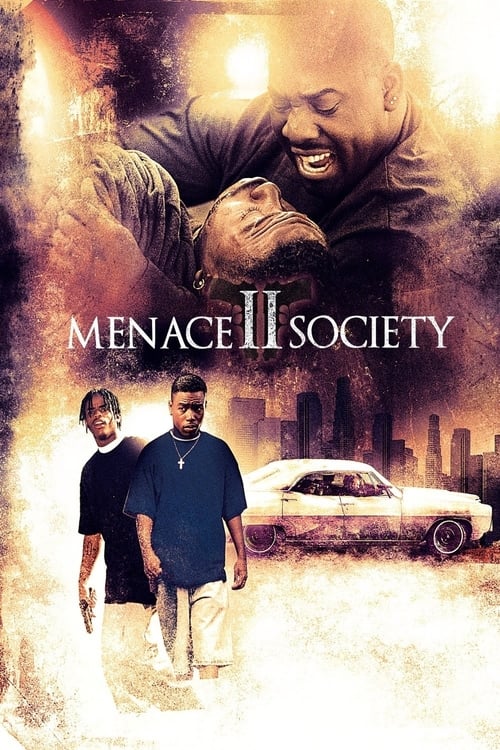
Menace II Society (1993)
Directed by Albert Hughes
No — Menace II Society is not woke, scoring 12 out of 100 on our wokeness meter.
Menace II Society arrives in 1993, a cinematic product whose social awareness feels tethered to a specific, grittier era.
Consciousness Markers
The cast is overwhelmingly Black, but this reflects the film's authentic Watts setting rather than a modern diversity-casting agenda; the ensemble exists naturally within the story.
The film depicts racial tensions (the Korean store owner, police dumping Caine and Sharif in a Hispanic neighborhood), but as naturalistic social texture rather than a modern activist thesis.
The film carries cautionary 'underlying messages' about inner-city violence, but delivers them through unflinching drama rather than preachy sermonizing.
Jada Pinkett's Ronnie has modest agency (a job, a plan to leave), but the film offers no feminist critique or messaging; women are largely peripheral to Caine's story.
Poverty and the drug economy are depicted, but the film makes no systemic anti-capitalist argument; it is a personal cautionary tragedy, not an eat-the-rich polemic.
No LGBTQ+ characters, themes, or subtext appear anywhere in the film.
No environmental or climate themes whatsoever.
No body-positivity themes or messaging.
No neurodivergent characters or themes are present.
A fictional narrative with no historical revisionism; it is not a historical film at all.
Why it received this score
Menace II Society arrives in 1993, a cinematic product whose social awareness feels tethered to a specific, grittier era. It presents its urban landscape with a certain authenticity that avoids the modern compulsion toward progressive signaling. The film depicts systemic tension and the harsh reality of street life as natural social textures, existing within the story rather than serving as a contemporary thesis for cultural change. We observe the struggles of its central figures without the benefit of a modern diversity-casting framework; the ensemble exists as a genuine reflection of its environment. The depiction of poverty and the drug economy, while present, never escalates into a polished anti-capitalist polemic. It is a cautionary tragedy, not a socio-economic manifesto.
The film maintains a low degree of progressive sensibility across several dimensions. There is no thematic engagement with environmentalism, LGBTQ+ narratives, or the concept of neurodivergence. Even the character of Ronnie, played by Jada Pinkett, possesses only a modest measure of agency, and the narrative avoids any sustained feminist critique. These elements are absent, not because the material could not accommodate them, but because the story prioritized kinetic realism over contemporary cultural commentary. The pervasive warning about the perils of inner-city violence is conveyed through unflinching drama. It is a heavy-handed warning, certainly, but it is not a lecture.
Ultimately, the film stands as a powerful document of its time. It does not aim to lecture the audience on modern issues. Instead, it utilizes a stark, unforgiving atmosphere to convey the weight of circumstance. The internal moral reckoning of Caine is handled with stark intensity, providing a final lesson about personal responsibility. This is a film preoccupied with survival and consequence, rather than with abstract social theory. It remains a formidable piece of cinema, even if its cultural awareness is decidedly vintage.
Analysis generated by our Consciousness Algorithm


Synopsis
A young street hustler attempts to escape the rigors and temptations of the ghetto in a quest for a better life.
Questions about Menace II Society
Is Menace II Society woke?
No — Menace II Society is not woke, scoring 12 out of 100 on our wokeness meter. That earns it a verdict of Ultra Based.
Does Menace II Society have any woke elements?
1 of the 10 markers register at 30 or above, led by Representation Casting (30). On Representation Casting: The cast is overwhelmingly Black, but this reflects the film's authentic Watts setting rather than a modern diversity-casting agenda; the ensemble exists naturally within the story.
How does Menace II Society compare to other 1993 movies?
It ranks #29 of the 97 films from 1993 we've scored; their average is 11. The wokest is Bound by Honor (60).
How is the Woke Score calculated?
An AI-assisted process researches the film and its reception, scores it 0–100 on ten markers, then combines those into one 0–100 Woke Score. It measures a specific set of 2020s cultural themes, not film quality.