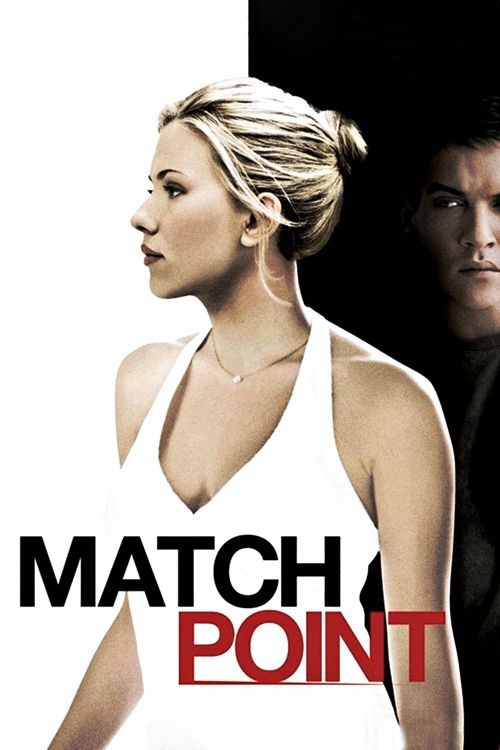
Match Point (2005)
Directed by Woody Allen
No — Match Point is not especially woke, scoring 22 out of 100 on our wokeness meter.
Woody Allen's Match Point arrives from 2005, a psychological thriller set among the moneyed drawing rooms of London, and it conducts its business without a single glance toward the social preoccupations that would later become mandatory.
Consciousness Markers
The film anatomizes greed, social climbing, and the moral rot of the moneyed Hewett family, but its critique is individual and philosophical rather than a systemic eat-the-rich polemic.
The film engages Dostoevsky and moral philosophy, but it dramatizes its ideas through irony and ambiguity rather than preaching at the audience.
The cast is almost entirely white British and American performers, with no deliberate or commented-upon diverse casting choices.
There are no LGBTQ+ characters, themes, or subtext anywhere in the film.
The women are defined by their relationships to men—the mistress to be disposed of and the wife obsessed with pregnancy—with no feminist critique or agency on offer.
Race is entirely absent as a theme; the class drama unfolds within an all-white milieu without any racial commentary.
No environmental or climate themes appear in the film whatsoever.
No body-positivity themes or messaging are present.
Chris is characterized as a brooding introvert and opera-loving loner, but this is a moral and temperamental portrait, not a depiction of neurodivergence.
The film is a contemporary original story with no historical revisionism.
Why it received this score
Woody Allen's Match Point arrives from 2005, a psychological thriller set among the moneyed drawing rooms of London, and it conducts its business without a single glance toward the social preoccupations that would later become mandatory. The cast is uniformly white and Anglo-American. Race, sexuality, and bodily self-regard are simply not topics the film has any interest in raising. Chris Wilton, a retired tennis professional of modest origins, marries upward into the Hewett family and discovers that the arrangement suits him. The film watches this ascent with a cold eye and no editorializing.
The women fare no better in the ledger of contemporary virtue. Chloe exists to want a child. Nola exists to be wanted and then to become inconvenient. Neither is granted an inner life that the camera bothers to record, and the film offers no critique of this arrangement, only its consequences. Chris reads Dostoevsky early on, which signals the film's actual ambition: a debate with Crime and Punishment in which guilt, punishment, and redemption are quietly withheld. Ideas are dramatized through irony and ambiguity. Nobody lectures. The shotgun, the diary, the wedding ring that bounces off the railing and lands on the pavement: these are the film's arguments, and they are made in silence.
There is a modest current of class resentment running beneath the surface. The Hewett family is smug, acquisitive, and entirely willing to purchase a son-in-law. Chris's crime grows from the fear of losing a lifestyle he has come to regard as his due. That is a critique of greed and social climbing, and it is aimed at individuals and at the universe's indifference, not at any system. The film declines to convert its moral philosophy into a program. It is, by the standards of its own era, a relic. A handsome, chilly, impeccably acted relic.
Analysis generated by our Consciousness Algorithm


Synopsis
Chris, a former tennis pro, takes a job as an instructor and befriends his wealthy young student, Tom. After being introduced to his family, Chris is soon engaged to Tom's sister, Chloe. Despite the professional and financial advantages that this relationship affords him, Chris becomes obsessed with Tom's fiancee, American actress Nola.
Questions about Match Point
Is Match Point woke?
No — Match Point is not especially woke, scoring 22 out of 100 on our wokeness meter. That earns it a verdict of Based.
Does Match Point have any woke elements?
1 of the 10 markers register at 30 or above, led by Eat the Rich (30). On Eat the Rich: The film anatomizes greed, social climbing, and the moral rot of the moneyed Hewett family, but its critique is individual and philosophical rather than a systemic eat-the-rich polemic.
How does Match Point compare to other 2005 movies?
It ranks #28 of the 181 films from 2005 we've scored; their average is 13. The wokest is The Constant Gardener (72).
How is the Woke Score calculated?
An AI-assisted process researches the film and its reception, scores it 0–100 on ten markers, then combines those into one 0–100 Woke Score. It measures a specific set of 2020s cultural themes, not film quality.