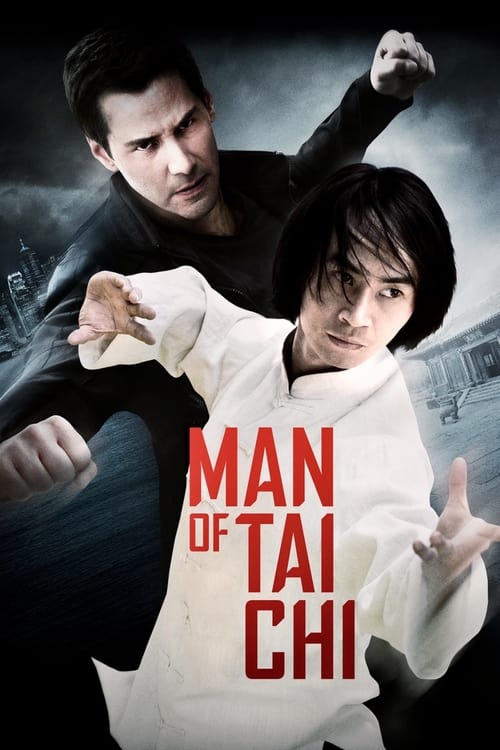
Man of Tai Chi (2013)
Directed by Keanu Reeves
No — Man of Tai Chi is not woke, scoring 13 out of 100 on our wokeness meter.
Man of Tai Chi arrives from 2013 with the modest ambition of being a martial arts picture and largely fulfills it.
Consciousness Markers
Wealthy elites pay to watch illegal gladiatorial combat and a tycoon deliberately engineers a temple's demolition to manipulate a working-class fighter, giving the film a clear class-exploitation undercurrent.
The cast is overwhelmingly Chinese and Hong Kong performers, but this is entirely natural to a martial arts film set in Beijing and Hong Kong, with no commentary or self-congratulation attached.
Karen Mok plays Inspector Suen Jing, a competent police officer who drives the investigation, but the film offers no feminist thesis or gender commentary.
The film gestures at Tai Chi philosophy and the value of inner peace versus violence, but it dramatizes these ideas rather than preaching them.
The film is set within Chinese society with an all-Asian principal cast, but it makes no statement about race, identity, or systemic injustice.
No LGBTQ+ characters, themes, or subtext appear anywhere in the film.
No environmental or climate themes are present.
No body positivity themes; the film is built around physical prowess and combat.
No neurodivergent characters or themes are present.
The film is a fictional martial arts story with no historical revisionism.
Why it received this score
Man of Tai Chi arrives from 2013 with the modest ambition of being a martial arts picture and largely fulfills it. Keanu Reeves directs for the first time, casting himself as Donaka Mark, a wealthy sadist who stages illegal fights for paying spectators, and Tiger Chen as the working-class Tai Chi disciple he cultivates into a killer. The choreography is grounded and legible, the camera stays back, and the whole enterprise has the reassuring texture of something made thirty years earlier. As a piece of social commentary, it is nearly inert.
Where the film shows a flicker of class consciousness, it keeps its voice down. Donaka's operation is a gladiatorial circuit for the rich, and he engineers the demolition order on Tiger's temple to force a decent man into the ring. That is an argument about who owns the violence, and it lands because the film stages it instead of announcing it. Karen Mok's Inspector Suen Jing carries the police investigation with competence and no ceremony; the film never stops to congratulate itself for it. The cast is almost entirely Chinese and Hong Kong performers, which is simply what a Beijing-set martial arts film requires, not a statement.
The film offers no gender thesis, no racial argument, no environmental concern, no reconsideration of history, and no interest in bodies except as instruments of combat. Tai Chi philosophy drifts through the dialogue, inner peace against violence, but the film trusts its fists to make the point. We are left with a lean, old-fashioned genre exercise that treats its ideas as subtext and its audience as adults. Refreshing, in its way. Rare, too.
Analysis generated by our Consciousness Algorithm
Part of


Synopsis
In Beijing, a young martial artist's skill places him in position to experience opportunities and sacrifices.
Questions about Man of Tai Chi
Is Man of Tai Chi woke?
No — Man of Tai Chi is not woke, scoring 13 out of 100 on our wokeness meter. That earns it a verdict of Ultra Based.
Does Man of Tai Chi have any woke elements?
1 of the 10 markers register at 30 or above, led by Eat the Rich (30). On Eat the Rich: Wealthy elites pay to watch illegal gladiatorial combat and a tycoon deliberately engineers a temple's demolition to manipulate a working-class fighter, giving the film a clear class-exploitation undercurrent.
How does Man of Tai Chi compare to other 2013 movies?
It ranks #96 of the 274 films from 2013 we've scored; their average is 14. The wokest is Belle (76).
How is the Woke Score calculated?
An AI-assisted process researches the film and its reception, scores it 0–100 on ten markers, then combines those into one 0–100 Woke Score. It measures a specific set of 2020s cultural themes, not film quality.