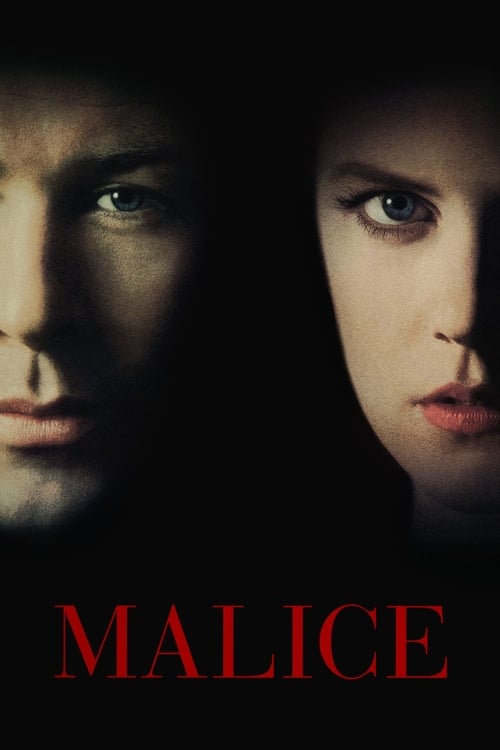
Malice (1993)
Directed by Harold Becker
No — Malice is not woke, scoring 0 out of 100 on our wokeness meter.
The 1993 neo-noir Malice arrives with a premise that could sustain a seminar in medical ethics and instead sustains a game of three-card monte.
Consciousness Markers
The cast is entirely white, led by Alec Baldwin, Nicole Kidman, and Bill Pullman, with no meaningful representation casting of any kind.
There are no LGBTQ+ characters, themes, or subtext anywhere in this 1993 neo-noir thriller.
Despite a women's college setting and a serial-rapist subplot, the film treats these as atmospheric backdrop; Nicole Kidman's character is a classic femme fatale con artist, not a feminist statement.
Race is entirely absent as a theme; the film concerns itself solely with insurance fraud and marital betrayal in a white Massachusetts college town.
No environmental or climate themes appear in the film whatsoever.
The malpractice lawsuit and insurance settlement function purely as thriller plot mechanics rather than any critique of wealth or capitalism.
No body-positivity themes; the film's treatment of infertility and surgery is strictly dramatic plot material.
No neurodivergent characters or themes are present.
The film is a contemporary fictional thriller with no historical subject matter to revise.
Jed's famous 'I am God' monologue is a character's egomaniacal outburst, not a social-issue lecture; the film preaches nothing.
Why it received this score
The 1993 neo-noir Malice arrives with a premise that could sustain a seminar in medical ethics and instead sustains a game of three-card monte. Andy and Tracy Safian want a child. A surgeon named Jed Hill rents their third floor, botches an operation, and leaves Tracy sterile. A malpractice suit follows, then a settlement, then the slow revelation that the whole catastrophe was a con engineered by Tracy and Jed for the money. Harold Becker directs with a straight face and a fondness for red herrings. The film's only real interest is the mechanism of the swindle.
The women's college where Andy serves as associate dean comes equipped with a serial rapist, a subplot Roger Ebert correctly identified as atmosphere rather than narrative. Nobody in this Massachusetts town has a politics. Nobody carries a grievance larger than a settlement figure. Jed's deposition outburst, in which he declares himself God because he can close a chest cavity, plays as the vanity of one arrogant man, not a thesis about medicine, insurance, or the institutions that underwrite both. Nicole Kidman's Tracy is a femme fatale in the classical mode, ruthless and unrepentant, and the film never asks us to pity her or to indict the world that produced her. Anne Bancroft appears for a single scene as an alcoholic mother and walks off with it.
Malice opened at number one and took $61.6 million worldwide against a $20 million budget, which tells us something about 1993 appetites. Aaron Sorkin has since called the whole enterprise a mess. The FBI, or at least a magazine summarizing the FBI, reportedly counts Jed Hill among cinema's more accurate psychopaths. That is the legacy: a well-tailored, hollow, entirely apolitical thriller that lectures nobody about anything and expects nothing from its audience beyond a tolerance for coincidence. Refreshing, in its way. Also exhausting.
Analysis generated by our Consciousness Algorithm

Synopsis
A tale about a happily married couple who would like to have children. Tracy teaches infants, Andy's a college professor. Things are never the same after she is taken to hospital and operated upon by Jed, a "know all" doctor.
Questions about Malice
Is Malice woke?
No — Malice is not woke, scoring 0 out of 100 on our wokeness meter. That earns it a verdict of Ultra Based.
Does Malice have any woke elements?
No. All 10 markers score zero.
How does Malice compare to other 1993 movies?
It ranks #76 of the 97 films from 1993 we've scored; their average is 11. The wokest is Bound by Honor (60).
How is the Woke Score calculated?
An AI-assisted process researches the film and its reception, scores it 0–100 on ten markers, then combines those into one 0–100 Woke Score. It measures a specific set of 2020s cultural themes, not film quality.