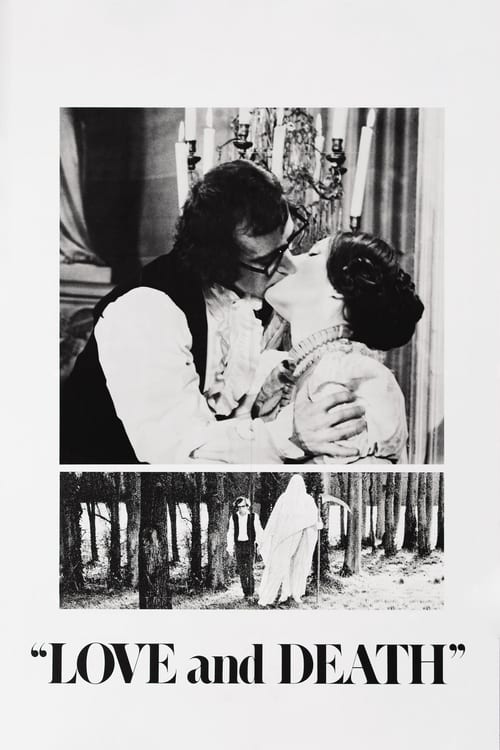
Love and Death (1975)
Directed by Woody Allen
No — Love and Death is not woke, scoring 0 out of 100 on our wokeness meter.
Love and Death arrives from 1975, a Woody Allen comedy that plunks his neurotic persona into a Tolstoy pastiche and lets him duel, marry, and philosophize his way toward a French firing squad.
Consciousness Markers
The cast is overwhelmingly white and the film makes no modern representation gestures.
There are no LGBTQ+ themes or characters.
Diane Keaton's Sonja is a lively comedic character, but the film has no feminist agenda or modern gender-politics framing.
Race is not a subject of the film; it is a white-cast satire of Russian literature and Napoleonic-era Europe.
There is no environmental or climate theme.
The film satirizes philosophy, war, and Russian literature, not capitalism or class exploitation in a modern eat-the-rich sense.
No body-positivity themes or messaging are present.
Boris is a neurotic comedic persona, but the film does not frame this as neurodivergence or advocate for it.
The Napoleonic setting is parodied for comedy, not revised for modern ideological purposes.
The philosophical debates are mock-serious satire, not modern preachy lecture energy.
Why it received this score
Love and Death arrives from 1975, a Woody Allen comedy that plunks his neurotic persona into a Tolstoy pastiche and lets him duel, marry, and philosophize his way toward a French firing squad. Boris Grushenko, scrawny and five foot six, loves his cousin Sonja, enlists reluctantly, becomes a war hero by accident, and debates the existence of God while an executioner waits. The film is a satire of the Golden Age of Russian literature, and its pleasures are literary and slapstick in equal measure.
Examined through the lens of contemporary cultural markers, the film is a barren field. The cast is uniformly white and the setting is czarist Russia, so questions of representation and racial consciousness never arise. There is no LGBTQ content, no environmental crusade, no indictment of capitalism, no body-positivity messaging, and no framing of Boris's neurosis as anything but a comic persona. Sonja is a lively and memorable character, but the film has no interest in gender politics. The philosophical debates are mock-serious, staged for laughs, not for sermons. When Boris and Sonja argue about the ethics of assassinating Napoleon, the goal is a punchline, not a position paper.
The result is a film that carries no modern progressive freight whatsoever. Its targets are Dostoevsky, Bergman, and Eisenstein, and its sensibility belongs entirely to the mid-1970s. The humor is cerebral and the tone is serene even when the jokes are reckless. We are left with a well-crafted comedy that asks nothing of our politics and offers only its own wit. A quiet, unbothered vintage that will not trouble the classifier.
A note on provenance. This is not an adaptation of any book, nor a remake, nor a sequel, nor a superhero picture, nor a true story, nor a chart-topping release. It won a Silver Bear in Berlin, which is not an Academy Award. It simply exists, funny and unaligned, awaiting our verdict without complaint. The verdict is a low one, delivered without malice. Some vintages are simply too old to register on the scale at all. This is one of them, and it seems perfectly content to remain so.
Thematic tags: none apply. The film is a period literary parody with no modern social agenda to score, and it earns a flat zero across every marker. We file it under comedy, romance, and the mid-1970s, and we move on. Another day, another film that predates the entire apparatus of classification. The sommelier sets down his glass and reaches for the next bottle, faintly relieved that this one required so little of him, and faintly disappointed for the same reason. Such is the work. It continues regardless, one vintage at a time, and the ledger stays open for whatever the next screening demands.
A brief closing observation on tone. The film's philosophical banter is bait for the unwary analyst, all that talk of God and death and the soul, and yet none of it argues a modern position. It argues for a laugh. We record the distinction. We always do. The catalogue grows heavier by the year, and the responsibility of separating sincere humanism from contemporary messaging falls to us, night after night, glass in hand, at a table lit by nothing but the projector's beam and the quiet certainty that the work will never truly be finished, only paused.
Analysis generated by our Consciousness Algorithm


Synopsis
In czarist Russia, a neurotic soldier and his distant cousin formulate a plot to assassinate Napoleon.
Questions about Love and Death
Is Love and Death woke?
No — Love and Death is not woke, scoring 0 out of 100 on our wokeness meter. That earns it a verdict of Ultra Based.
Does Love and Death have any woke elements?
No. All 10 markers score zero.
How does Love and Death compare to other 1975 movies?
It ranks #22 of the 22 films from 1975 we've scored; their average is 15. The wokest is Dog Day Afternoon (62).
How is the Woke Score calculated?
An AI-assisted process researches the film and its reception, scores it 0–100 on ten markers, then combines those into one 0–100 Woke Score. It measures a specific set of 2020s cultural themes, not film quality.