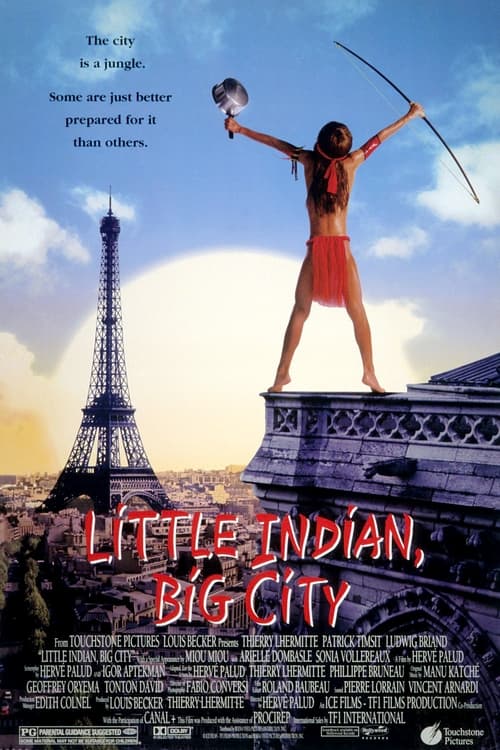
Little Indian, Big City (1994)
Directed by Hervé Palud
No — Little Indian, Big City is not woke, scoring 5 out of 100 on our wokeness meter.
Some films arrive at a cultural moment and some arrive to fill a slot in the winter holiday schedule.
Consciousness Markers
The film centers on Amazonian indigenous characters, but the jungle boy Mimi-Siku is played by a white French actor and the native setting is treated as a comic curiosity rather than authentic representation.
Indigenous Amazonian culture is present as a backdrop, but the film mines it purely for fish-out-of-water comedy rather than engaging racial identity or power.
Stephen's work as a commodities broker and Parisian corporate life get mild satirical shading, but the film has no coherent critique of wealth or capitalism.
Patricia is an ex-wife living independently among the Amazonians, but the plot treats her primarily as an obstacle to Stephen's remarriage and offers no feminist critique.
No LGBTQ+ characters, themes, or subtext appear anywhere in the film.
The Amazon rainforest serves as an exotic setting, but there is no environmental advocacy or climate messaging.
No body positivity themes or messaging are present.
No neurodivergent characters or themes are depicted.
The film is a contemporary fiction with no historical revisionism.
This is a broad 1990s family comedy; it makes no attempt to lecture or moralize to its audience.
Why it received this score
Some films arrive at a cultural moment and some arrive to fill a slot in the winter holiday schedule. Little Indian, Big City belongs firmly to the latter, a 1994 French comedy that shipped a jungle boy to Paris and asked the audience to find the collision hilarious. The premise is sturdy enough: a commodities broker named Steph needs his long-lost wife's signature to marry again, discovers a teenage son raised among Amazonian villagers, and drags the boy back to the metropolis for a few days of culture shock. The Amazon exists here as a painted backdrop and a source of punchlines. Indigenous life is a comic curiosity, a place where the jokes write themselves and nobody checks the spelling. The boy is played by a white French adolescent, which the production appears to have regarded as a casting decision rather than a statement.
The film's politics are as thin as its plot. Steph's profession as a broker gets a light dusting of satire, the kind that winks at corporate greed without ever naming it, and the Parisian business world is mocked mostly for being full of men in suits. Patricia, the ex-wife, lives independently among the villagers and refuses to sign the papers, which is the closest the screenplay comes to giving a woman an interior life. She functions as a gatekeeper, not a person. There is no environmental argument to be found in the rainforest footage, no reckoning with race, no interest in the people whose home serves as the first act. The camera looks at the Amazon the way a tourist looks at a postcard.
This leaves a broad family comedy that lectures no one and means no harm, which is not the same as meaning well. It wants laughs, and it gets a few, mostly from the fish-out-of-water machinery. It does not want to teach, and it does not. There is something almost admirable in that refusal, or there would be, if the film were better.
Analysis generated by our Consciousness Algorithm
Synopsis
Stephen, an international trader, tracks down his ex-wife Patricia in some Amazonian backwater. He needs her consent to a divorce so that he can marry Charlotte. Unfortunately, he discovers a son he didn’t know he had – Mimi-Siku. The young jungle boy yearns to see Paris so Stephen reluctantly agrees to take him back home with him for a few days. How will Mimi-Siku react to life in the great metropolis?
Questions about Little Indian, Big City
Is Little Indian, Big City woke?
No — Little Indian, Big City is not woke, scoring 5 out of 100 on our wokeness meter. That earns it a verdict of Ultra Based.
Does Little Indian, Big City have any woke elements?
Very few. None of the 10 markers reaches 30, the level where a marker counts as present; the highest is Representation Casting at 12.
How does Little Indian, Big City compare to other 1994 movies?
It ranks #45 of the 86 films from 1994 we've scored; their average is 10. The wokest is On Deadly Ground (75).
How is the Woke Score calculated?
An AI-assisted process researches the film and its reception, scores it 0–100 on ten markers, then combines those into one 0–100 Woke Score. It measures a specific set of 2020s cultural themes, not film quality.