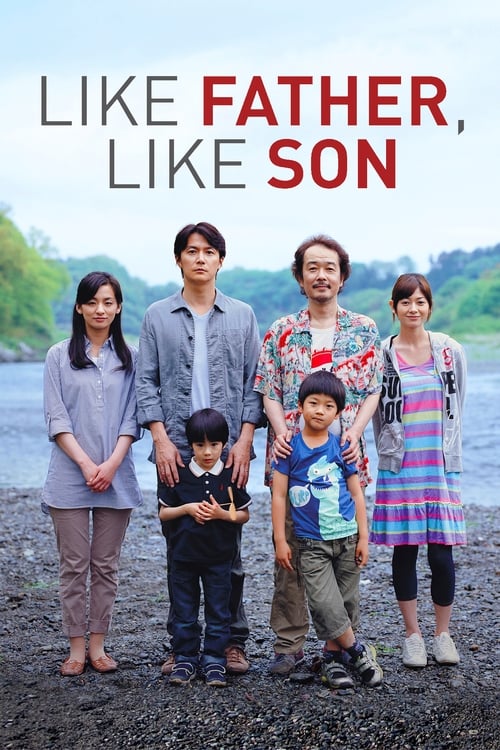
Like Father, Like Son (2013)
Directed by Hirokazu Kore-eda
No — Like Father, Like Son is not woke, scoring 8 out of 100 on our wokeness meter.
Like Father, Like Son arrives from 2013 with the quiet confidence of a film that has no interest in being measured by the cultural anxieties of a later decade.
Consciousness Markers
Ryota is characterized as a money-driven businessman whose materialist values are implicitly contrasted with the warmer, poorer Saiki family, offering a mild critique of wealth and status. It is a quiet thematic undercurrent rather than an eat-the-rich polemic.
Kore-eda's style is observational and restrained, letting themes emerge through nuance rather than speeches. There is little overt moralizing or direct address to the audience.
The film touches on the mother's bond and gently critiques Ryota's neglect of his wife, but this is humanist family drama rather than a feminist agenda. No explicit gender-politics framework is advanced.
The cast is entirely Japanese, which is simply the natural demographic of a Japanese-language domestic drama rather than a deliberate diversity-casting initiative. No representation-casting intent is present.
There are no LGBTQ+ characters, relationships, or themes anywhere in the film.
The central tension is class difference between the wealthy Nonomiyas and the small-town Saikis, not race. No racial consciousness or commentary is present.
There is no environmental or climate theme in the film.
No body-positivity themes or messaging appear in the film.
No neurodivergence is depicted or discussed.
The film is a fictional domestic drama with no historical revisionism.
Why it received this score
Like Father, Like Son arrives from 2013 with the quiet confidence of a film that has no interest in being measured by the cultural anxieties of a later decade. Hirokazu Kore-eda tells the story of two families whose infant sons were switched at birth, and the moral dilemma that follows is intimate, parental, and rooted in class. Ryota is a successful architect, driven by money and status. The Saikis are small-town people with less income and more warmth. The film watches them negotiate an impossible choice without turning anyone into a case study.
The cast is entirely Japanese because the story is a Japanese domestic drama, not because anyone was filling a quota. There are no LGBTQ themes, no racial-consciousness project, no climate crusade, no body-positivity message, no neurodivergent subplot, and no revisionist history. The faintest social critique is economic. Ryota's materialism is set against the Saikis' emotional generosity, which amounts to a mild suspicion of wealth and status, not a call to eat the rich. The film also notices that Ryota neglects his wife, and it values the mother's bond, but this is humanist family observation, not a feminist manifesto. Kore-eda's restraint keeps the lecture energy low. He prefers a long shot of a child's camera to a speech about what we owe each other.
That restraint is the film's saving grace and its limitation as a specimen of modern social consciousness. It asks us to sit with ambiguity. It does not instruct us. The result is a serious, moving piece of cinema that would score poorly on any contemporary checklist and remain entirely untroubled by that fact. A temperate vintage. Drink it with dinner and discuss inheritance, class, and the limits of paternal pride. Just do not expect a sermon.
Analysis generated by our Consciousness Algorithm


Synopsis
Ryota Nonomiya is a successful businessman driven by money. He learns that his biological son was switched with another child after birth. He must make a life-changing decision and choose his true son or the boy he raised as his own.
Questions about Like Father, Like Son
Is Like Father, Like Son woke?
No — Like Father, Like Son is not woke, scoring 8 out of 100 on our wokeness meter. That earns it a verdict of Ultra Based.
Does Like Father, Like Son have any woke elements?
Very few. None of the 10 markers reaches 30, the level where a marker counts as present; the highest is Eat the Rich at 15.
How does Like Father, Like Son compare to other 2013 movies?
It ranks #137 of the 274 films from 2013 we've scored; their average is 14. The wokest is Belle (76).
How is the Woke Score calculated?
An AI-assisted process researches the film and its reception, scores it 0–100 on ten markers, then combines those into one 0–100 Woke Score. It measures a specific set of 2020s cultural themes, not film quality.