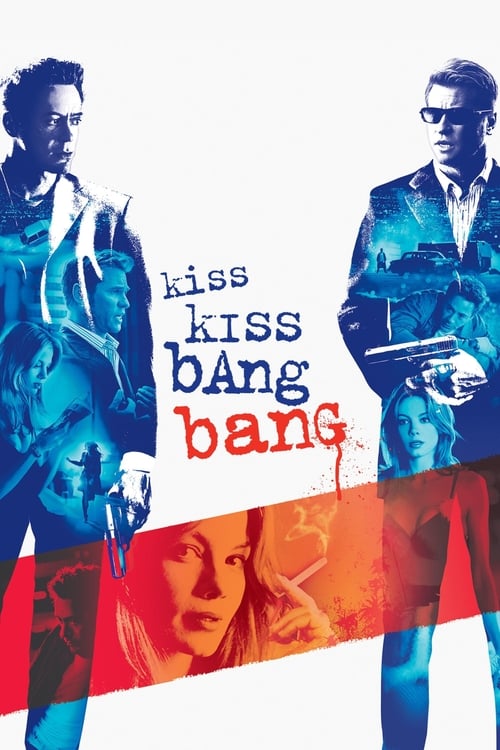
Kiss Kiss Bang Bang (2005)
Directed by Shane Black
No — Kiss Kiss Bang Bang is not woke, scoring 14 out of 100 on our wokeness meter.
Shane Black's directorial debut arrives as a neo-noir pastiche with its tongue lodged firmly in its cheek, and it has aged into a curious artifact of mid-2000s cultural inventory.
Consciousness Markers
Val Kilmer's 'Gay' Perry van Shrike is a prominent, openly gay detective who repeatedly asserts his orientation, an intentional stereotype-subversion for 2005, though played largely for comedic effect.
Michelle Monaghan's Harmony has a substantive backstory involving her sister's abuse, but the film offers no feminist thesis and treats her largely as a romantic interest.
The cast is overwhelmingly white, with Rockmond Dunbar as a minor thug the only notable non-white performer; no deliberate diversity casting is evident.
The Hollywood-industry satire pokes at vanity and phoniness but mounts no critique of wealth or capitalism as such.
The film is a tongue-in-cheek genre homage that winks at the audience but never lectures on social issues.
No engagement with race or racial themes; the two henchmen are simply named Mr. Fire and Mr. Frying Pan.
No environmental or climate content whatsoever.
No body-positivity themes present.
No neurodivergence themes present.
No historical revisionism; the film is a contemporary neo-noir pastiche.
Why it received this score
Shane Black's directorial debut arrives as a neo-noir pastiche with its tongue lodged firmly in its cheek, and it has aged into a curious artifact of mid-2000s cultural inventory. The most conspicuous item is Val Kilmer's "Gay" Perry van Shrike, a private detective who announces his orientation at every opportunity and also kicks down doors and shoots people. Black has said he wanted to break a stereotype, and the gesture registers, though the film plays the character for comedy at nearly every turn. It is a subversion with a laugh track attached, which places it somewhere in the middle of the register and no higher.
Elsewhere the pickings thin out. Michelle Monaghan's Harmony carries a grim backstory involving her sister and a sexually abusive father, and the film treats that material with a straight face, but it never builds a thesis about women from it. She remains a romantic objective with a tragic footnote. The cast is overwhelmingly white, with Rockmond Dunbar as the lone exception playing a thug, and the two heavies are named Mr. Fire and Mr. Frying Pan, which is the extent of the film's engagement with anything racial. No environmental content. No body politics. No neurodivergence. No historical revision. The Hollywood satire needles vanity and phoniness without ever reaching for a wallet.
Craft and timing remain. The film winks at its audience constantly and lectures no one, which in this climate reads as a small mercy. It is a well-made piece of genre recreation with one progressive flourish, delivered as a punchline, and the years have not added much to it.
Analysis generated by our Consciousness Algorithm


Synopsis
A petty thief posing as an actor is brought to Los Angeles for an unlikely audition and finds himself in the middle of a murder investigation along with his high school dream girl and a detective who's been training him for his upcoming role...
Questions about Kiss Kiss Bang Bang
Is Kiss Kiss Bang Bang woke?
No — Kiss Kiss Bang Bang is not woke, scoring 14 out of 100 on our wokeness meter. That earns it a verdict of Ultra Based.
Does Kiss Kiss Bang Bang have any woke elements?
1 of the 10 markers register at 30 or above, led by LGBTQ+ Themes (45). On LGBTQ+ Themes: Val Kilmer's 'Gay' Perry van Shrike is a prominent, openly gay detective who repeatedly asserts his orientation, an intentional stereotype-subversion for 2005, though played largely for comedic effect.
How does Kiss Kiss Bang Bang compare to other 2005 movies?
It ranks #57 of the 181 films from 2005 we've scored; their average is 13. The wokest is The Constant Gardener (72).
How is the Woke Score calculated?
An AI-assisted process researches the film and its reception, scores it 0–100 on ten markers, then combines those into one 0–100 Woke Score. It measures a specific set of 2020s cultural themes, not film quality.